In Search of Historic Colours: The Empress Theatre Marquee

The historic downtown of Fort Macleod, one of two Provincial Historic Areas in the province, is well known for its impressive commercial buildings of brick and sandstone masonry. Collectively, these Classical Revival buildings exemplify an Edwardian commercial streetscape just prior to the First World War.

One of the main street’s crown jewels is the Empress Theatre, an elegant brick building with decorative sandstone details built in 1912. Historically a hub of the town’s social life, the theatre hosted plays, vaudeville acts and performers from Alberta, across North America and even overseas, as graffiti preserved in the original basement dressing rooms attests to this day. The original façade was theatrical in its own right and featured a grand arched entrance and recessed box office. As tastes changed and motion pictures grew in popularity, the original entry was enclosed to provide a lobby and concession, the auditorium was renovated with plush upholstered seats in the Art Deco style and neon tulips mounted on the ceiling, and a bold new neon sign and marquee replaced the original blade sign on the front facade. These 1930s and 1950s renovations added layers of architectural history and significance to the building and contributed to its designation as a Provincial Historic Resource in 1982.

empress2
The Empress Theatre in April 2016 (top). Bottom from left: View west along 24 Street in 1953, Glenbow Archives photograph NA-5600-6653 (cropped slightly from original); detail of 1953 streetscape showing the Empress marquee in essentially its present form; historic colours exposed on a blade sign letter; a plywood mock-up to evaluate proposed blade sign colours.

The Town of Fort Macleod owns the theatre and has embarked on an extensive rehabilitation project that includes rehabilitation of the historic neon marquee. The marquee was refurbished in the late 1980s by Fort Macleod’s Main Street Project but a generation of exposure to the elements has taken its toll on the galvanized sheet metal, paint, and fragile neon tubing. Removal of the signs for other façade repairs was an ideal opportunity to re-examine and document the marquee’s colour history. Read more

Rocky Mountain Alpine Project: Willmore Wilderness Park

From August 8-12th, 2016, Todd Kristensen (Northern Archaeologist), Robin Woywitka (Cultural Land Use Analyst), Courtney Lakevold (Archaeological Information Coordinator) and graduate student Timothy Allan visited Willmore Wilderness Park as part of the Rocky Mountain Alpine Project (RMAP). RMAP is focused on the recovery of archaeological artifacts and other organic remains (e.g., feathers, bones, caribou antlers and dung) from melting ice patches. Amazing artifacts have been found melting out of ice patches in alpine areas in the Yukon, Northwest Territories, United States and Norway. These finds have been very important for understanding how people used alpine areas in the past.

Alberta has vast stretches of alpine environments, many of which are quite fragile. One element of those fragile alpine habitats are ice patches that are currently melting at a rapid pace. The goal of RMAP is to explore Alberta’s ice patches to see how people in the past used alpine environments and see how it compares to that of people in other parts of Canada and the world. Last summer, the first RMAP expedition took place in Jasper National Park where many organics were found, as well as a piece of leather that was radiocarbon dated to A.D. 1670. Read more

Stone tools, Bugs, and the Boreal Forest: Adventures in Northern Archaeology

When people think of archaeology in Alberta they might picture buffalo jumps, rock art, or medicine wheels. These are dramatic types of sites on the prairies but what about the north? Alberta’s boreal forest has a unique record and requires a unique breed of archaeologist to find it. This blog is a small window to archaeological work in the northern half of the province and some of the interesting archaeological sites hiding in our forests.

Boreal Breed

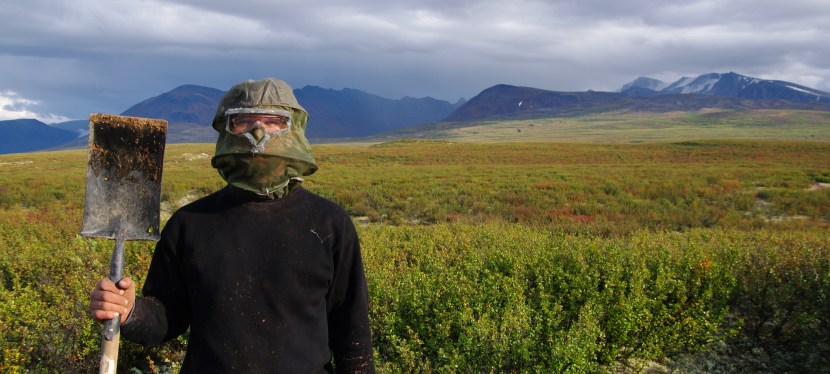
Archaeologists working in northern Alberta brave bugs, blowdown (piles of fallen trees stacked like a cruel game of KerPlunk) and a range of conditions from blistering hot to bitterly cold. Forests are quite good at concealing sites so archaeologists dig hundreds of small shovel tests to find them. Most archaeology in the ‘Green Zone’ (typically forested Crown Land) happens in advance of forestry, oil and gas activity, gravel operations, and construction of transmission or road corridors. The hard work and skill of consulting archaeologists has resulted in over 8000 archaeological sites in the Green Zone.

Roughly 8000 sites have been found in Alberta’s boreal forest.
Roughly 8000 sites have been found in Alberta’s boreal forest (highlighted in green).

The Nature of Northern Sites

Most of the successful shovel tests yield small collections of stone debris from pre-contact human tool making. Sites in the north are typically smaller than on the plains. Why? Pre-contact people in the north were generally more mobile and lived in smaller groups; southern bison herds supported bigger groups that stayed in one spot for longer periods, which produced bigger collections of artifacts. Archaeological visibility is also a factor. Prairie landforms are often easier to locate and interpret while artifacts, bones, or stone features on the surface can help guide archaeologists to productive areas under the ground. Not so in the north. Hot spots for artifacts are often harder to access, are covered in vegetation and dense roots, and are challenging to interpret (e.g., ‘how has this terrace changed over thousands of years’). Read more

Changing Animals: Alberta’s Ice Age Megafauna and Wally’s Beach

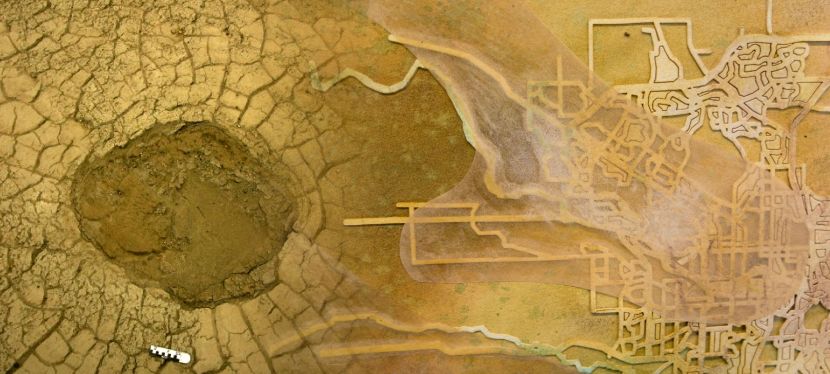
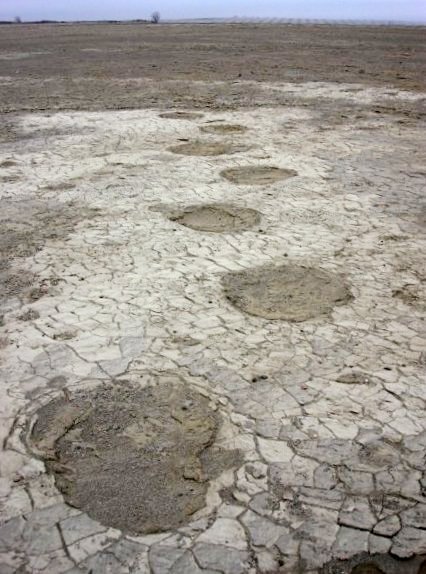
When St. Mary Reservoir in southern Alberta was filled in the 1950s, no one knew that it submerged an incredible record of life from 13,000 years ago. That record, including footprints of mammoth, camel, and horse, was recently exposed – the internationally significant site is now informing opinions about the role humans played in the extinction of Alberta’s ‘megafauna’.

Rare and information-rich trackways from lumbering mammoth were revealed by scouring winds at St. Mary Reservoir (courtesy of Shayne Tolman).

Wally’s Beach

Shayne Tolman, a teacher from Cardston, is responsible for drawing attention to St. Mary Reservoir and Wally’s Beach, a site complex on an ancient island in St. Mary River that is currently being investigated by Dr. Brian Kooyman and a team from the University of Calgary. Archaeologists have discovered that the menu of some of Alberta’s oldest humans included megafauna like camel, horse, and perhaps mammoth. Over six thousand artifacts indicate that people were hunting big game at a time when these animals were likely struggling to cope with climate change. Did human hunting lead to megafauna extinction or are warming temperatures to blame? Many researchers argue that pre-contact human populations were too small to impact big game while others suggest that targeted hunting patterns among small groups could have big consequences.

Megafauna of Alberta at the end of the last Ice Age (produced by Todd Kristensen)

Read more

The Borden Number System: What the FcOq?

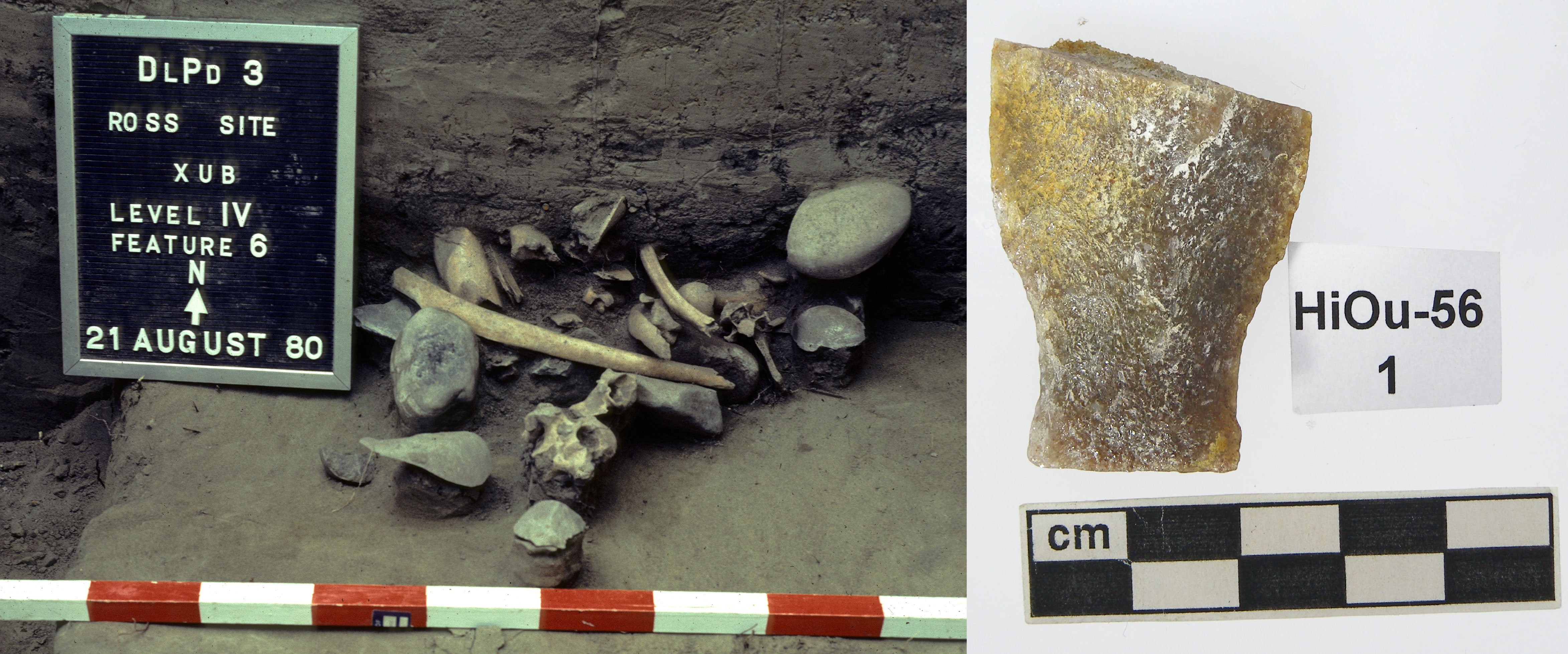
In a previous post we talked about how Alberta has almost 40,000 recorded archaeological sites. Each of these sites has its own record and associated artifacts so, you can imagine, it is a lot to keep track of. One of the most important tools we use to organize site data is a Borden number. You may have heard sites referred to by their Borden number before; for example Head-Smashed-In is also known as DkPj-1. The Borden number is actually more important than the site name as the Borden number is what is used to organize all site records and for cataloguing artifacts. In fact, the majority of sites in Alberta do not have a name at all, they are known solely by their Borden number.

Borden number DlPd-3 (Ross Site) is used as the unique identifier for this archaeological site (left). Borden numbers are also used to catalogue artifacts that are recovered from archaeological sites (right).
Borden number DlPd-3 (Ross Site) is used as the unique identifier for this archaeological site (left). Borden numbers are also used to catalogue artifacts as a way to identify what site they came from (right). (Photo Credits: Royal Alberta Museum)

Read more

The Battle of Jutland, First World War Commemoration and Alberta Place Names

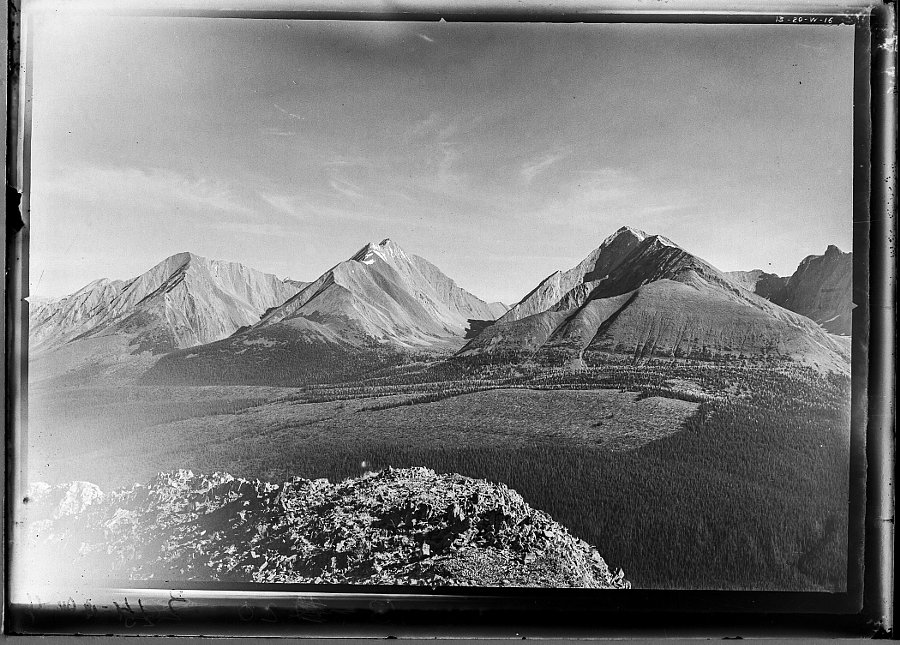
No single event has had such a dramatic impact on place names in Alberta than the First World War Battle of Jutland. Deep in the heart of Kananaskis Country can be found a series of mountains bearing the names of the ships and naval commanders of this naval battle. At least twenty-six mountains bear names commemorating the Battle of Jutland – sixteen of them are named for Royal Navy vessels that took part in the battle and ten are named for the Admirals, ship captains and seamen that lead and fought at Jutland. Additionally, many features associated with the mountains (glaciers, lakes and creeks) have subsequently been given Jutland names. The great number of Jutland-related geographical names in Alberta is curious. While there is no questioning the significance of the Battle of Jutland – it was the only major sea battle of the First World War, one of the few times in which dreadnought battleships fought directly against each other and its results affected strategy and tactics on both sides and altered the course of the war – it was also a battle in which there was no significant Canadian presence; no Canadian ships were involved and only one Canadian casualty has ever been confirmed. So, how did so many of these mountains along the Alberta-British Columbia boundary end up being named to commemorate this battle?

Mount Engadine (left), The Tower (middle) and Mount Galatea (right), taken in 1916 by the Interprovincial Boundary Survey. Mount Engadine and Mount Galatea are named for Royal Navy vessels that fought at the Battle of Jutland, the seaplane carrier HMS Engadine and the light cruiser HMS Galatea.
Mount Engadine (left), The Tower (middle) and Mount Galatea (right), taken in 1916 by the Interprovincial Boundary Survey. Mount Engadine and Mount Galatea are named for Royal Navy vessels that fought at the Battle of Jutland, the seaplane carrier HMS Engadine and the light cruiser HMS Galatea. Image Source: Mountain Legacy Project, IMG_3320. The Mountain Legacy Project is based at the School of Environmental Studies, University of Victoria, Victoria, BC. For more information, go to mountainlegacy.ca, or email mntnlgcy@uvic.ca.

Read more

National Aboriginal Day 2016

Photo Credit: Government of Alberta

The Historic Resources Management Branch is privileged to work with and learn from Indigenous communities in Alberta. On June 21, we join Canadians nation-wide in celebrating National Aboriginal Day. Now in its 20th official year, National Aboriginal Day provides an opportunity for Indigenous and non-Indigenous peoples alike to come together in recognition of the histories, cultures and contributions of First Nations, Metis and Inuit peoples in our province and across the country. Indigenous and Northern Affairs Canada (INAC) has put together a great video to celebrate the 20th Anniversary.

Whether you take in a film at Edmonton’s Amiskwaciy History Series’ Film Festival, check out the festivities at Head Smashed In Buffalo Jump, visit the Friendship Centre in your community or commemorate the day in your own way, take the time to remember: we are all Treaty people.

A listing of 2016 National Aboriginal Day events in Alberta can be found here.

Written By: Laura Golebiowski, Aboriginal Consultation Advisor

Blood Kettles and Buffalo Jumps: Communal Hunting on the Plains of Alberta

According to Blackfoot tradition, as Old Man traveled north he created the mountains, rivers, grass and trees. When he came to the area of the present day Porcupine Hills in southwest Alberta, he formed images of people from mud and breathed life into them. The people asked Old Man what they would eat, and so, he created images of buffalo from clay and brought them to life. He then took the people to a rocky ledge and called to the buffalo, who ran in a straight line over the cliff: “Those are your food.”

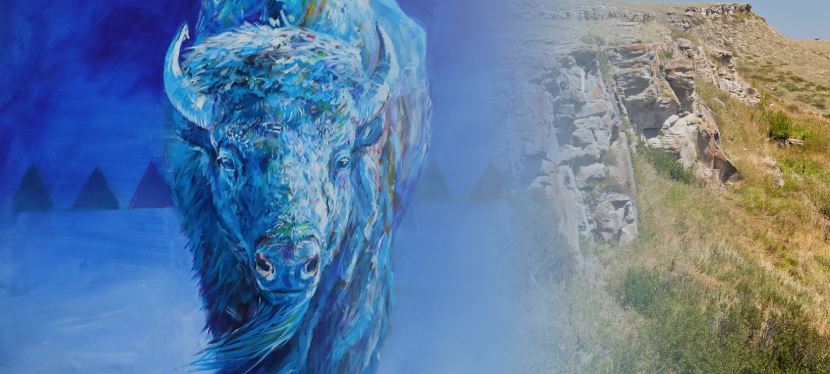
Tens of millions of buffalo once roamed the Great Plains of North America from Alberta’s grasslands down to Texas. To people of the plains, there was no more important food source. A number of ingenious methods were devised for communal (group) hunting – buffalo were lured into ambushes, corralled with fire, chased onto frozen lakes or into deep snow, and driven into elaborate traps called pis’kun by the Blackfoot (translated as ‘deep-blood kettles’). Of the hundreds of mass kill sites, perhaps none is more impressive than the buffalo jump, the most famous of which is Alberta’s Head-Smashed-In. Read more

Alberta Historical Resources Foundation Seeking Board Members

The Alberta Historical Resources Foundation (AHRF) – the primary source of the Government of Alberta funding for heritage projects – is currently accepting applications to fill seven vacancies on the Board of Directors, including the position of Chair.

Founded in 1973, AHRF has evolved into a complex agency that serves a wide range of stakeholders. Board members are appointed for a term of up to three years. Board meetings are held four times a year for approximately 1.5 days. Board members are also occasionally asked to attend heritage events on behalf of the Foundation.

Online applications are preferred. For details on the position profile and to apply online, please visit www.jobs.alberta.ca. Job ID is 1035487.

Help us ensure the preservation and promotion of Alberta’s heritage through a competent and vibrant board. Applications will be accepted until May 15, 2016.

Archaeology and the June 2013 Floods in Southern Alberta

In June 2013, heavy rainfall triggered catastrophic flooding in southern Alberta that has been characterized as some of the worst in the province’s history. Areas along the Bow, Elbow, Highwood, Red Deer, Sheep, Little Bow and South Saskatchewan Rivers, and their tributaries, were affected. Estimates of property damage from the flood make it one of the most costly in Canadian history. Personal property, however, was not the only casualty. The torrents of water accelerated natural erosional and depositional processes, resulting in significant alteration to many of southern Alberta’s river systems.

Debris-flow fan on the Highwood River, caused by the June 2013 flood.
Debris-flow fan on the Highwood River.
Erosional exposure on the Sheep River, caused by the June 2013 flood.

The potential for finding archaeological sites along southern Alberta’s river systems has always been high. The distribution of known archaeological sites in Alberta indicate the importance of the major river systems to precontact and historic people as sources of fresh water, food resources and travel corridors.  As a result of these associations, a number of archaeological sites were also identified as casualties of the June 2013 flood. Read more