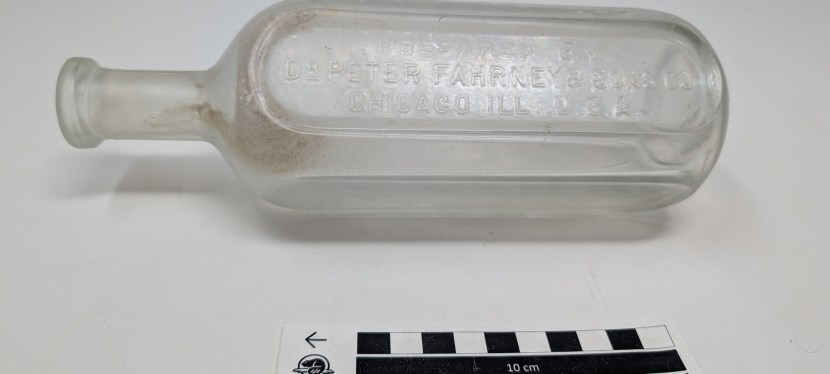
Editor’s note: The banner image above features a bottle found near the historic site of Brickburn. The clear, machine-made square glass bottle is embossed with the words, “Prepared by Dr. Peter Fahrney & Sons Co. Chicago, Ill., U.S.A.”. This bottle likely contained the infamous 14 per cent “Blood Vitalizer” products of Dr. Peter Fahrney.
Written by: Sophie Smith and Lindsay Amundsen-Meyer, Department of Anthropology and Archaeology, University of Calgary
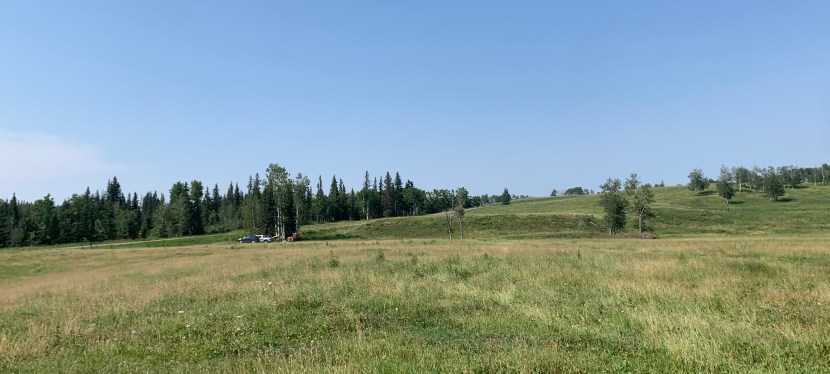
Over the past two years, the University of Calgary’s field school and Public Archaeology Program, in partnership with Calgary Parks and Open Spaces, completed excavations in Edworthy Park. The park’s approximately 140 acres of land on the south side of the Bow River were purchased from the Edworthy family by the City of Calgary in 1962. Before the land was sold and turned into green space, a small quarry and brick factory called Burnvale was established by a man named John ‘Gravity’ Watson, just west of the Edworthy homestead. This factory was then sold to Edward Henry Crandell in 1905. Crandell soon created the Calgary Pressed Brick Company, establishing the Brickburn factory and officially founding the town of Brickburn.
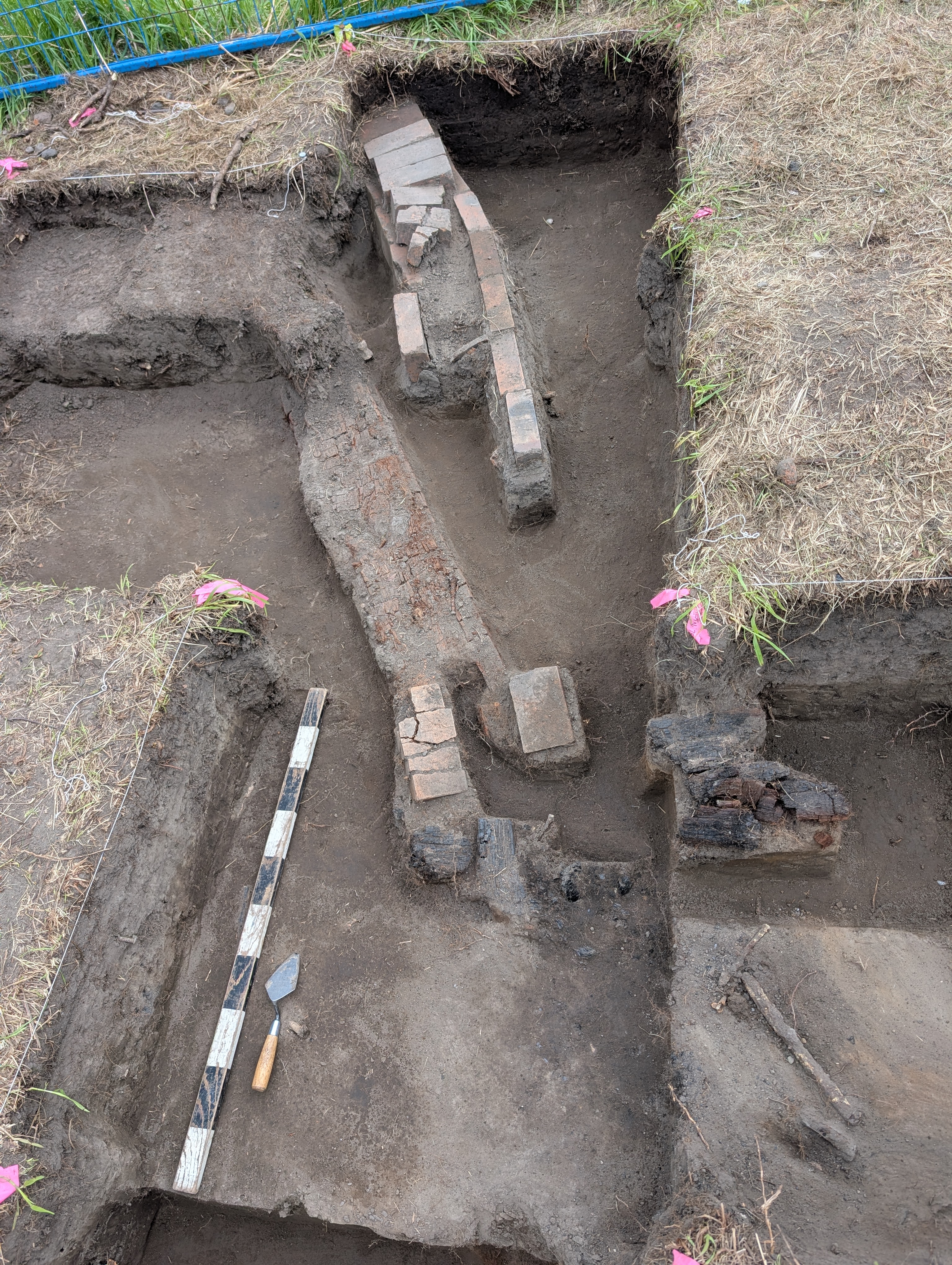
Although small, this town contained the typical necessities, such as a post office, cookhouse, church, housing and general store. Brickburn also had a train stop that, initially, was just a small whistle stop. It was then upgraded by Crandell to ship bricks and receive goods from the east or west. The Brickburn factory operated continuously until 1932, when it was deserted during the Great Depression. Over the past two years, archaeological research at site EgPm-389, associated with Brickburn, has uncovered an array of interesting features and recovered many historic artifacts, including decorated ceramics, glass marbles, beads and glass bottles.
A bottle with a story to tell
Many bottles recovered from the site display makers’ marks, which can be used to determine who made the bottle, when it was manufactured and how it was produced. One such machine-made bottle reads, “PREPARED BY/DR PETER FAHRNEY & SONS CO/CHICAGO. ILL., U.S.A.” As it turns out, this bottle and Dr. Peter Fahrney have quite an interesting story. He was even featured in a 1915 article titled, “Notables of the West – Being the Portraits and Biographies of Progressive Men of the West Who Have Helped in the Development and History Making of this Wonderful Country Vol. 2.” What a title!
Read more