

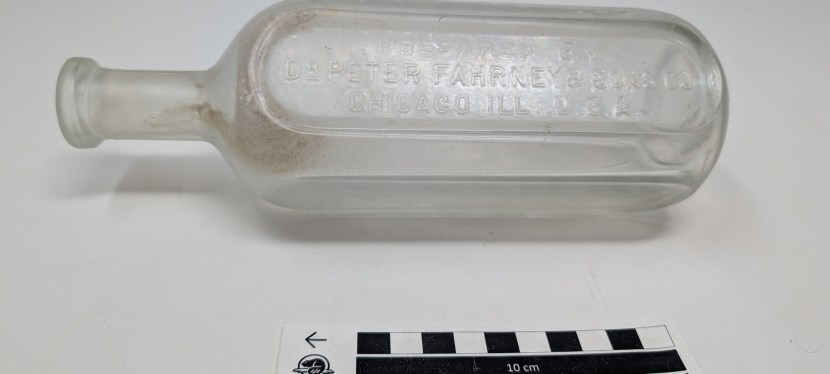
Editor’s note: The banner image above features a bottle found near the historic site of Brickburn. The clear, machine-made square glass bottle is embossed with the words, “Prepared by Dr. Peter Fahrney & Sons Co. Chicago, Ill., U.S.A.”. This bottle likely contained the infamous 14 per cent “Blood Vitalizer” products of Dr. Peter Fahrney.
Written by: Sophie Smith and Lindsay Amundsen-Meyer, Department of Anthropology and Archaeology, University of Calgary
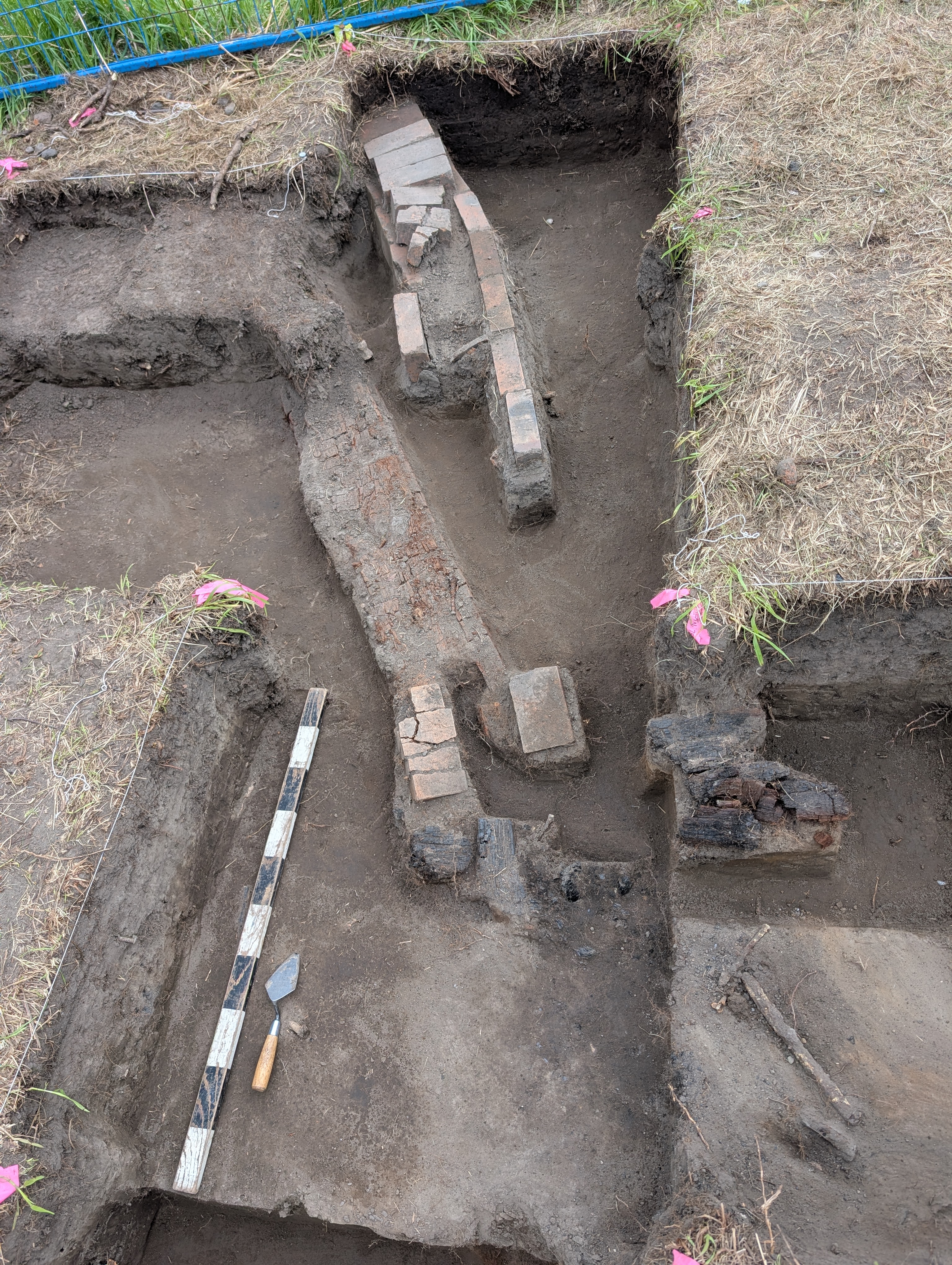
Over the past two years, the University of Calgary’s field school and Public Archaeology Program, in partnership with Calgary Parks and Open Spaces, completed excavations in Edworthy Park. The park’s approximately 140 acres of land on the south side of the Bow River were purchased from the Edworthy family by the City of Calgary in 1962. Before the land was sold and turned into green space, a small quarry and brick factory called Burnvale was established by a man named John ‘Gravity’ Watson, just west of the Edworthy homestead. This factory was then sold to Edward Henry Crandell in 1905. Crandell soon created the Calgary Pressed Brick Company, establishing the Brickburn factory and officially founding the town of Brickburn.
Although small, this town contained the typical necessities, such as a post office, cookhouse, church, housing and general store. Brickburn also had a train stop that, initially, was just a small whistle stop. It was then upgraded by Crandell to ship bricks and receive goods from the east or west. The Brickburn factory operated continuously until 1932, when it was deserted during the Great Depression. Over the past two years, archaeological research at site EgPm-389, associated with Brickburn, has uncovered an array of interesting features and recovered many historic artifacts, including decorated ceramics, glass marbles, beads and glass bottles.
A bottle with a story to tell
Many bottles recovered from the site display makers’ marks, which can be used to determine who made the bottle, when it was manufactured and how it was produced. One such machine-made bottle reads, “PREPARED BY/DR PETER FAHRNEY & SONS CO/CHICAGO. ILL., U.S.A.” As it turns out, this bottle and Dr. Peter Fahrney have quite an interesting story. He was even featured in a 1915 article titled, “Notables of the West – Being the Portraits and Biographies of Progressive Men of the West Who Have Helped in the Development and History Making of this Wonderful Country Vol. 2.” What a title!
Born on February 2, 1840, in Cumberland Valley, Maryland, Fahrney came into this world in the shadow of his grandfather and father. His grandfather, also named Peter Fahrney, had acquired fame in the 1730s as a notable herbal practitioner. Travelling from Pennsylvania into Maryland and Virginia to practise his profession, he earned the nickname “Little Dutch Doctor,” and one of his tonics, advertised as a blood cleanser, became incredibly successful. This product would lead the Fahrney family to wealth and success.
Following his family’s legacy, the young Peter Fahrney entered Jefferson Medical College in Philadelphia after taking a course in chemical and pharmaceutical training at the Philadelphia School of Pharmacy. This kick-started his career: he began practising at Morrisons Cove in Blair County, Pennsylvania, and later moved to Franklin County, Maryland, where he took over his cousin Dr. John Burkholder’s practice. At this time, Dr. Peter Fahrney began to patent his own medicines and products.
Between 1887 and 1890, Dr. Peter Fahrney ran his business at 393 Ogden Avenue in Chicago, Illinois, and established the company name that appears on the bottle today: Dr. Peter Fahrney & Sons Co. Shortly after Fahrney’s death in 1905, Ezra Camerer, his oldest son, was named president of the company and continued his father’s business until his own death in 1930. Ezra’s younger brother Emery ran the company until his death in 1935, after which it was placed in trust for Emery’s family; the estate was estimated to be worth $2 million.
A best-selling remedy
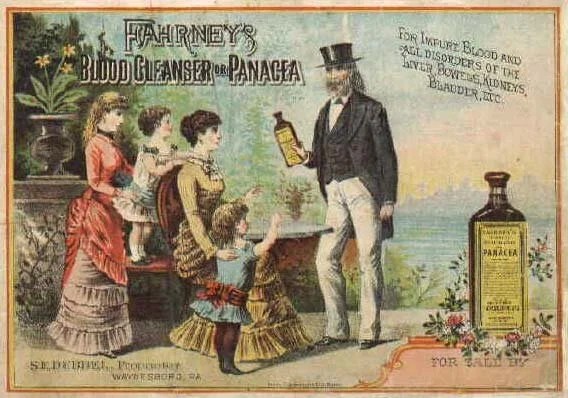
The company produced a substantial number of products that fell under the category of herbal medicines and tonics, such as “Forni’s Magolo” and a liniment called “Heil-Oel.” The one product that prospered throughout the company’s operation originated with Dr. Fahrney’s grandfather: “Dr. Peter Fahrney’s Blood Vitalizer.” This product was highly regarded, with the Washington, D.C., National Tribune stating at the time: “During its (Blood Vitalizer) existence, hundreds of so called medicinal discoveries have sprung up, only to be cast aside and forgotten, because they could not stand the test of time, but the Blood Vitalizer has held its well earned place on the field of medicine and is today without a rival as a family medicine.” This product claimed to cure numerous illnesses, such as rheumatism, kidney and liver troubles, indigestion and constipation. Additionally, stomach and bowel troubles and all diseases caused by impure or impoverished blood, or by a disordered stomach, could allegedly be cured by the amazing Blood Vitalizer.
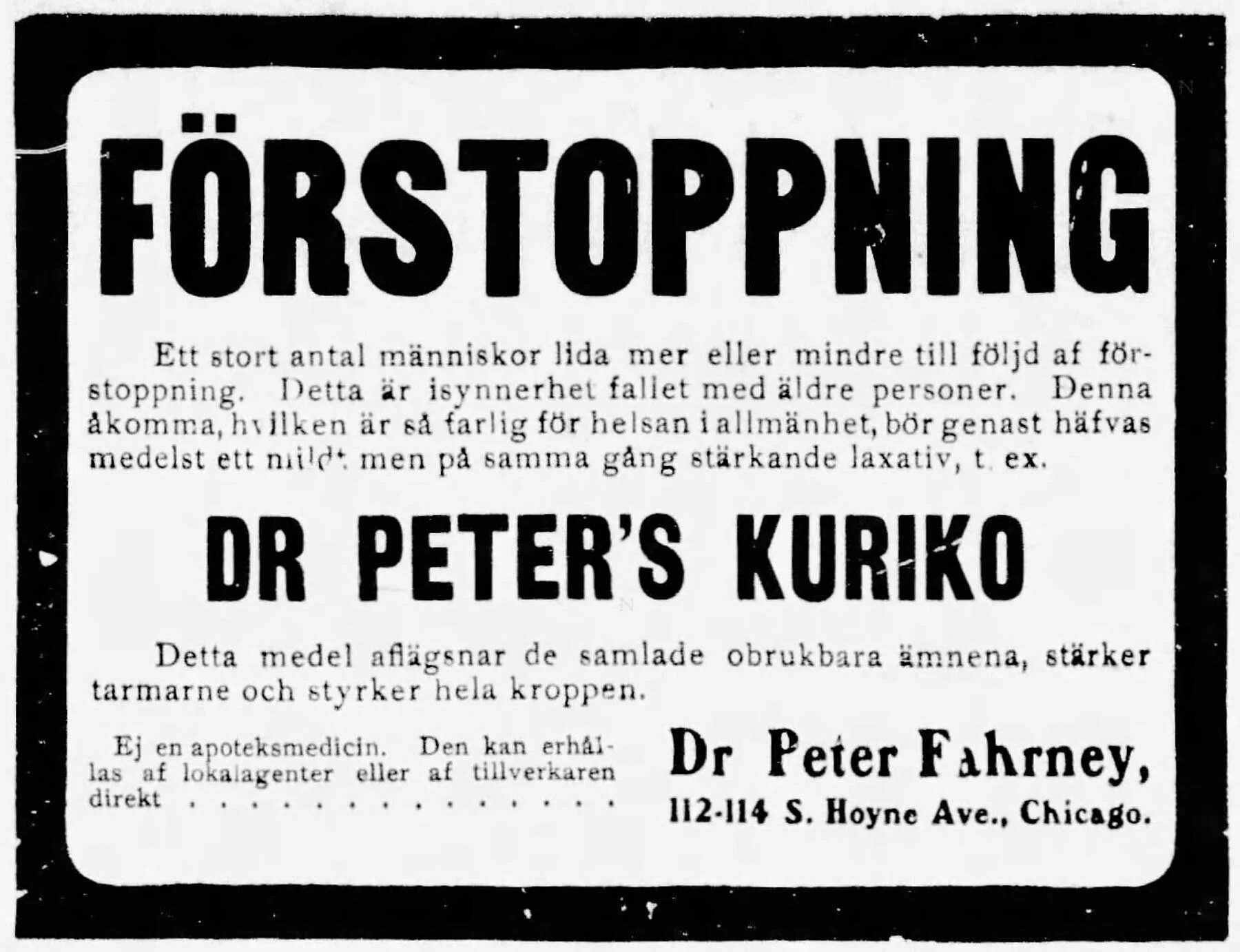
At the same time, the product was advertised globally under different names, as seen in a German newspaper advertising it as “Forni’s Alpenkrauter” or “Blut Beleber,” which allegedly meant “alpine herbs blood animator.” The product’s success may be attributed to its many names and aliases, as Dr. Peter Fahrney & Sons Co. specifically tailored the name to the place where it was advertised. For example, alternative names included “Hoboko,” “Novoro,” “Zokoro,” “Kuriko” and “Gomozo” in languages such as French, Dutch, Swedish and Polish.
Regardless of the name under which the Blood Vitalizer was advertised, the most important feature of the product was always its use of natural ingredients, such as herbs, roots, leaves and bark. Often called “nature’s medicine,” the recipe used the same ingredients and preparation methods that Dr. Peter Fahrney’s grandfather had used 100 years earlier. The belief was that the human constitution was the same as it had been a century earlier; therefore, why change anything?
“Don’t ask your druggist about it!”
What these global advertisements always failed to mention was the product’s 14 per cent alcohol concentration. An advertisement in the 1893 issue of Farmers Review would inform readers that their “glow of vitality” was not intoxication, regardless of whether it felt that way, but instead was the result of a newly cleansed and revivified system: “it cleansed and revivifies the entire system; you couldn’t get drunk if you drank a barrel of it.” In addition to omitting mention of the Blood Vitalizer’s 14 per cent alcohol content, advertisements often noted that customers should not ask their local druggist for the product: “Don’t ask your druggist about it. It can be had of local retail agents only. Write Dr. Peter Fahrney, Chicago.”
In September 1913, the U.S. Department of Agriculture analyzed the Blood Vitalizer at its North Dakota station, only to discover that the product was nothing more than a mild laxative and alcoholic stimulant made palatable with a small amount of sugar. At $1.25 per pint, Dr. Peter Fahrney was an obvious target for accusations that he was a snake oil salesman.
In addition to the widespread advertising of this product, its success may also be attributed to Prohibition, as a 14 per cent alcoholic stimulant was likely in great demand during this period. Despite the conclusions of the U.S. Department of Agriculture, the Blood Vitalizer continued to be advertised in newspapers as a medicinal product. For example, the September 12, 1924, edition of the Riverdale Illinois Pointer promoted the product for sale at an establishment called George Tuch’s Place. This advertisement appeared to be a sneaky way around Prohibition, disguising a club that served alcohol—in the form of Dr. Peter Fahrney’s “Blood Vitalizer”—as an establishment selling a medicinal product. By the late 1940s, multiple advertisements continued to promote the authenticity of Dr. Fahrney’s reputation as a doctor and stressed the product’s medicinal roots and herbs. However, the drink’s purported magical effects and expected results had been toned down to those of a laxative.
One small find, a much larger story
We may never know whether Brickburn’s residents turned to this product for its supposed medicinal benefits or for entirely different reasons. What is clear, however, is that this artifact offers a unique window into the intersections of medicine, marketing, consumer habits and attitudes toward alcohol in the early 20th century.
If you would like to learn more stories like this and participate in archaeological excavations at EgPm-389, keep an eye out for information on the 2027 Public Archaeology Program.
Sources
Bachrach, Julia. 2021. Spotlight on Chicago’s Patent Medicine Industry. Julia Bachrach Consulting. Julia Bachrach Consulting, LLC. https://www.jbachrach.com/blog/2021/6/28/spotlight-on-chicagos-patent-medicine-industry, accessed July 15, 2026.
Bay Bottles. 2018. Dr. Peter Fahrney & Sons Co., Chicago, Ill., USA. “The Old Reliable Home Preparation for Home Use.” Bay Bottles. WordPress. https://baybottles.com/2018/09/25/dr-peter-fahrney-sons-co-chicago-ill-usa-the-old-reliable-home-preparation-for-home-use/, accessed July 15, 2026.
Boonsboro Historical Society. 2017. BOONSBORO REFLECTIONS: Dr. Peter Fahrney’s Legacy. Boonsboro Historical Society | Preserving & Celebrating 225 Years of History in Boonsboro, MD. https://boonsborohistoricalsociety.org/boonsboro-reflections-dr-peter-fahrneys-legacy/, accessed July 15, 2026.
Britannica Editors. 2018. Prohibition. Encyclopedia Britannica. Britannica. https://www.britannica.com/event/Prohibition-United-States-history-1920-1933, accessed July 15, 2026.
Collins, Kendall. 2026. The Fascinating History of Calgary’s Edworthy Park and Who It’s Named After. Https://Dailyhive.Com/Calgary/Calgary-Edworthy-Park-History. Daily Hive. https://dailyhive.com/calgary/calgary-edworthy-park-history#google_vignette, accessed July 15, 2026.
Edworthy Park Heritage Society. 2022. Shaganappi Point & Edworthy Park A New History : Inniiwaa’iitainniksissta’poohpi. Edworthy Park Heritage Society.

