

Editor’s note: Sara Bohuch has been a conservator in the University of Calgary’s LCR (Libraries and Cultural Resources) Department since May 2023. She received her MSc in Conservation Practice from Cardiff University (Wales) and, since moving back to Alberta, has completed conservation projects on everything from saddles to staircases. Her recent work at the U of C is with the photographs, archival papers and other surprises that can be found within the Glenbow Library and Archives portion of the LCR department.
The banner image above was photographed by Sara Bohuch.
Written by: Sara Bohuch, BA Archaeology (Simon Fraser University), MSc Conservation Practice (Cardiff University)
Archival records can give the illusion of a neat and tidy history. The material is almost the definition of unassuming: boxes of paper sitting in a temperature-controlled room, organized for ease of access and use. But any foray into reading the seemingly innocuous records that make up a library or archive quickly reveals a truth: what may seem like dusty, logistical data can be particularly complicated.
An example of this can be found in a letter filed away on the shelves of the Glenbow Archives. The letter is part of the George and John McDougall family fonds, a collection made up of two metres of textual records, 490 photographs and two postcard albums that pertain to the family’s time in Alberta. Most of it was transferred to the Glenbow in 1968, with additional components donated in the decades that followed.
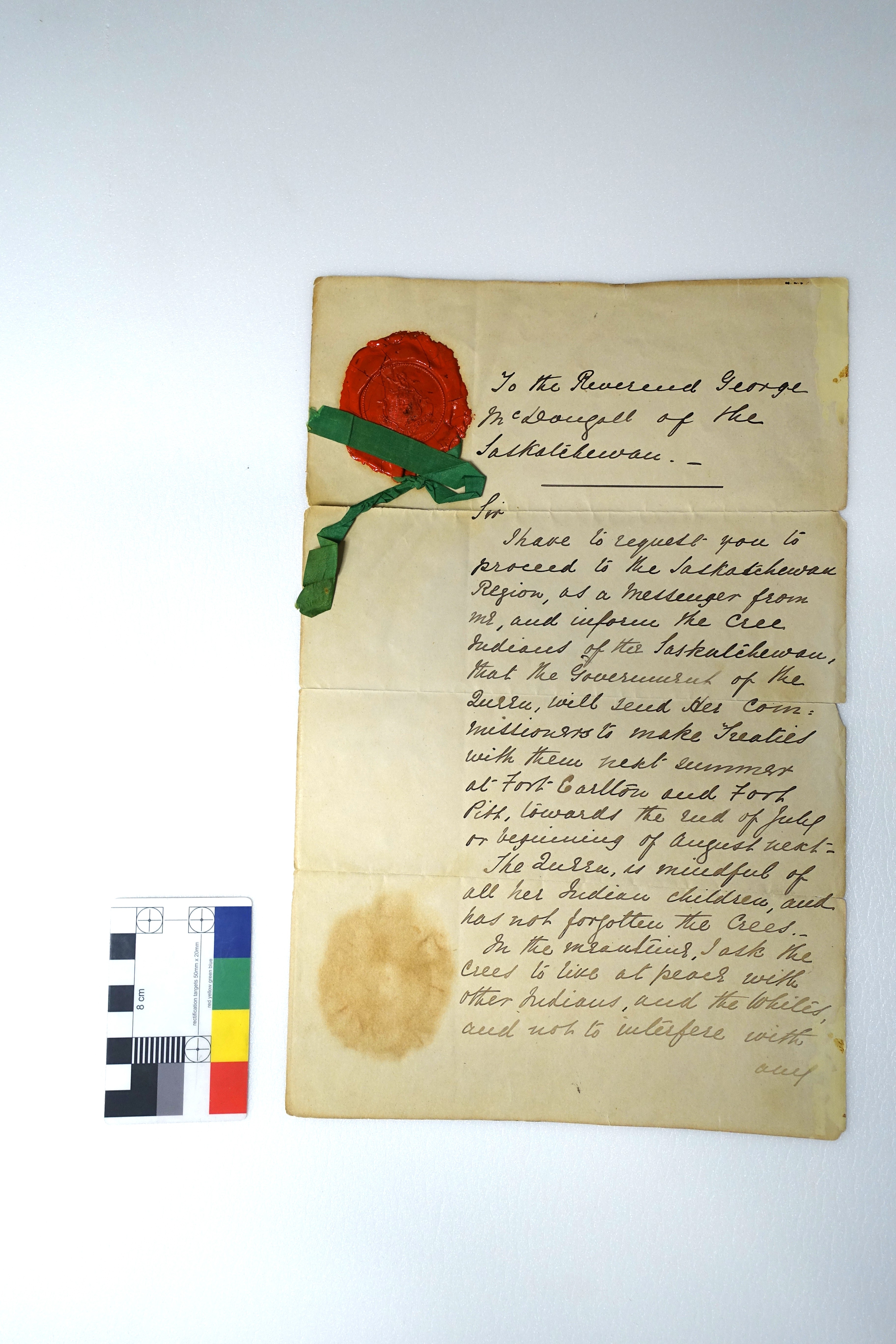
The letter in question dates to 1875 and was written to one of the family’s patriarchs. It’s a dry inquiry (in both its material nature and its topic) from a politician in Manitoba. But the contents become much more interesting when you realize their direct connection to the creation of Treaty 6:
“To the Reverend George McDougall of the Saskatchewan –
Sir
I have to request you to proceed to the Saskatchewan Region, as a messenger from me, and inform the Cree Indians of the Saskatchewan, that the Government of the Queen, will send Her Commissioners to make Treaties with them next summer at Fort Carlton and Fort Pitt, towards the end of July or beginning of August next:
The Queen is mindful of all her Indian children, and has not forgotten the Crees.
In the meantime, I ask the Crees to live at peace with other Indians, and the Whites, and not to interfere with any surveyors or other servants or subjects of the Queen in any of their operations.
The Queen, has always dealt justly with Her Indian Children, and has their good at heart.
This letter will be your authority for delivering the message I send by you, and you can show it to any Chiefs you meet.
Given at Government House
Fort Garry, Manitoba
This ninth day of August A.D. 1875 –
Under my hand and seal.
Alex. Morris
Lieutenant Governor of the Northwest Territories”
Treaties
The Numbered Treaties of Canada are a long and complex part of the country’s history. The 11 different treaties that were penned between 1871 and 1921 opened the west and the north for agricultural and industrial development. The Government of Canada understood the treaties to be a surrender of land rights in return for resources and assistance, while First Nations leaders viewed the treaties as the foundation of a new and ongoing relationship with the Crown that included shared occupancy of the land. Multiple groups of First Nations entered into these agreements and debates have followed ever since, due to disagreements on the interpretation of the terms and how they were presented.
By the time this letter was sent in August 1875, Treaties 1–4 had been concluded, covering lands in parts of present-day Manitoba, Ontario and Saskatchewan. Treaty 5 would be signed in September 1875 and would address most of central and northern Manitoba, along with small portions of Saskatchewan and Ontario.
Treaty 6 would deal with the central areas of the Prairie provinces and the sites of modern cities such as Edmonton, Lloydminster and Saskatoon. Before it could be properly written and presented, the government required intelligence about the area and the people who lived there. It needed a local agent who could discuss and assess the “amenability” of the different First Nations in the Alberta-Saskatchewan region to the proposed treaty. While the letter refers only to Cree people in this territory, other communities also lived there, including the Assiniboine, Dene and Ojibwe.
In the letter, Lieutenant Governor Alexander Morris granted Reverend George McDougall authority to act on behalf of the Crown and serve as a messenger for the government. This role allowed McDougall to become directly involved in the treaty process by supplying information and opinions that contributed to the two groups eventually meeting and signing the document.
Alexander Morris and Reverend George McDougall
Alexander Morris was born in 1826 to a political family and spent his working years in political and legal roles, including a position in the cabinet of Prime Minister John A. Macdonald. A strong proponent of Confederation, Morris was a politician, lawyer and author who wrote several well-respected works on Canada’s political landscape. A well-established and respected figure in Canada’s political community, Morris was appointed to several prominent posts, including Lieutenant Governor of the Northwest Territories (1872–1876), Lieutenant Governor of Manitoba (1872–1877) and Treaty Commissioner (1873–1876).
Morris was not as familiar with the landscape of the westernmost prairie provinces or the numerous First Nations that called the areas around Saskatchewan and Alberta home. To rectify this knowledge gap, Morris received federal authorization to reach out to an “approved” local contact who was active in the areas affected by the prospective Treaty 6: a local missionary named George McDougall.
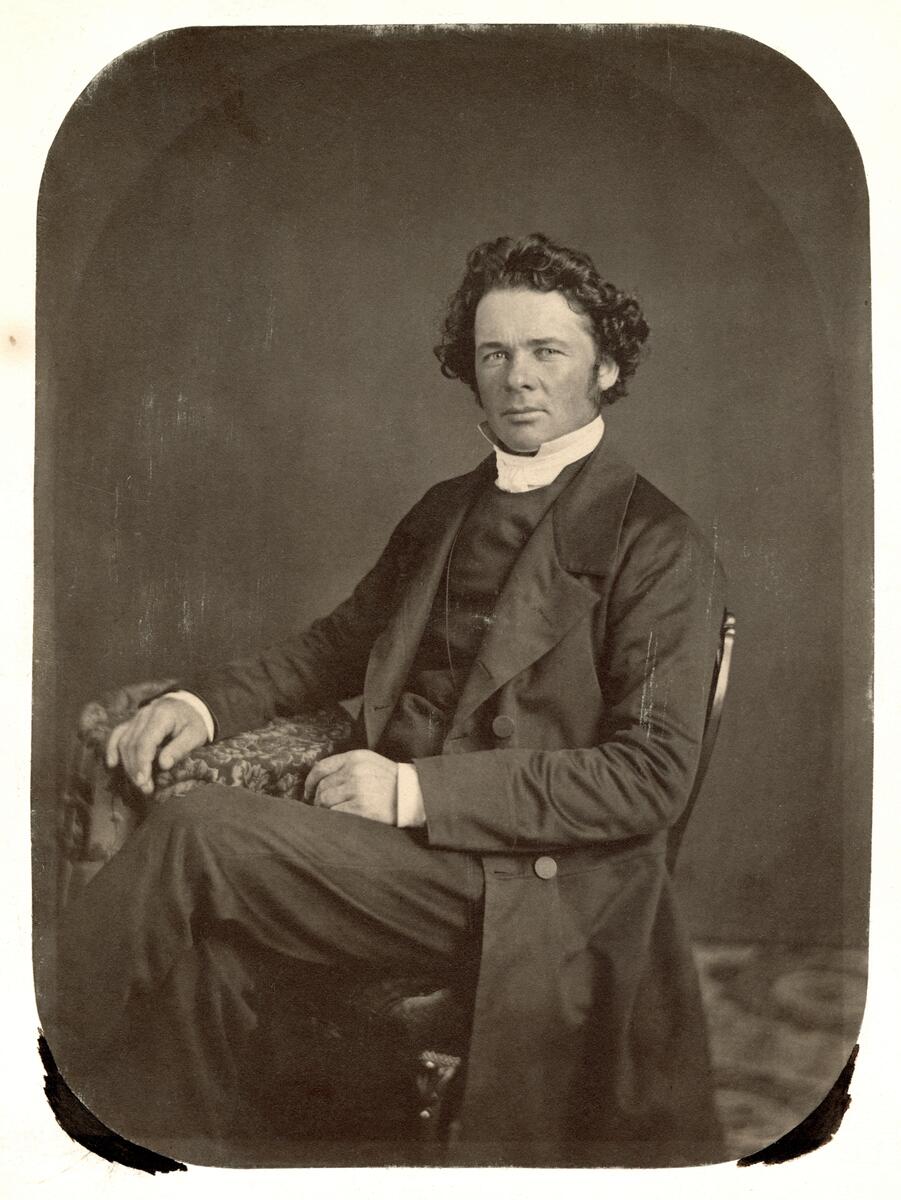
Born in 1821 in Ontario, George McDougall was officially ordained in the Methodist faith in 1854. He moved west in 1860 when he was appointed to a mission in present-day Manitoba. He subsequently established the Victoria Mission roughly 130 kilometres east of Edmonton.
During his time in western Canada, McDougall founded missions and promoted Euro-Canadian settlement. By the time Lieutenant Governor Morris contacted him, McDougall had cultivated a wide variety of First Nations contacts in the area. McDougall became one of the government’s go-to contacts and was on hand to answer questions and eventually help prepare First Nations to sign Treaties 6 and 7.
The context
The negotiation of Treaty 6 took place in extremely difficult circumstances for First Nations people. The Government of Canada was eager to extinguish Aboriginal title to pave the way for immigration and agricultural settlement in the Prairie West, while Plains First Nations people were facing epidemic disease and starvation due to the collapse of the bison population. The role of figures such as Morris and McDougall in treaty-making, as well as the process itself—including the nature of the negotiations and the understanding (or misunderstanding) of the terms—remains controversial and contested to this day.
Treaty 6 was signed later in 1876 during a series of meetings that stretched into the autumn of that year. After its signing, Treaty Commissioner/Lieutenant Governor Alexander Morris stepped down from his role and returned home to Ottawa in 1877, where he lived until his death in 1889.
Reverend George McDougall was not present at the signing of Treaty 6 or Treaty 7. In January 1876, he died in a blizzard near Calgary while on a buffalo hunt.
Conservation
The original 1875 letter is currently being conserved and stabilized in the conservation workrooms at the University of Calgary’s special collections department. The letter is 151 years old and looks its age. The paper is brittle, the ink has faded and the red wax seal has left stains on the surface where the letter was folded. Even the bright green ribbon used in the sealing looks mangled.
The most serious damage to the letter consists of tears along the original fold lines. Over time, the deformation of the paper has created weak points in the surface. As the paper aged and became more brittle due to oxygen interacting with its wood components, the folds created “paths of least resistance,” making the paper prone to tearing along those weak points.
These tears are repaired using a pressure drying system and Japanese tissue with wheat starch paste. This will provide support to the paper and ensure that the letter can be accessed again by the public.
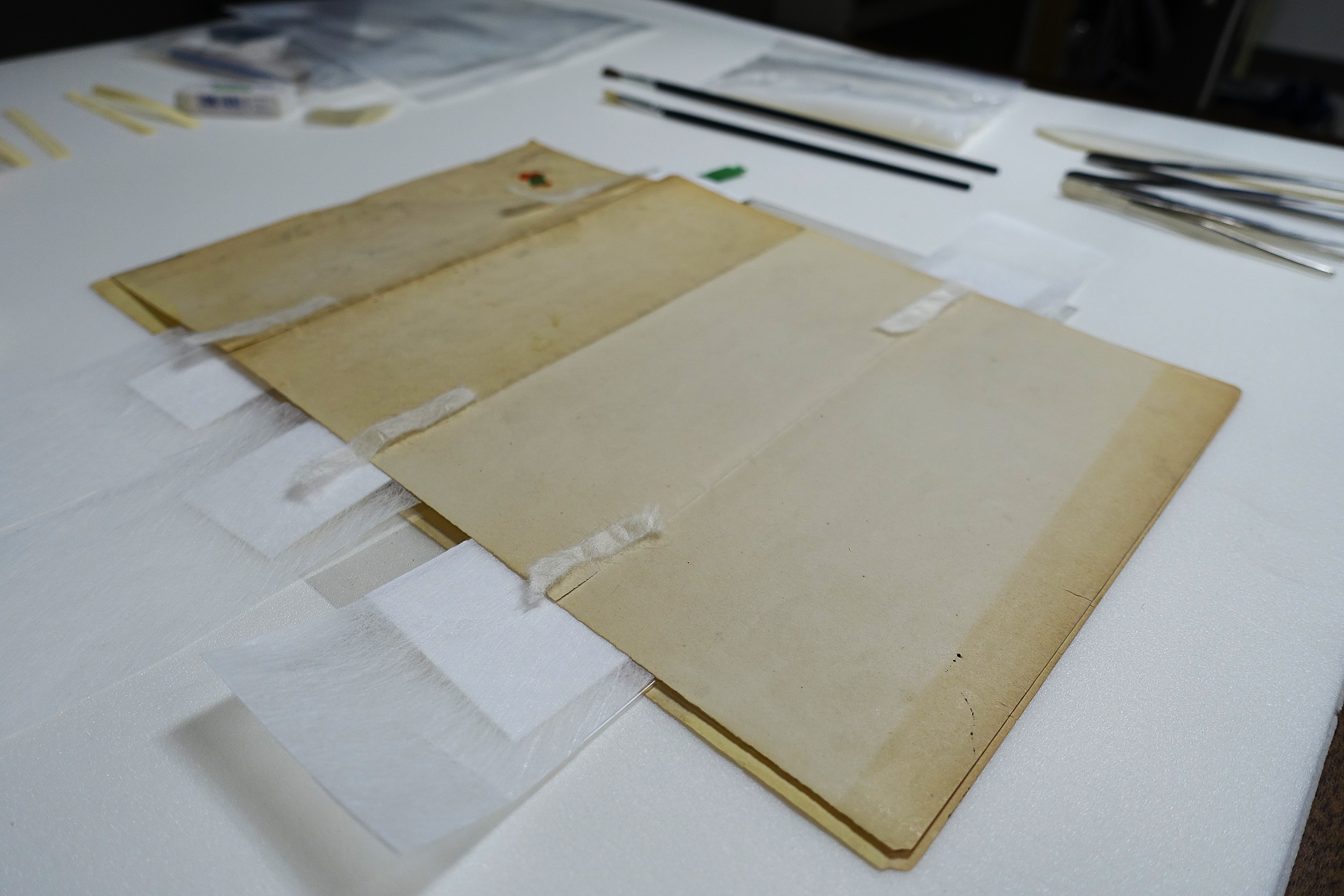
The point of conservation is not to restore the letter to its original pristine state. Its age is part of its story and adds information to the historical context. The point of the treatment is to provide stability so that the letter can survive even longer.
This is especially important because this letter (and others in the same series) was on a short-term loan to the Office of the Treaty Commissioner in Saskatoon. To commemorate the 150th anniversary of the signing of Treaty 6, the letter was displayed alongside an original Treaty 6 manuscript.

