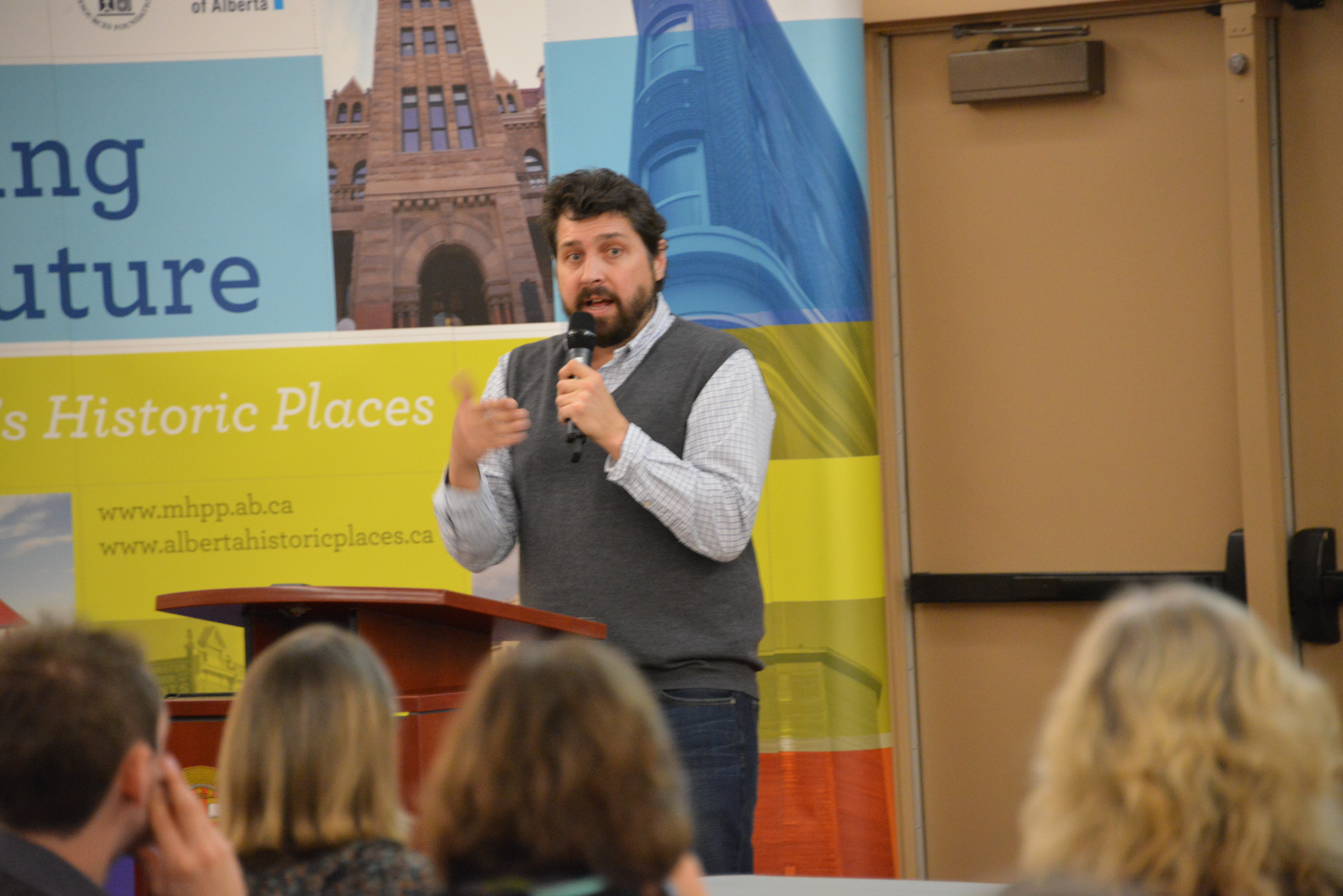
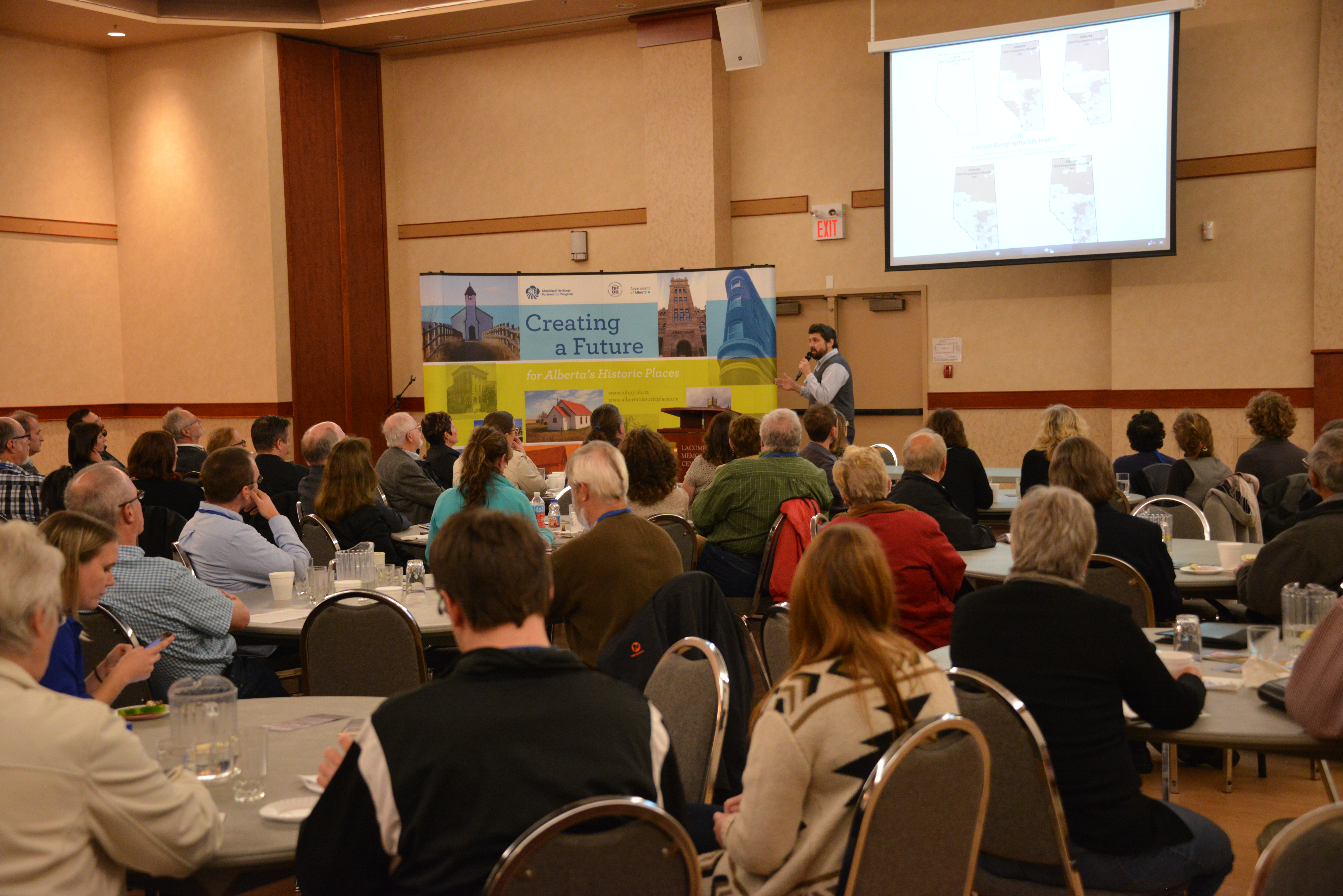
Facebook, Twitter, blogs and other types of social media can connect heritage conservationists throughout the world. We sometimes get so focused on the brick, stone or wood that we forget that successful heritage conservation is built on relationships between people, according to Kayla Jonas-Galvin, a heritage planner based in southern Ontario. Social media websites allow user to create and share content with each other. In her keynote address at the 2014 Municipal Heritage Forum in Lacombe, Kayla highlighted the many ways social media enables communication between heritage professionals and members of the public.
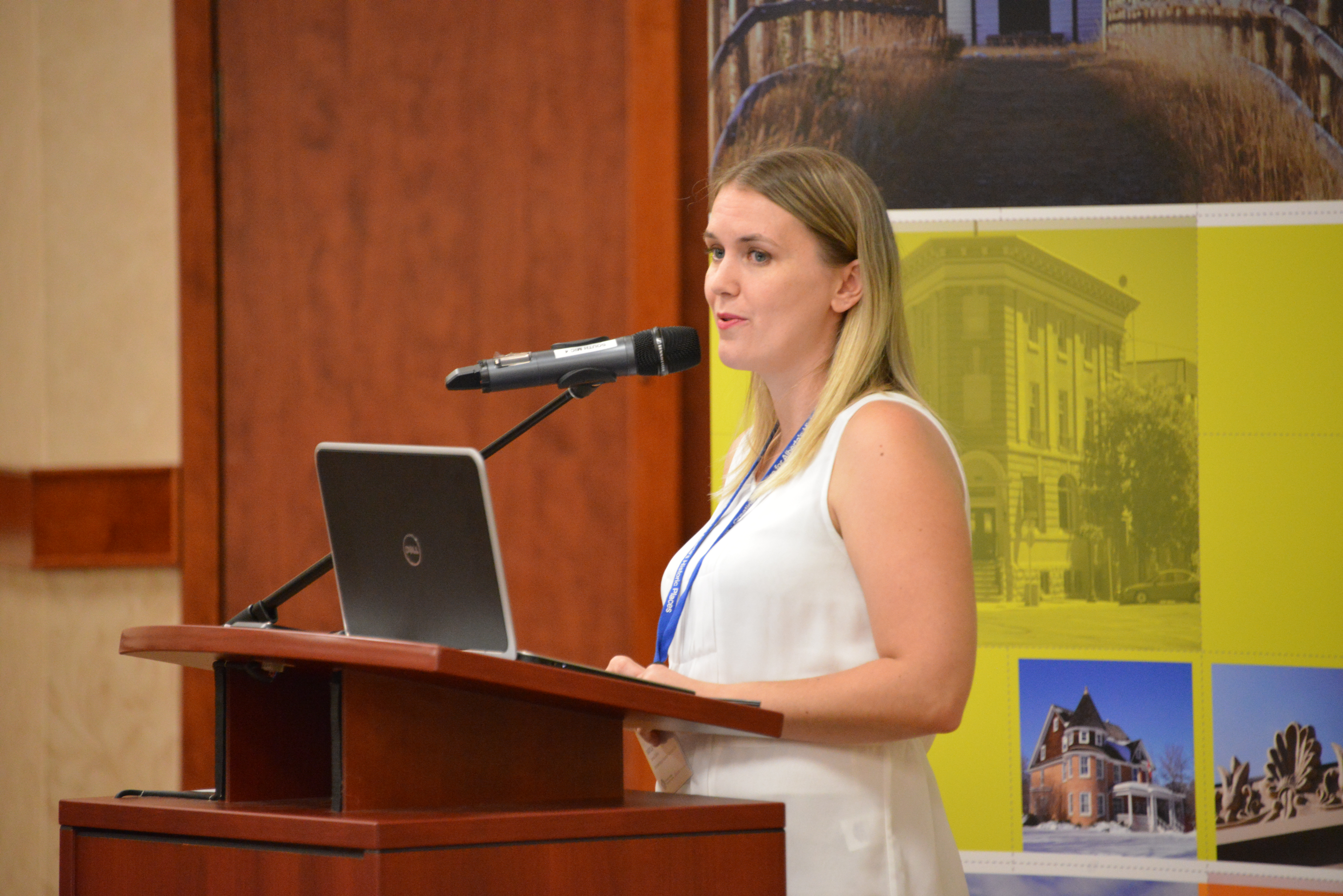
Kayla Jonas-Galvin speaking to the delegates at Municipal Heritage Forum. (October 16, 2014)
Kayla speaks from experience. She has worked for the Heritage Resources Centre (at the University of Waterloo), the Architectural Conservatory of Ontario and ARA Heritage. She finds that social media is a key tool in promoting heritage conservation. She is responsible for, among other things, founding the #builtheritage twitter chat – a twitter chat sponsored by the U.S. National Trust for Historic Preservation. What started as a small group of heritage conservationists discussing heritage and conservation issues quickly grew into a large international discussion that drew in many people beyond hard-core conservationists.
Kayla emphasised that social media shouldn’t be complicated—it’s just another way to have a conversation. It’s an opportunity to talk to several people, often separated by vast distances, as though they were sitting in the next room. With this in mind, Kayla founded #builtheritage twitter chats to spark discussion of heritage conservation issues with people outside Waterloo. She started the chats by simply tweeting a few people that she was interested in talking to about problems of conserving historic places. The chats quickly grew to attract conservationists from all over the United States, Canada and around the world. People who had never met were suddenly talking to each other about the problems and opportunities they faced when trying to conserve historic places in their own communities. Anyone could participate and in time many people who normally did not think about heritage conservation were suddenly involved. At one point, Gloria Estefan replied to a tweet about the Miami Marine Stadium.
So how do we use these tools? Kayla emphasised the importance of setting goals. Who do you wish to reach and what do you want to say? Facebook and Twitter (just two examples) connect people in different ways. Twitter’s short text messages allow large groups of people to chat in real time, while Facebook allows users to share and comment on pictures and weblinks with friends easily.
Kayla related stories about how social media is bringing heritage preservation into the mainstream. There are many groups on Facebook that love to share old photos. The Vintage Edmonton Facebook page currently has over 11 000 followers. Hundreds of people who probably don’t consider themselves heritage conservationists share pictures and stories of Edmonton’s history.
To be effective, says Kayla, it’s important to have personality and to talk to other people. Don’t treat social media channels as just as a means of delivering announcements—talk to people. Social media is another avenue to start a conversation.
If we all encourage people to share photos, sound records and videos we’re probably going to be surprised by the number of people who want to discuss our common heritage. We need to start asking ourselves what about my heritage can be shared over social media and who do I want to share it with.
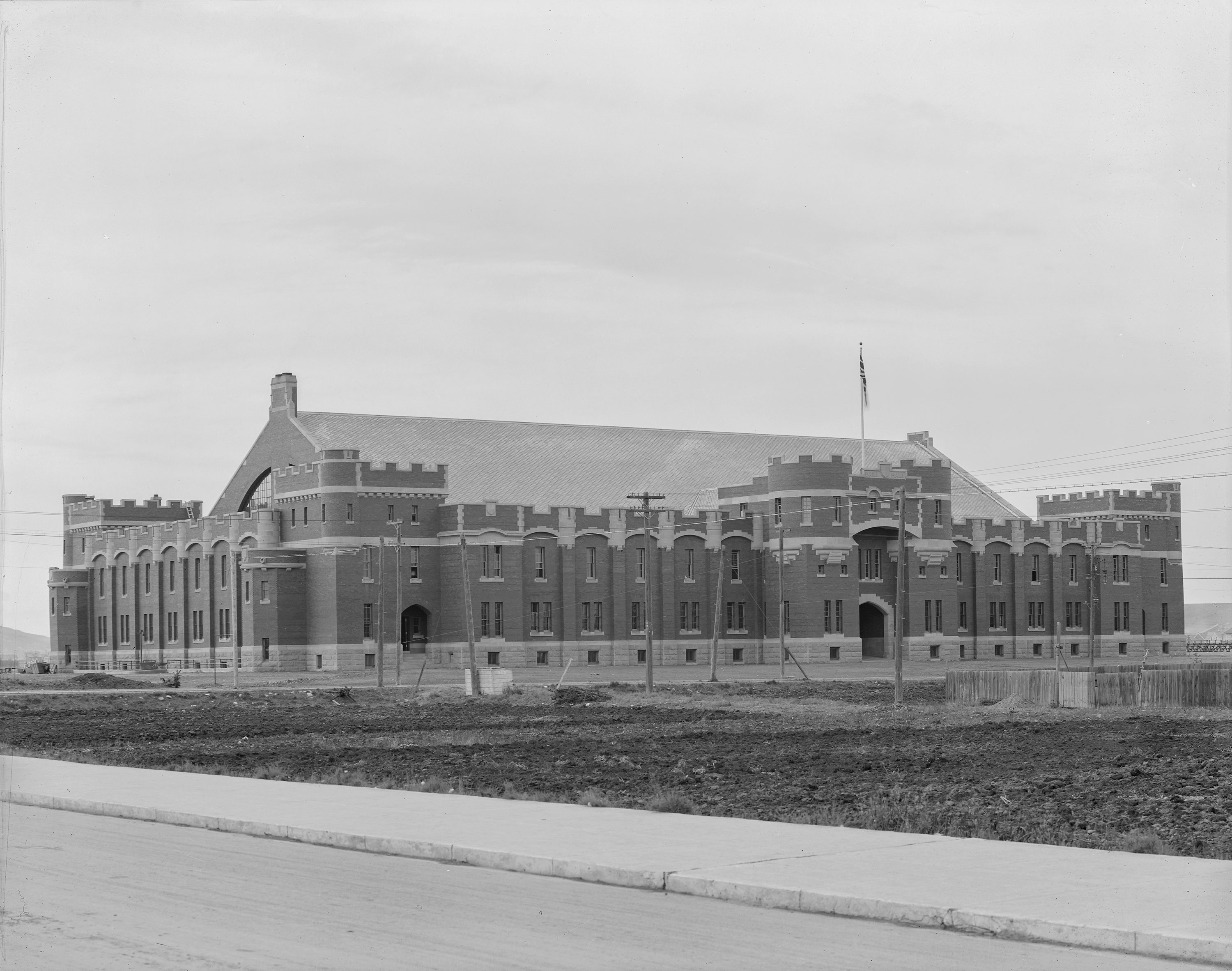
Mewata Armoury (Provincial Archives of Alberta, P.4017).
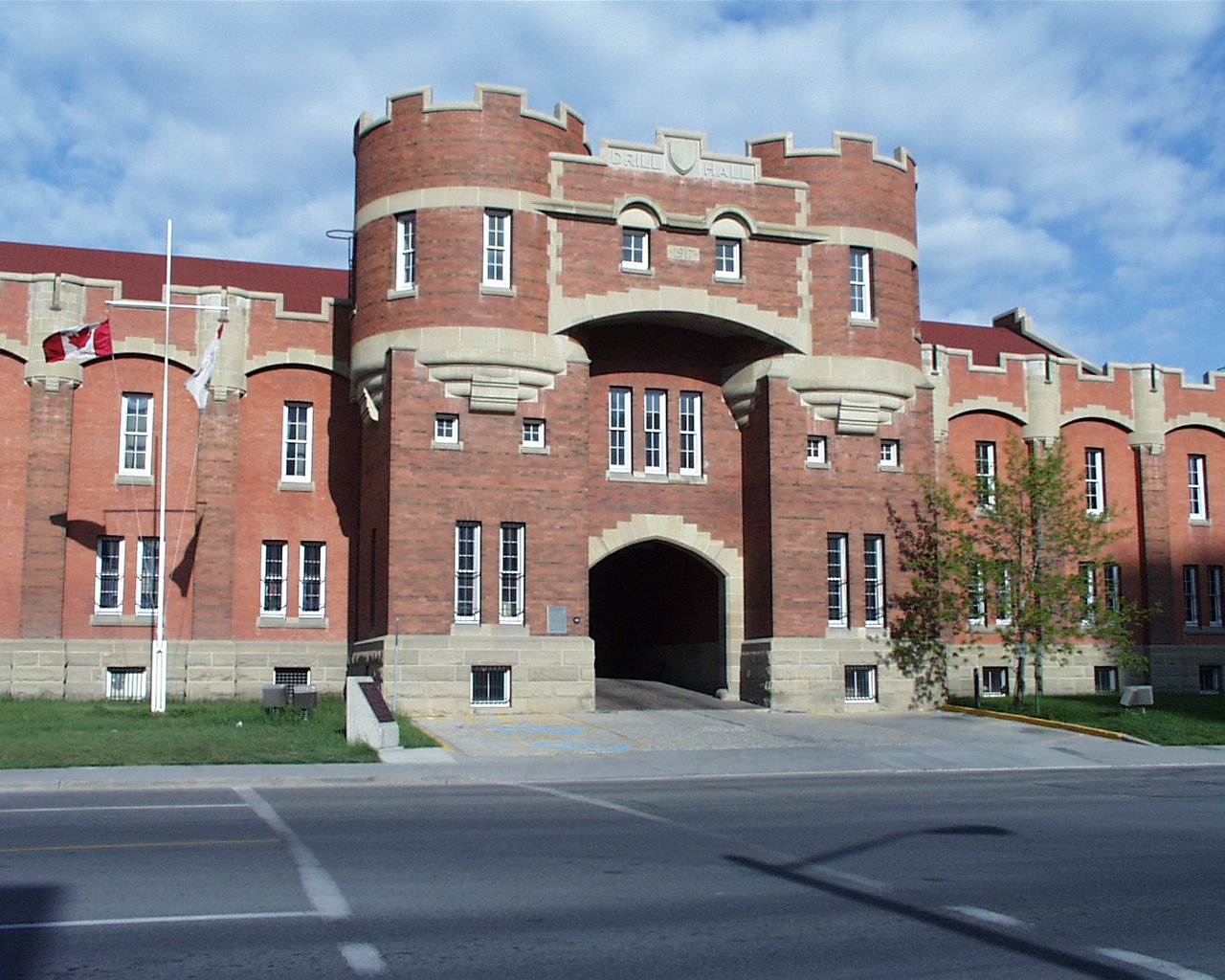
Plans for an elaborate armoury in Calgary were well underway prior to the outbreak of the First World War, as the need for a permanent, military training structure was apparent within the first decade of the twentieth century. The story of the construction of Calgary’s own armoury was a drawn out affair that lasted to nearly the end of the Great War. There were problems from the very beginning, including fierce opposition to the cost and chosen site of the armoury, a shortage of building materials and ultimately the outbreak of war. In the end, the result was a state of the art facility with a central drill hall surrounded by 117 rooms and complete with dining hall, shooting gallery and even a bowling alley. This post will examine the Mewata Armoury, a building that was established during the First World War, and its place as a significant symbol of military heritage in Alberta.
In the early 1900s, the Canadian military underwent a number of reforms to modernize it and establish permanent facilities for the army. The federal government set the ambitious goal to establish 350 new drill halls and the decision to construct these served a dual purpose. These structures were to foster a sense of military pride amongst Canadians while boosting recruitment and create a closer connection between civilians and soldiers. Calgary was considered part of Ottawa’s military expansion plan early on and the city became the headquarters for Military District No. 13 in 1907, which covered all of Alberta and the district of MacKenzie (a portion of the Northwest Territories at the time). This declaration was significant since it meant that the area was deemed to be an important part of the future of the Canadian military.
It was nevertheless the local military regiments, and not the federal government, that took it upon themselves to push for the construction of a new armoury. Calgary was growing rapidly in the early twentieth century and they felt they needed a facility to house their growing regiments. The city’s military organizations wanted a building that would better accommodate their soldiers and approached the federal government for approval to build an armoury in Calgary. Potential sites for the location were suggested over the next few years, but were all deemed insufficient and plans for the armoury were soon shelved.
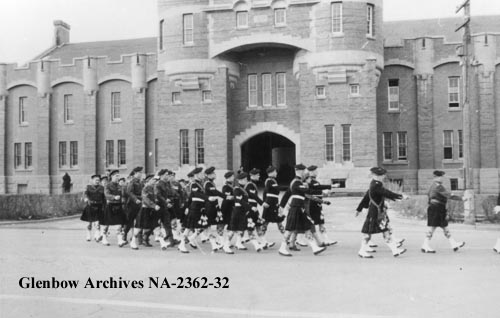
Calgary Highlanders pipe band parading by Mewata Armoury, Calgary, date unknown. (Glenbow Archives, NA-2362-32).
It was not until Sam Hughes was appointed Canada’s Minister of Militia and Defence in 1911 that Ottawa’s plans for a modern militia were put in motion. Hughes undertook the responsibility of reforming Canada’s military and his ambitious agenda included the construction of armouries and drill halls across the country. Hughes promoted the volunteer soldier as the foundation of the Canadian military and believed that volunteerism was the most viable form of recruitment. He was also a strong supporter of building a shared place for civilians and soldiers. This belief was reinforced by the need for an armoury, as it would serve as a visible presence to foster civic pride, and in turn, increase the number of soldiers who enlist. In addition to providing an adequate space for training, the new structures were to be a permanent symbol of Canada’s military reform program.
Another supporter of this vision was the Calgary Conservative MP, Richard Bedford Bennett. Bennett agreed with Hughes’ plan for an elaborate military structure and wanted Calgary to have its own armoury. One of Bennett’s first decisions upon taking office was to lobby the federal government to establish such a facility. Although the city already held a number of rented military buildings for training purposes and used school grounds for parades, these sites were spread throughout Calgary and it was considered more practical to consolidate these into a single location. The city also remained without a permanent indoor space for military training during the winter months. Bennett considered this to be inadequate for a growing city and the proposal for an armoury was revisited. It took minimal lobbying on Bennett’s behalf to convince Hughes that Calgary was worthy of a magnificent armoury and the funds were soon allotted to begin building.
When it came to deciding on the location for Calgary’s armoury, Bennett had just one area in mind, Mewata Park. The site was already being used as an athletic field and had originally been designated a civic park for the people of Calgary. The site was centrally located, which meant that it would be impossible for the structure to be missed by many Calgarians during their daily commute downtown.
As the plans for the new armoury proceeded, the project was met with opposition, notably from Alberta Liberals, who felt that the federal government had no right to devote public land to a military institution. They also raised concern over the cost that would be incurred to construct the new building. The daily pro-Liberal newspaper, Morning Albertan, voiced their opinion against the construction of an armoury, citing that “an expenditure of such an amount would be a lavish and inexcusable waste of money.” However, this did not appear to be the sentiment of the majority of the citizens of Calgary. The opposition was soon squashed by people who came out in strong support of the armoury during the 1913 municipal election. This was a heated election issue that year and included a question on the ballot enquiring if citizens wanted to see the project move forward. More than 70% of voters were in favour of constructing an armoury at Mewata Park, indicating their support for the local military. In 1916, supporters were granted their request and the City of Calgary donated the land to the federal government to build the armoury.
The First World War erupted in August of 1914 and the armoury’s construction was therefore delayed for a few years. This was due to the city’s resources being allocated to more necessary and immediate projects for the war efforts. A brick shortage contributed to construction being deferred even further. Building was eventually underway in September, 1916 and was finalized in the fall of 1918. Once completed, the armoury was used as a training centre and demobilization depot for soldiers returning from WWI. Although it was too late for the armoury to be fully utilized for the war, the construction of an impressive military facility helped to encourage pride among its citizens.
Although the armoury’s interior has been remodelled substantially, the exterior has retained its original appearance as constructed in 1916. The building is one of only two similar structures in the province (the other being the Prince of Wales Armoury in Edmonton). The architectural design is a classic example of the gothic and Tudor revival, which was built to look like a fortress with its four corner towers and six smaller side towers. What makes the Mewata Armoury unique is its castle-like style, massive size and the use of brick and sandstone construction. This is one of the last buildings in Calgary that was created with sandstone.
Mewata Armoury remains a long-standing military landmark and shows the federal government’s commitment to a militia-presence in Calgary. A number of regiments have called the armoury home over the years, including the Calgary Regiment’s First Battalion (currently the Calgary Highlanders), the Second Battalion (now the King’s Own Calgary Regiment) and various cavalry units. Mewata Armoury has primarily been used as a military facility, but has also been a training centre for the police, a base for numerous Cadet Corps and is the headquarters for the Southern Alberta Militia District. Various sporting events have been held at the armoury and Mewata Park was still used as an athletic field. The armoury remains an important site, as it was constructed to connect the military with the civilian population, amidst the First World War.
This was the third part of a series commemorating the First World War. This series will look at a range of topics that will show Alberta’s involvement in this historic event.
Written by: Erin Hoar, Historic Resources Management Branch Officer
Sources:
Designation File # 177, in the custody of the Historic Resources Management Branch.
Lackenbauer, P. Whitney “Partisan Politics, Civic Priorities, and the Urban Militia: Situating the Calgary Armoury, 1907-1917.” Urban History Review 33, no. 2 (2005): 45-60.
“Mewata Armoury” Alberta Register of Historic Places. HeRMIS. (Accessed August 12, 2014).
Rowe, Allan “Historical Context Paper Mewata Armoury (Calgary),” Historic Resources Management Branch, Des. File #177. (April 25, 2014).
In Jasper National Park there are five mountains named for First World War Victoria Cross recipients with Alberta connections. The peaks are located within a series of mountains known as the Victoria Cross Ranges. The names of these mountains honour Private John Chipman Kerr, Private Cecil John Kinross, Captain George Burdon McKean, Private John George Pattison and Sergeant Raphael Louis Zengel.
The Victoria Cross was established in 1856 by Queen Victoria to recognize military personnel who demonstrated bravery when faced with the opposition during wartime. It is the highest military decoration that can be bestowed upon a soldier in the British Commonwealth. This post will look at the recipients of the Victoria Cross who the mountains in Jasper National Park are dedicated to.
Mount Kerr
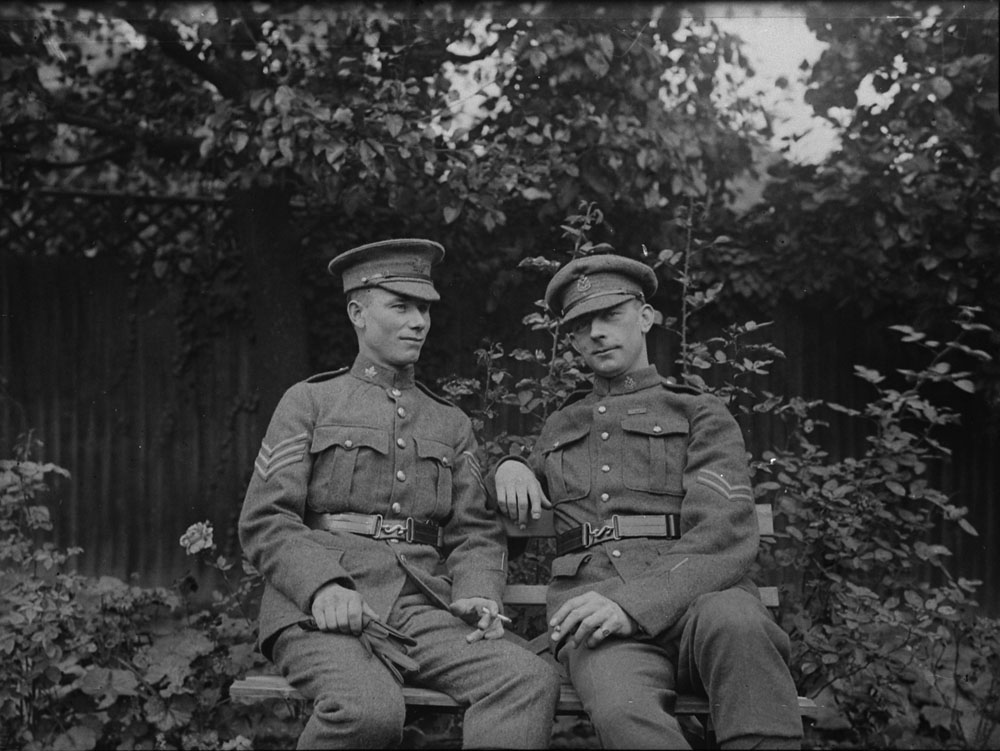
Mount Kerr is named in honour of Private John Chipman Kerr, who served in the Alberta raised, 49th Battalion (Edmonton Regiment), Canadian Expeditionary Force. Kerr, originally from Fox River, Nova Scotia, moved to Spirit River, Alberta before enlisting for service in 1915.
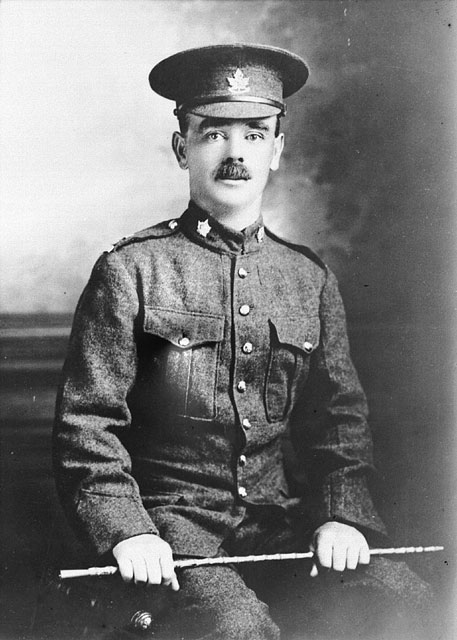
J. C. Kerr (right) c. 1914-1919 (Credit: Canada Dept. of National Defence/Library and Archives Canada).
On September 16, 1916, during the Battle of the Somme, Kerr and his unit prepared to ambush German soldiers. As the lead bayonet man, Kerr was 30 metres ahead of his comrades and exchanged fire with enemy troops. The Germans, believing that they had been surrounded, surrendered to Kerr. Sixty-two prisoners were captured and 250 yards of enemy territory was seized. Kerr was injured and lost a finger in the attack, but reported back for active duty before the wound had been fully dressed.
For his actions on that day, Private Kerr was awarded the Victoria Cross.
After the war, Kerr returned to farming, worked in the Turner Valley oil fields and as a forest ranger. He enlisted in the Second World War and transferred to the Royal Canadian Air Force. John Kerr died in Port Moody, British Columbia in February 1963. His Victoria Cross is displayed at the Canadian War Museum in Ottawa.
Mount Kinross
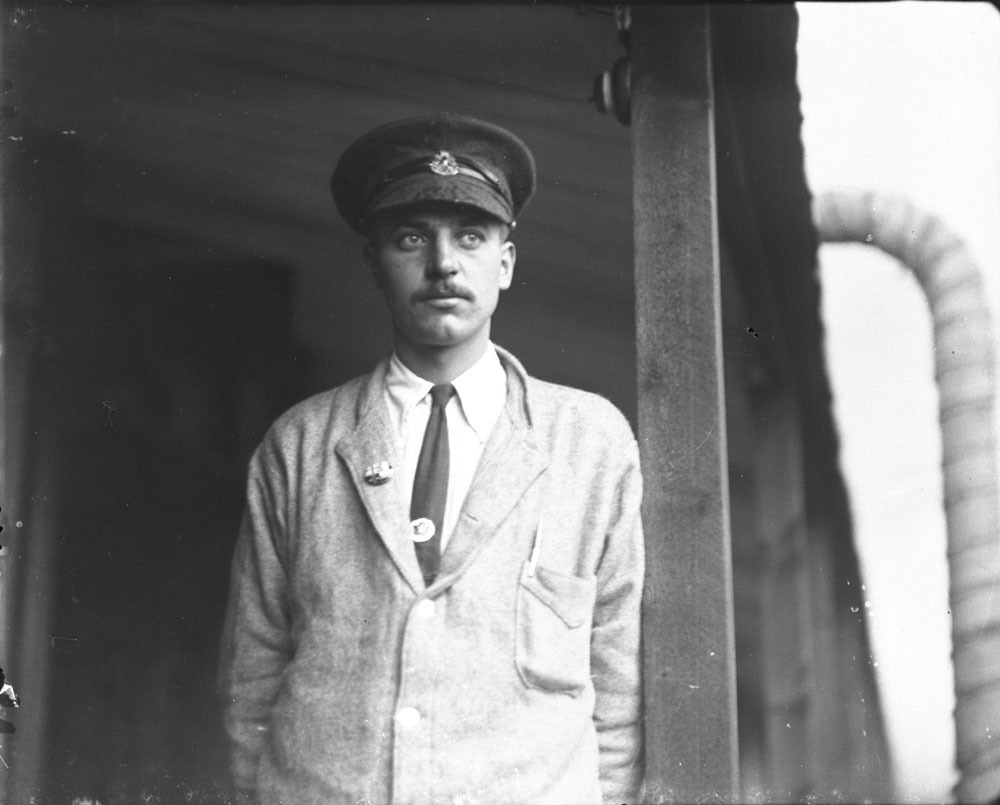
Mount Kinross was named for Private Cecil John Kinross. Originally from England, he had immigrated to a rural Alberta farm with his family at the age of 16. He enlisted in the 51st Battalion, Canadian Expeditionary Force in 1915 and later transferred to the 49th Battalion in France.
C. J. Kinross c. 1914-1919 (Credit: Canada Dept. of National Defence/Library and Archives Canada).
On October 30, 1917, during the Battle of Passchendaele in Belgium, Kinross’s unit was under intense artillery fire. Showing no concern for his own personal safety, he took off alone and charged towards the enemy, killing six soldiers and destroying their machine gun. His action inspired his comrades and their unit to advance 300 yards into enemy territory. Kinross was severely injured in the battle and did not return to the front lines.
Kinross received the Victoria Cross for his act of bravery that day.
His citation announced “he showed marvellous coolness and courage, fighting with the utmost aggressiveness against heavy odds until seriously wounded.” Private Kinross was honourably discharged and he returned to Lougheed, Alberta, where he lived until his death in June of 1957. His Victoria Cross remains with his family and the miniature is on display at the Loyal Edmonton Regiment Museum in Edmonton.
Mount McKean
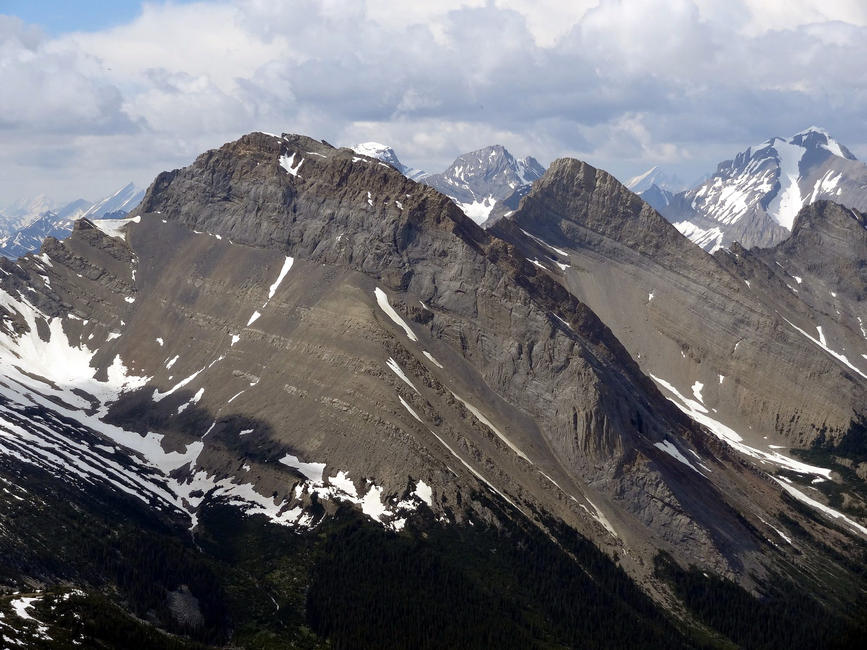
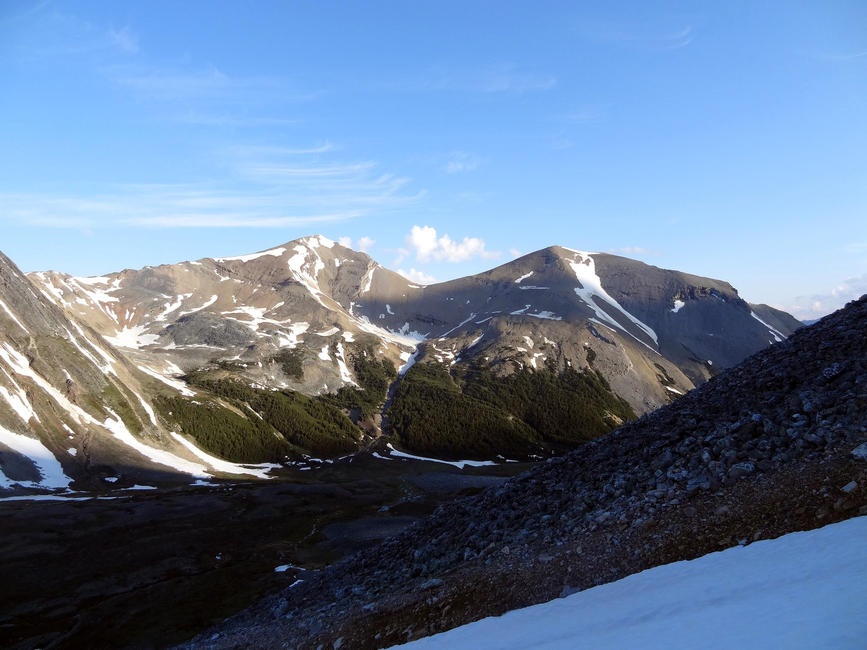
Mount McKean (Courtesy of Mountain Nerd on Summit Search).
Mount McKean is dedicated to Captain George Burdon McKean, who immigrated to Canada from England in 1902 to join his brother on a farm near Lethbridge. He studied at Robertson College, a theological school in Edmonton, and was an assistant minister at the time of his enlistment in 1915. McKean first enlisted as a Private in the 51st Battalion, Canadian Expeditionary Force and later became a Lieutenant in the 14th battalion (Royal Montreal Regiment).
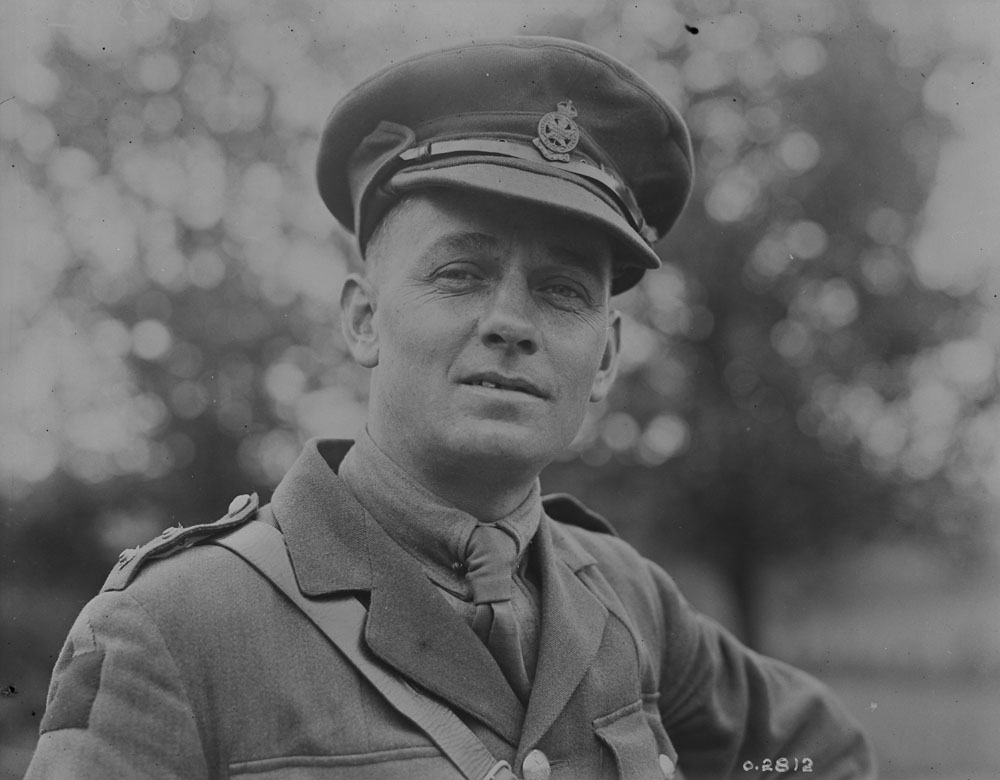
G. B. McKean, 1918 (Credit: Canada Dept. of National Defence/Library and Archives Canada).
In April of 1918, while stationed near Gavrelle, France, McKean led his troops in a raid against German forces. When his men hesitated, McKean took off alone towards the enemy’s heavily fortified trench, taking out two of their soldiers. This move instilled confidence in his unit, who quickly followed to seize the trench and capture its remaining soldiers. Lieutenant McKean was praised for his actions and was awarded the Victoria Cross. His citation reads “This officer’s splendid bravery and dash undoubtedly saved many lives, for had not this position been captured, the whole of the raiding party would have been exposed to dangerous enfilading fire during the withdrawal.”
In addition to the Victoria Cross, McKean also received the Military Cross and the Military Medal for his service during the war. He was later promoted to Captain. After the war, he returned to England. He was killed in an industrial accident in November 1926. In addition to being commemorated by Mount McKean, in 2003, a public square in Cagnicourt, France was named La Place George Burdon McKean. His Victoria Cross is in the collection of the Canadian War Museum.
Mount Pattison
J. G. Pattison c. 1914-1919 (Credit: Canada Dept. of National Defence/Library and Archives Canada).
Mount Pattison is dedicated to Private John George Pattison. He was born and raised in England and moved to Canada in 1906 with his wife and four children. He worked for the Calgary Gas Company. In 1916, at 40 years of age, he enlisted in Calgary with the 50th (Calgary) Battalion, Canadian Expeditionary Force.
In April of 1917 at Vimy Ridge, the 50th Battalion was advancing towards German occupied territory when they were confronted with heavy machine gun fire. Pattison charged forward to face the opposition and hurled grenades at the enemy which allowed him to take out the remainder of the German crew. He was awarded the Victoria Cross for his actions and credited with making further advances possible. Pattison was one of four Canadians to receive the Victoria Cross at the Battle of Vimy Ridge.
A few weeks later, Private Pattison was killed in action on June 3, 1917, during an attack on a German occupied power station in Lens, France. In addition to the mountain named in his honour, Pattison Bridge over the Elbow River in Calgary commemorates his service and sacrifice.
Mount Zengel
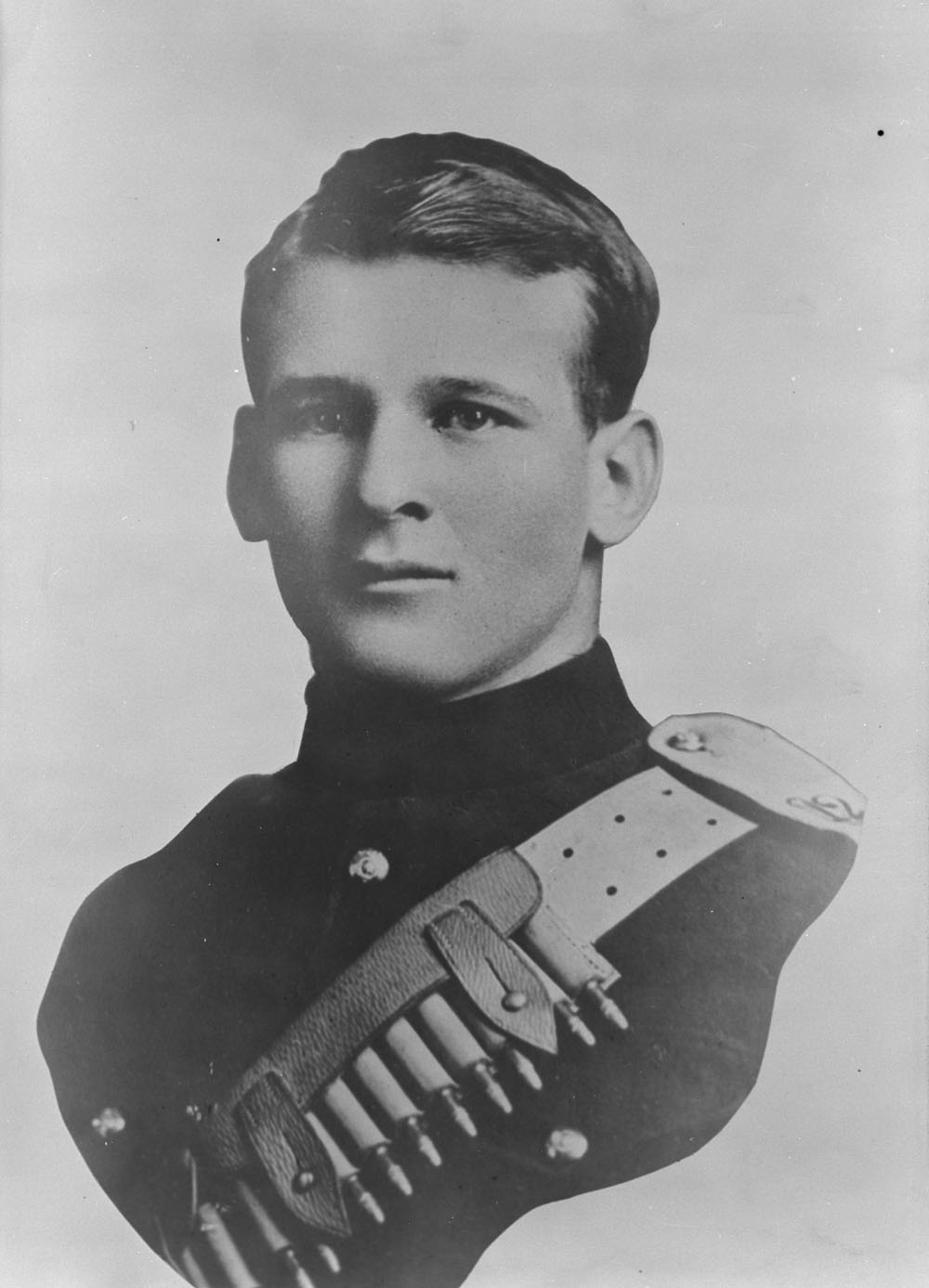
R. L. Zengel c. 1914 (Credit: Canada Dept. of National Defence/Library and Archives Canada).
Mount Zengel is named in honour of Sergeant Raphael Louis Zengel, who came to Canada from Minnesota at a young age. The Zengel family initially settled on a homestead in Saskatchewan before Raphael enlisted to the 45th (Manitoba) Battalion, Canadian Expeditionary Force in 1915. He later became a sergeant in the 5th (Western Cavalry) Battalion.
On August 9, 1918 near Amiens, France, on the second day of a massive campaign against German forces, Sergeant Zengel’s platoon came under heavy machine-gun fire. He rushed ahead and met the defensive unit, killing two of their machine gunners and forcing the others to scatter. He was cited for his excellent work through the attack and for showing utter disregard for his own personal safety.
Sergeant Zengel was awarded the Victoria Cross for his contribution at the Battle of Amiens. (He had previously been awarded the Military Medal for his service at the Battle of Passchendaele). After the war he became a long-time resident of Rocky Mountain House, Alberta. He died in February 1977. Branch No. 8 of the Royal Canadian Legion in Rocky Mountain House is named the R.L. Zengel V.C. to commemorate his award distinction. In 1936, the Geographic Board of Canada named Zengle Lake in Saskatchewan in his honour, misspelling his name in the process.
Mount Zengel on the right (Courtesy of Mountain Nerd on Summit Search).
The tribute to these soldiers in 1951 was made possible by the co-operation of federal and provincial governments. However, at the time, the proposal created controversy. The issue’s resolution would bring about the creation of the Victoria Cross Ranges and an agreement between the Governments of Alberta and Canada still governs geographical naming in in Alberta today. That will be the subject of our next place names post.
Nix, James Ernest. “McKean, George Burdon.” Dictionary of Canadian Biography, vol. 15, University of Toronto/Université Laval, 2005. (Accessed August 29, 2014).
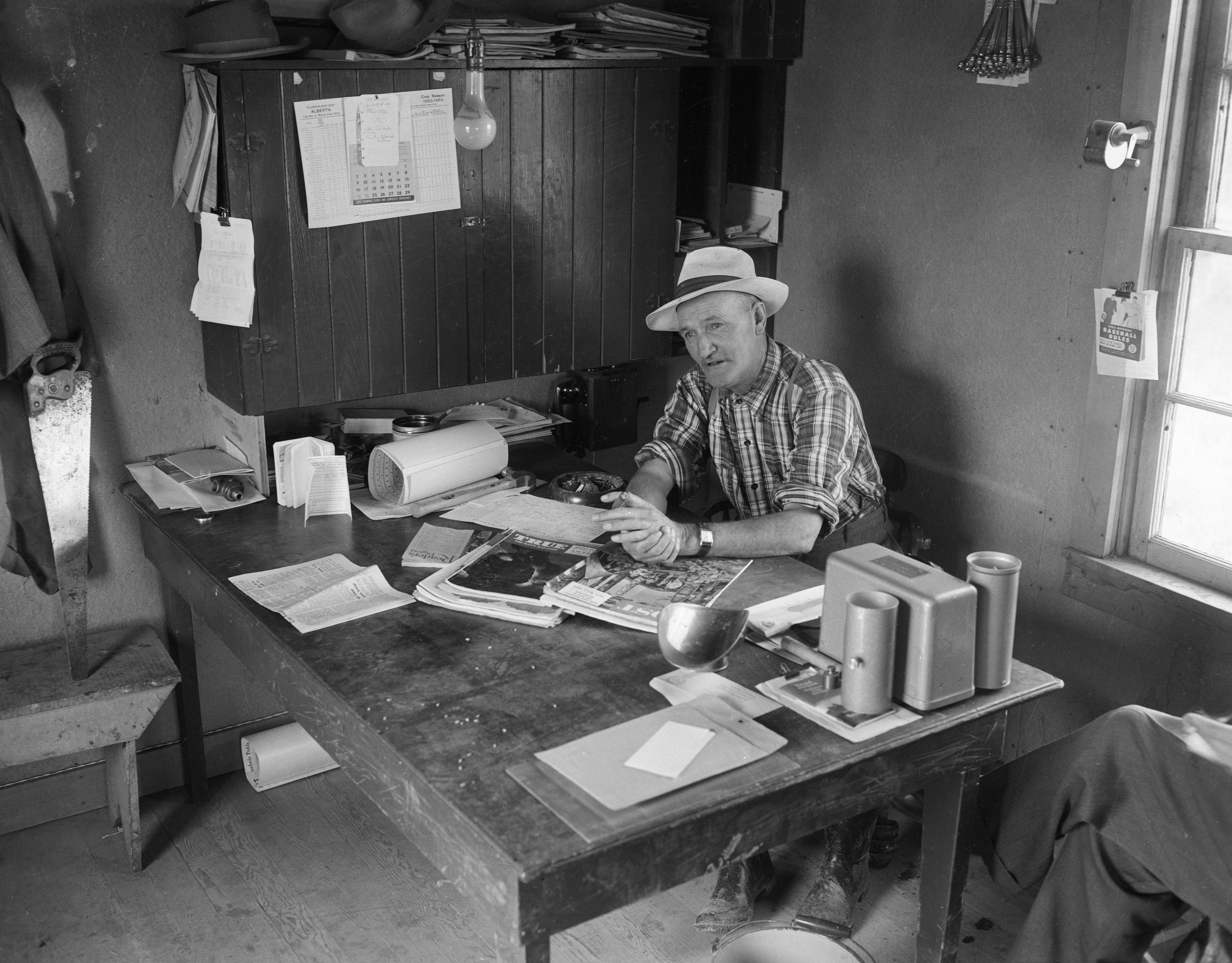
The elevator agent in his office was at the heart of the community, 1950s. (Glenbow Archives, Photo: Glenbow Archives, NA-4510-707.)
It’s when the grain is ripe for harvest in late August or early September that I miss going to our local Alberta Wheat Pool elevator the most. Jumping off the combine and going to the elevator to have its friendly agent, Bill, run a moisture test on a grain sample and discuss the state of the crop was one of my jobs on the farm. When I arrived in Alberta in the 1980s, drinking coffee and shooting the breeze with the neighbours while the elevator agent was busy, was part of the culture, but the old-timer grain farmers could smell change the air. How right they were.
Our closest local elevator, a single composite wood crib facility constructed in 1963, at Eckville, closed in 2001. Since then we rarely visit an elevator. Now we have our own moisture tester, analysis market conditions using the internet, and have our grain trucked from the bins in the yard to the inland terminal at Lacombe or further afield—selling grain over the phone and having it trucked to a concrete silo is not much fun!
Alberta Wheat Pool at Eckville (Photo courtesy of the Alberta Heritage Survey, 79-R0240-13.)
In past decades farmers were in and out of the elevator office in a rhythm that reflected the farmer’s seasonal activity. A major reason to go to the elevator was to update the permit book, which kept a record of the type, quantity and grade of grain delivered as well as the number of acres seeded to various grains, and the acreage assigned to each grain for quota purposes. Canadian Wheat Board regulations required that all grain sales, even to local users, be recorded in the permit book.
The permit book had its origins in the quota system on cereal grains introduced during the Second World War. Beginning with the crop year 1941-1942, farmers were only able to deliver limited amounts of grain, based on their acreage, at certain times. The quota system, administered by the Wheat Board, was designed to prevent the clogging of the grain handling system at a time when production exceeded available markets. It continued after the war in an attempt to give each producer an equal opportunity to sell his or her grain at the Wheat Board price for the crop year.
A farmer’s pay check and hence his loyalty to one grain company over another was ultimately determined by whether he could get space in the elevator to deliver his quota of grain. If there was room, some farmers preferred to haul to the Alberta Wheat Pool or United Grain Growers elevator, lured by the promise of patronage dividends on deliveries in relation to the companies’ profits for the year.
Many farmers made a point of being at the elevator office often, not only to find out what was going on but to establish a good relationship with the agent. They sometimes helped out when the agent was especially busy. In years when the harvest was plentiful, railway box cars were often in short supply and elevator storage space was limited, bonds of friendship, along with a reputation for reliable delivery and honesty might ensure one’s grain would be taken in before the neighbour’s.
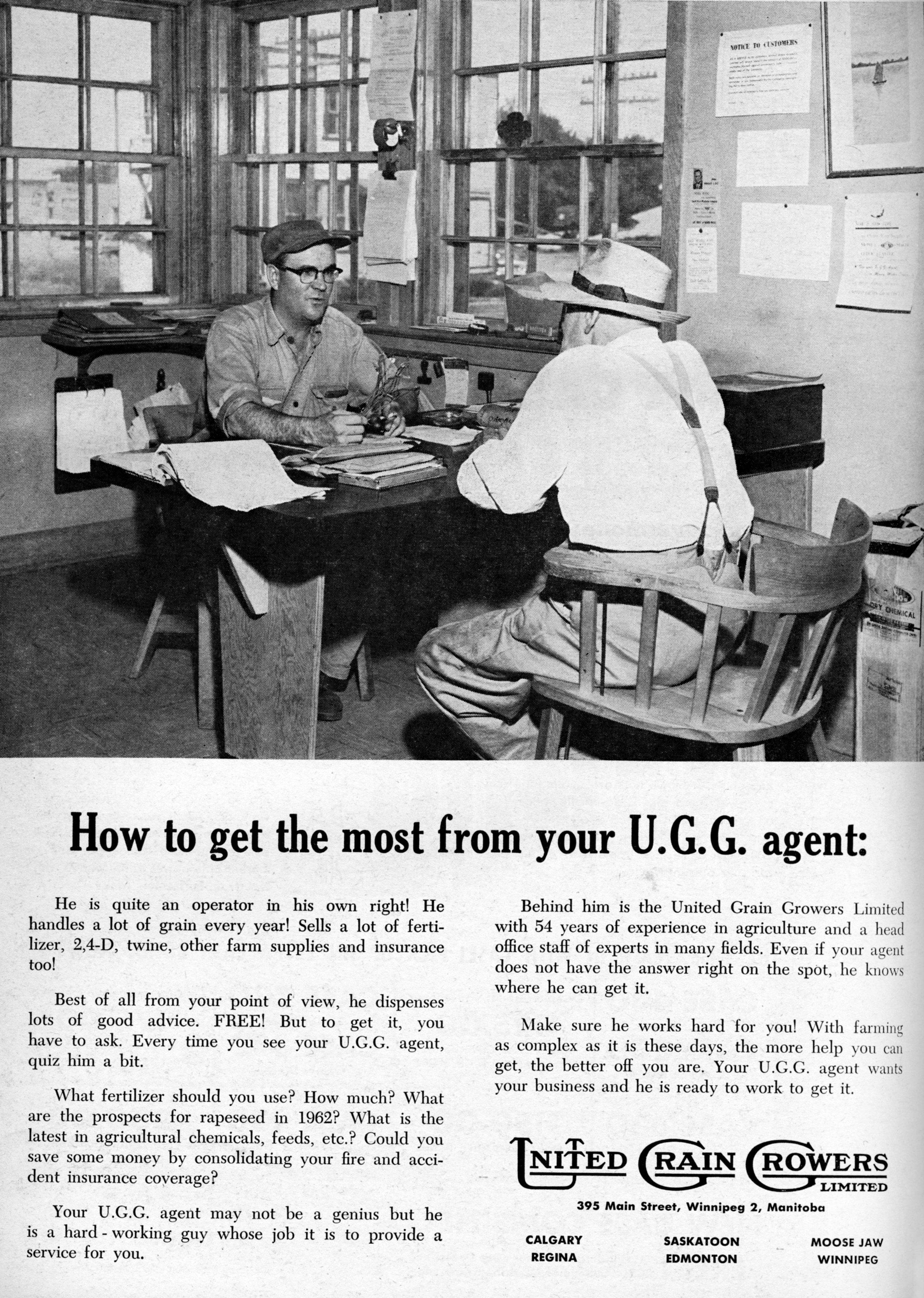
There were a thousand and one reasons why a farmer might be at the elevator other than when he was delivering grain. He bought coal and flour throughout the year, seed in the spring and from the 1950s, fertilizer. He might be in to check prices, find out if there was space in the elevator for his grain or pick up a cheque for grain previously delivered. Farmers needed the use of the scale at the elevator for inter-farm grain sales, and the elevator agent usually obliged.
UGG promoted a new image of their agents as the dispenser of free advice: “How to get the most from your UGG agent,” Country Guide, August 1961, pag e 41. (Reproduced with the permission of the Glenbow Archives.)
There was no need for a business excuse to go to the elevator. On wet days farmers dropped in to see who else was there, play crib or just to complain about the weather. The elevator office was a good place to catch up on local gossip: who had bought a new tractor, who was selling out, who was renting land from who, and to gauge the relative condition of neighbouring crops, as well as shifting land and machinery auction prices.
Farmers gravitated towards the elevator they dealt with and elevator agents played host to groups of farmer-customers in their cramped offices during visits to town. The elevator agent, urged on by his company to network and increase sales, was part of the community, involved in social and sporting events. At Forshee, a long forgotten elevator siding between Rimbey and Bentley, Harry Proudfoot, a U.G.G. agent from 1946-1968, was a member of several athletic teams, and helped his farmer neighbours during haying season and other times when grain deliveries were slow.
Back in the 1930s when elevator agents often had the only radio in the district, broadcasts were a lure for farmers, who might hope to catch more than the day’s grain prices. In the 1990s farmer went to the elevator to catch the farm weather cast and to watch world-wide commodity trading on cutting-edge computers. The farmers gathered whiled away hours discussing every farming topic under the sun. The agent would go off to receive a load or two of grain, and they would often still be there when he returned from the driveway.
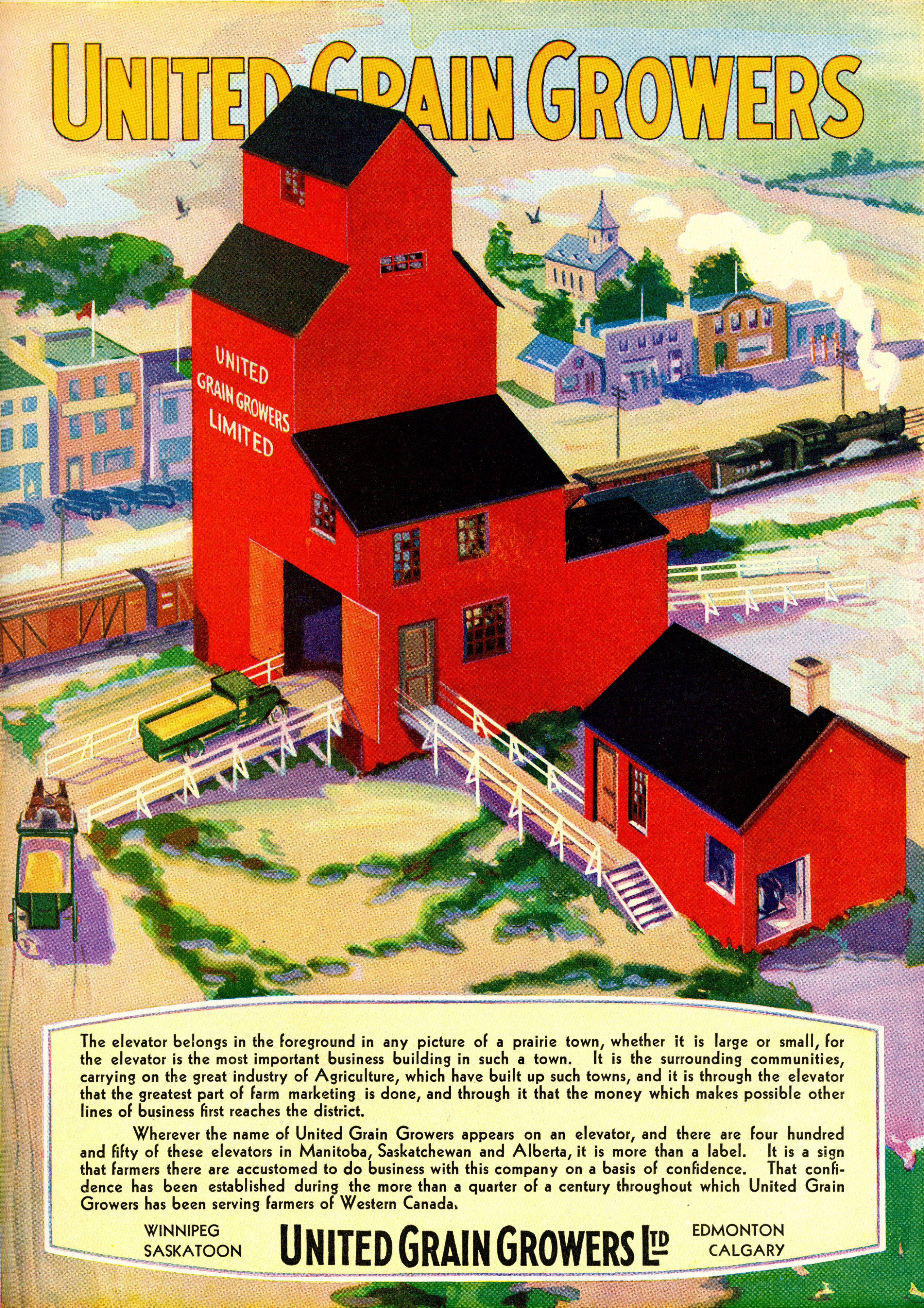
A somewhat idealized artistic perspective on the importance of the grain elevator to the business of the prairie town. Country Guide, March, 1933, page 10, (reproduced with the permission of the Glenbow Archives.)
From the mid-twentieth century, much of the farmer’s economic news, social connections, information about the latest cropping practices, and even family activities and entertainment came through the elevator office as grain companies vied to be foremost in the farmers’ lives and keep their business. All grain companies, especially the farmer-owned Alberta Wheat Pool and United Grain Growers, pushed the image of the grain elevator as the stable symbol of rural life.
It ended for us in 2001. We knew it would happen. We saw elevators topple all over the province after 1995. When Eckville went down in a cloud of dust we did not go to watch. Now in 2014, the Canadian Wheat Board is no more: there are no quotas, no permit book. We market our own grain. Like so many others in the farming community we have lost a connectedness with fellow grain producers and direct involvement with the grain handling system that really was centred in the elevator office.
It’s not an overstatement to say that the final keynote presentation at the 2014 Municipal Heritage Forum in Lacombe blew everybody away. Larry Laliberté, GIS Librarian at the University of Alberta, opened Forum attendees’ horizons with an intriguing presentation entitled, “Historical GIS: Connecting Collections.”
Larry Laliberté presents “Historical GIS: Connection Collections”
In his presentation, Larry described how history’s main mode of communication is narrative, while Geography’s distinctive form of expression is visual. If we begin to connect these two methodologies, as can now be done through Geographic Information Systems (GIS) technology, it opens the doors to new perspectives and insights. This is what Laliberté described as a type of “visual narrative, a spatial story, a landscape liturgy.”
This shift in thinking from text to visual has been described as a kind of “spatial turn” in the way people conceptualize the world around them, past, present and future. In 2012, the Editorial Journal of Map and Library Geographies (8:177-180), put it this way. It is “a change in thinking from finding and retrieving information from text-based means to doing so visually, from geography or location-based methods.”
One only has to be aware of such popular social media as Foursquare to see how popular and ubiquitous this so-called “spatial turn” has become. GIS technology can give us practical and insightful ways to consider and deepen our knowledge of the historic places all around us. Compelling blogs such as #LostYEG: Lost Edmonton explores how the street scape has evolved over time.
The GIS tools now widely available create an opportunity for “Spatial History.” This is an approach to studying or exploring the historic past that “combines and uses a multitude of sources that can be situation in space as well as time.”
Forum attendees attentively taking in the closing keynote presentation by Larry Laliberté on “Historical GIS: Connecting Collections.”
Laliberté used one of his recent projects – which involved historic maps – as a case study to open up the topic for our Forum attendees. He and his team have analyzed 1913-1914 fire insurance plans from the City of Edmonton. These maps were scanned and then geo-referenced with contemporary maps, yielding detailed map layers that could be studied. Additional information gleaned from the 1911 Census allowed researchers to understand in detail the density of the built environment along Jasper Avenue, along with a high degree of demographic detail about the people who lived there at that time. When you mix in archival materials such as historic postcards and other sources, which can be tagged for location, a rich environment of information is created. It was almost something like creating a “Google Streetview,” type of experience for the early 20th century.
As Larry mentioned, this new field of Historical GIS is not an end in itself, but rather a research tool, an approach by which we can access or look at history and historic places. It does not provide the answers to the historical questions we may have, but it certainly does expand the toolkit by which we can begin to construct or unearth those answers.
Halloween is tomorrow. I wanted to take this opportunity to look back at the different ways Halloween has been celebrated in Alberta since the late nineteenth century. Early newspapers offer a fascinating window into how we celebrated Halloween, ranging from private and public parties, to ‘trick-or-treating’ and pranking.
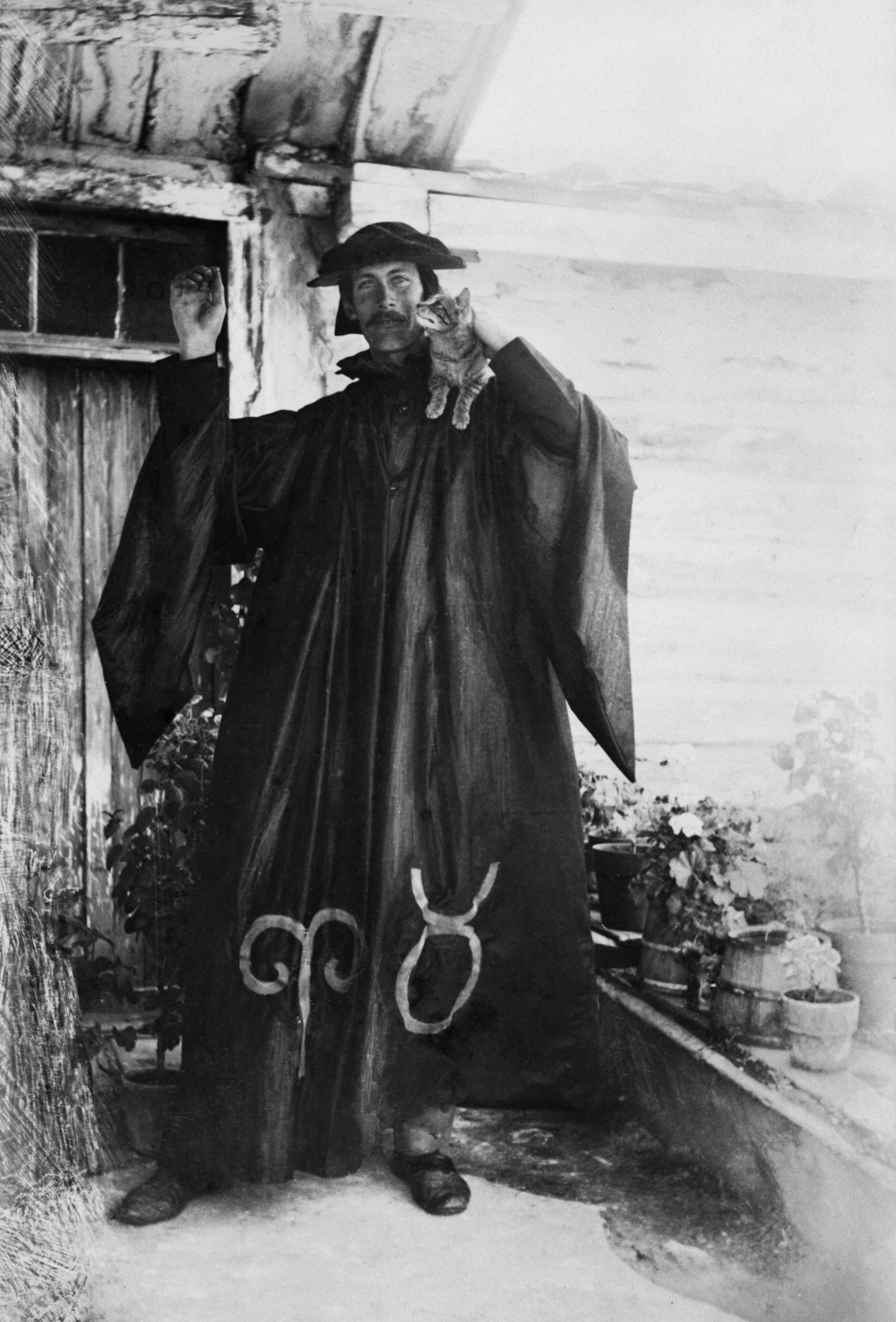
Halloween at the Wineglass Ranch near Brocket (1907-08). Courtesy of the Glenbow Archives, NA-4035-188.
Like most holidays, Halloween is a fusion of ancient and modern traditions. Halloween traces its origins back thousands of years to the Celtic festival of Samhain (October 31 – November 1), which marked the start of the Celtic New Year. It was believed that the boundary between the physical and supernatural worlds broke down during Samhain, and spirits, ghosts and fairies could cross over and walk the earth. The festival was Christianized in the ninth century becoming ‘All Hallows Day’ (November 1, now generally called ‘All Saints Day’). Though Christianized, many of the customs associated with Samhain endured, particularly among the Celtic peoples of Ireland, Scotland and Wales. These cultural traditions were brought to North America by waves of immigrants and evolved into what we know today as Halloween.
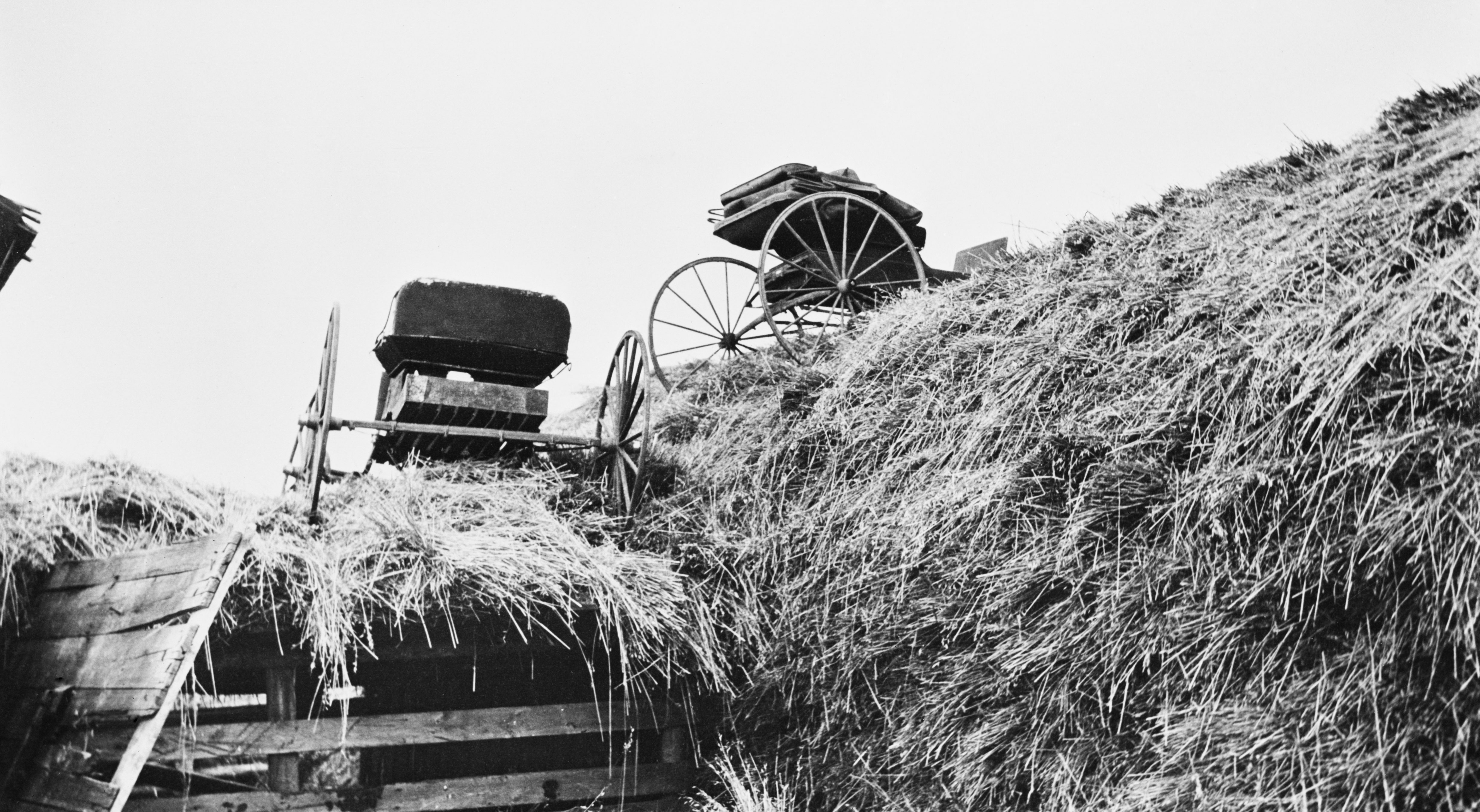
From the start Halloween in Alberta was marked by “general nuisance” and “sundry pranks,” such as soaping windows, unhinging gates, or moving property. Reporting on Halloween in Innisfail in 1897, the Calgary Herald noted that “several small buildings took the usual trot around town during the evening.” Generally speaking, these items were left where they could be found – the goal was to create a nuisance, not to steal. Occasionally, however, people were left searching for their property the next day. In 1925, a farmer posted a notice in the Red Deer News requesting that the “Halloween revellers” who removed his garden gate “kindly return the same forthwith or indicate…where they have taken it.” Carriages and cars were also popular targets for Halloween pranksters, who enjoyed taking them for a joyride. Such tricks occasionally had unforeseen consequences: One prankster in Rockyford, for example, got more than he bargained for in 1919 when he took a car for a joyride, only to find that there was a baby asleep in the backseat. After a frantic half-hour of searching, the car was found abandoned at the town’s bank, and the baby was found “fast asleep as if nothing had happened at all.”
Aftermath of Halloween pranking in Airdrie (1930s). Courtesy of the Glenbow Archives, NA-598-12.
The boundaries of acceptable behaviour on Halloween were quite clear – pranks that could be rectified with minimal expense or effort were considered harmless fun, but any destruction of property was strongly condemned. The Edmonton Bulletin commented in 1912 that Halloween was a “recognized night of immunity from punishment” for pranksters, provided that “no serious depredations were committed.” Similar comments from newspapers across Alberta suggest a broad tolerance for relatively benign pranks, though it is also clear that this tolerance had limits. Halloween in Edmonton in 1917, for example, was marked by significant destruction of property – Chinese laundries were targeted for vandalism, sidewalks were torn up, and many fences and outbuildings were heavily damaged or destroyed. The Edmonton Bulletin expressed indignation at the night’s events, denouncing revellers as “youthful marauders” and commenting that their actions had “quite passed the limits of joking.” The Raymond Recorder struck a similar tone in a 1932 editorial pleading for a “Sane Halloween.” “Why is there any amusement in destroying private property?” asked the clearly frustrated editor, who issued a rather ominous warning to potential troublemakers: “any person who is the victim of meddlesome pranks on Halloween night…is quite within the law in protecting his property, and if anyone is hurt, the trespasser is entirely at fault.”
It is also clear from newspaper coverage that different standards of behaviour were expected from boys and girls. Minor social disorder on Halloween was clearly viewed as a by-product of youthful exuberance and a rite of passage –for boys. Most newspapers were very clear that Halloween pranks had been carried out by “the boys of the town” or “the male portion of the population.” In 1914, the Didsbury Pioneer urged the “boys and girls” to “conduct themselves properly in their fun and not damage other peoples’ property,” but such statements explicitly suggesting that girls participated in pranking are very rare. The extent to which girls actually took part in Halloween disorder is unclear, but such behaviour would clearly have not been socially acceptable.
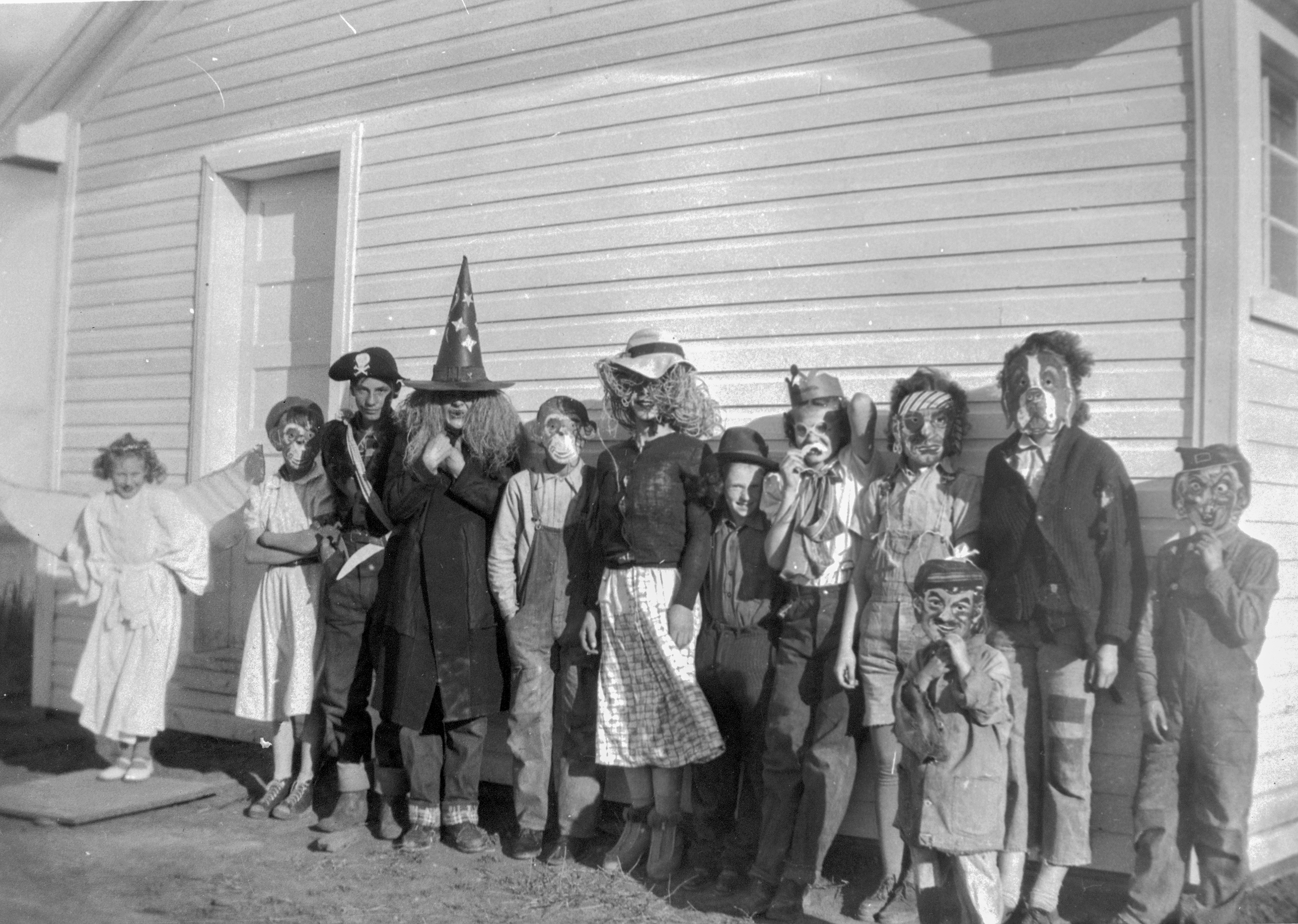
Trick-or-treating near Little Smokey River (ca. 1950). Courtesy of the Provincial Archives of Alberta, A15910.
For those Albertans who wanted no part in pranking, Halloween offered many other opportunities for celebration. Archival photographs and newspaper stories reveal that private costume parties have been a part of Halloween fun in Alberta since the late nineteenth century. Similarly, a wide range of clubs and societies hosted costume parties for their members. The Edmonton Caledonian Society pointed with satisfaction to the Celtic roots of the holiday, inviting its members in 1908 to “celebrate this old-fashioned Scottish festival” (as late as 1919, the city’s Scots were promoting Halloween as a “peculiarly Scotch night”). During World War One, Halloween balls doubled as fundraisers for causes associated with the war effort, such as the Red Cross and the Returned Soldiers’ Fund. Such events offered people a respectable way to celebrate Halloween, free from any association with pranking or social disorder.
The most famous activity associated with Halloween, of course, is ‘trick-or-treating.’ The practice of going door-to-door in costume asking for food may echo cultural traditions that date back hundreds of years to the British Isles. The use of the term ‘trick-or-treat’ – and the implied promise that giving youth a treat will stop them from taking your carriage for a joyride – appears to be a North American phenomenon. “The kids are expected to be out in full forces on their quest for Halloween treats” remarked the Western Globe in 1938, “and the old cry of ‘Trick or Treat’ will be the password.” The popularity of ‘trick-or-treating’ took off after World War Two, and the annual custom anchored itself as the most characteristic practise associated with Halloween night.
From the ancient customs of Celtic Britain to the practise of dressing up and collecting candy from strangers, Halloween has undergone a significant transformation over the past several thousand years. However you choose to observe the day, have a safe and happy Halloween!
Written by: Allan Rowe, Historic Places Research Officer.
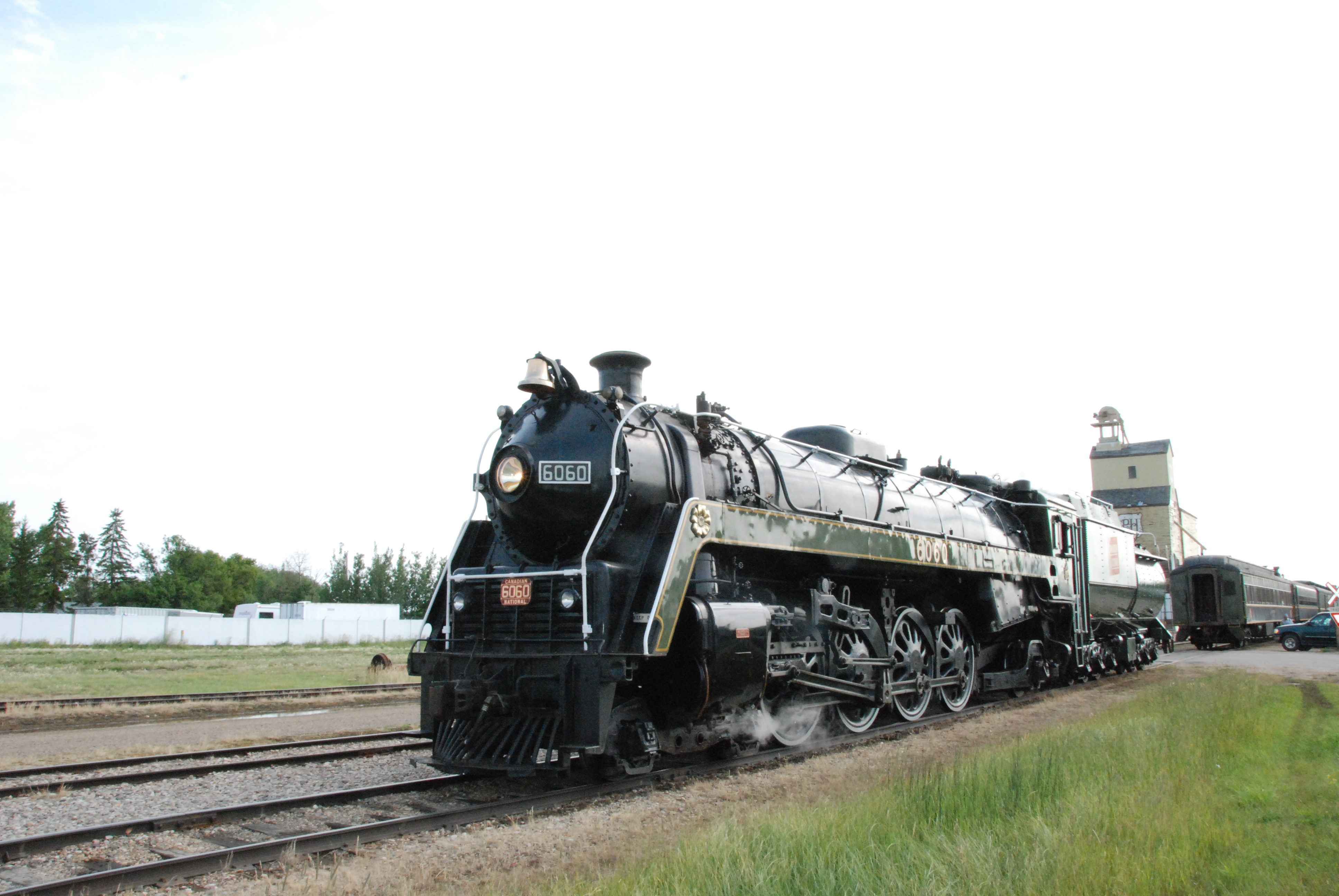
Canadian National Railways Steam Locomotive 6060 in Stettler (2009). A unique Provincial Historic Resource.
As Manager of the Historic Places Research and Designation Program, one of Brenda Manweiler’s primary responsibilities is the Provincial Historic Resources Designation Program. The goal of the Provincial Historic Resources Designation Program is to identify, evaluate, and designate those historic resources that are most significant to the province as a whole. Currently there are some 360 sites protected as Provincial Historic Resources in Alberta, with several more added every year.
The designation program is almost entirely driven by citizen input. Applications for provincial designation come from the public, usually the property owner but sometimes also from other individuals or groups concerned about the long-term future of a resource.
Once a resource is designated, its owner cannot destroy, disturb, alter, restore, or repair it without written approval from the provincial government. But the owner gains tangible benefits, including access to conservation grants and technical advice, and the intangible benefit of knowing that a valued property will be preserved and protected into the future.
Brenda feels these citizen advocates could take even greater advantage of the Provincial Historic Resources Designation Program if they better understood the designation criteria. Here are some key things she’d like people to know:
A property doesn’t have to be grand or architecturally detailed, nor associated with some famous person to be designated. It doesn’t even have to be a building.
“I would love to see more of these unique historic places,” she says. “One of the gaps that we have in our family of historic resources is sports and leisure sites,” she continues. “Canada is such a hockey country; Alberta is such a hockey province. Where’s an ice rink? Where’s the baseball field? I’d love to designate some sites that help to celebrate Alberta’s strong history in athletic pursuits.”
Provincial designation isn’t better than municipal designation, just different.
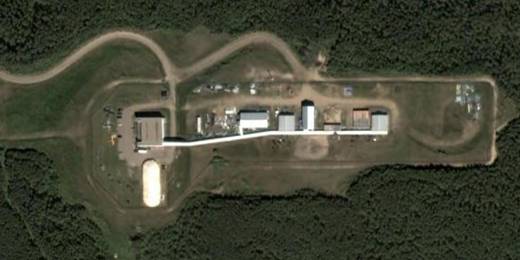
Northern Defence Radar Station, Cold Lake
Brenda explains: “Provincial significance is determined by looking through a pretty big lens. Is this site significant to all Albertans? Has the site helped shape the province into what it is today? Municipal designations have a narrower scope, a local lens to look through to determine significance.” But a municipally designated site can be just as significant as a provincial one—often even more so—within its own community context. Both levels of designation offer the same form of protection: the resources cannot be altered without approval from the designating authority.
She continues: “We have a variety of sites throughout the province that have been designated as both Municipal and Provincial Historic Resources. People might think that’s just duplication, so why bother? But I think it’s important to note the perspective that we come at it from. A provincial point of view is going to be lot different than a local perspective, so a site could end up being designated under both categories for different reasons.”
An example is Calgary City Hall, which is designated by the federal, provincial, and municipal governments. Both the provincial and municipal designations recognize the building’s significance as Calgary’s seat of government, and as an excellent example of Richardsonian Romanesque architecture. But the municipal designation also notes that it is “the earliest known example of steel-frame construction in Calgary” and that it was designed by a prominent Calgary-based architect.
Designation is not just about the sites and structures; it’s also about people and how they’ve used these places.
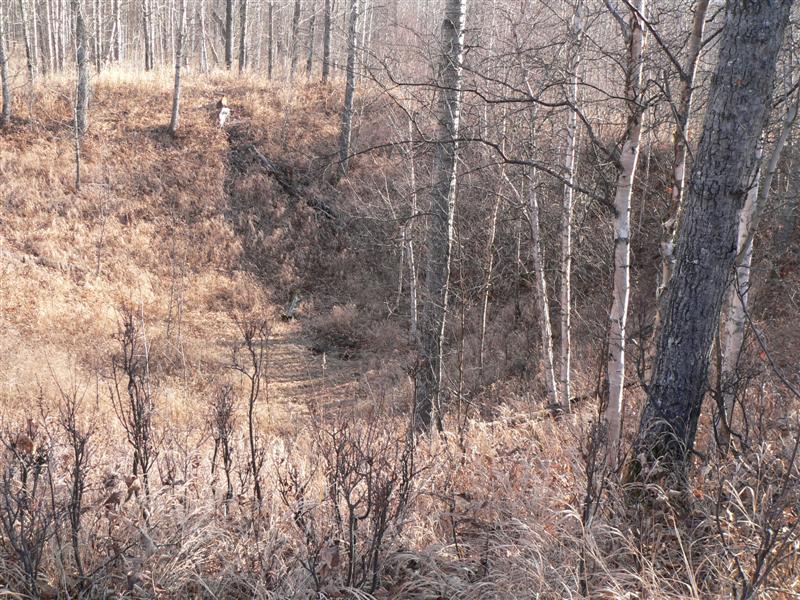
Looking down into the Whitecourt / Woodlands Meteorite Impact Crater (2007)
The most modest or ordinary place could be where a remarkable person lived or worked, or where some once-crucial, unusual, or game-changing human activity took place—and that’s what makes the site historically significant.
One of Brenda’s favourite examples is the Owen Residence/Dominion Meteorological Station in Edmonton. Inside this ordinary American four-square dwelling was “arguably the most significant meteorological post outside of Toronto” (according to the Statement of Significance). Even more remarkable, it was operated by “Weather Lady” Eda Owen, one of the few female meteorologists in the world working at a major station.
Another very modest but significant place is the Community Rest Room in Ponoka. When farm families came into town to conduct business, men could congregate in their choice of hotels, bars, and pool halls. This facility provided a much-needed retreat for women and children, offering not only toilets and showers but also a safe and social meeting place—and even a venue for political organizing.
“So much of the significance associated with Provincial Historic Resources comes down to the unique stories—the events, people, and places that have helped to make Alberta what it is today,” Brenda says.
The Alberta Historical Resources Foundation gives out Heritage Awards biennially. The Heritage Awards recognise individuals and groups work to conserve, protect and interpret Alberta’s rich and diverse heritage. The 2014 awards ceremony took place in Red Deer on October 16th.
The ceremony was a great night where some very worthy Albertans were recognized for their work in conserving and interpreting Alberta’s heritage. Our very own Gary Chen, Heritage Conservation Advisor (and shutter-bug extraordinaire) was on the scene. We have some great pictures from the awards ceremony we’d like to share with you.
The staff of the Historic Resources Management Branch congratulate each and every award winner. The tireless work they do in preserving Alberta’s heritage is welcome and appreciated, by us and many, many other Albertans. We couldn’t do what we do without the support and encouragement of people such as these.
The 2014 Alberta Historical Resources Foundation Heritage Awards ceremony in Red Deer, Alberta.
Wheatland County won a Heritage Conservation Award for the Gleichen Water Tower. Rex Harwood accepts the award on behalf of the county.
CommunityWise Resource Centre received a Heritage Conservation Award for restoring the façade of the Old YWCA building in Calgary. Philip McCutcheon accepts the award on behalf of CommunityWise.
The father-daughter team of Emerson Sanford and Janice Sanford Beck accepted a Heritage Awareness Award for Life of the Trails series of books.
The Edmonton Historical Board won a Heritage Awareness Award for the Edmonton Architectural Heritage Website. Ann Hall and Leslie Chevalier accepted the award on behalf of the EHB.
The Fort Saskatchewan Historical Society won a Heritage Awareness Award for organising the Peoples of the North Saskatchewan Festival. Ray Thurston accepts the award on the society’s behalf.
Jonathan Koch won a Heritage Awareness award for his work on Forgottenalberta.com
The St. Jean Baptiste Historical Society received honourable mention in the Heritage Awareness Category for organising the Retrouvailles 100th Anniversary Homecoming. Gerry Nicolet accepted the award on the society’s behalf.
The City of Medicine Hat won the Municipal Heritage Preservation award. Earl Morris (left) and Malcolm Sissons (right) accept the award.
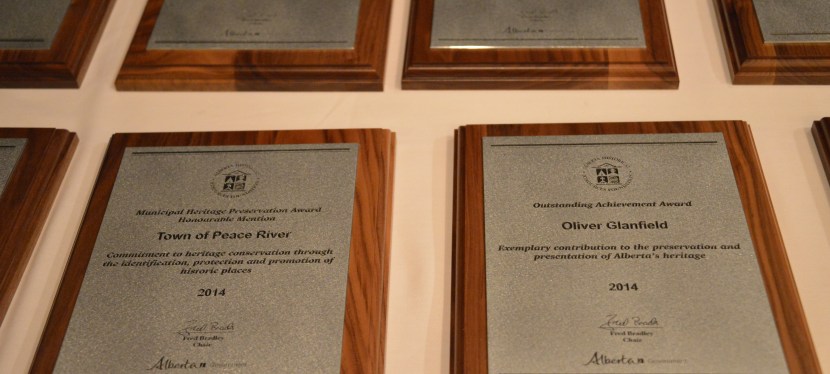
The Town of Peace River was given Honourable Mention in the Municipal Heritage Preservation category. Laura Gloor and Kate Churchill accept the award.
Oliver Glanfield won an Outstanding Achievement Award for tirelessly promoting the history of northern Alberta, particularly the community of Fort Chipewyan.
Marshall Rolling won an Outstanding Achievement Award for his work as a historian, curator and archivist in the community of Fairview.
Glenys Smith won an Outstanding Achievement Award for her work with the Camrose Heritage Railway Station and Park since 1999.
All the winners of 2014 Heritage Conservation Awards.
Written by: Michael Thome, Municipal Heritage Services Officer.
A big thank you to everyone who helped to make our first Municipal Heritage Forum held outside of Edmonton and Calgary a huge success! We are very grateful for all of you who took the time to attend, contribute presentations or assist with logistics. We hope everyone had an enjoyable time, met some new people and learned about Alberta’s historic places.
Forum attendees in front of Lacombe’s first Municipal Heritage Resource, St. Andrew’s United Church
We look forward to seeing many of you at the 2015 Municipal Heritage Forum that will be held in conjunction with the Heritage Canada The National Trust conference in Calgary from October 22-24. Stay tuned for information on how you can access one of the free registration passes to what is sure to be a fantastic event.
Written by: Rebecca Goodenough, Municipal Heritage Services Officer
Writing-on-Stone Provincial Park is nestled into the winding valleys and coulees along Milk River in Southern Alberta. Painted and carved on its fragile sandstone walls are one of the largest collections of rock art in North America. Appropriately named, Writing-on-Stone is a rocky canvas of ancient and historic art that spans many centuries.
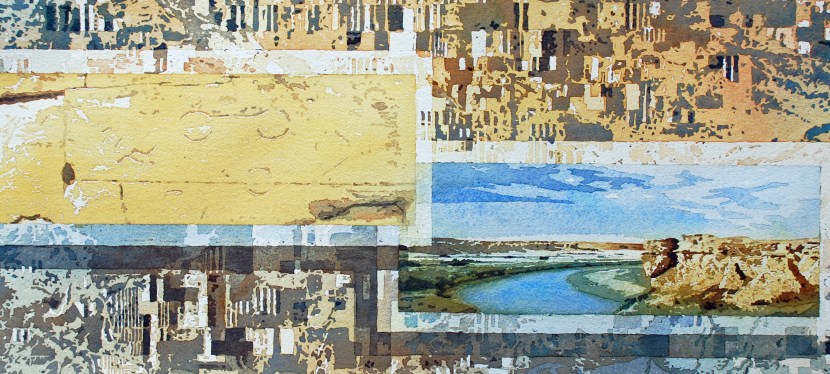
To increase awareness of this unique piece of the past and to encourage the preservation of sensitive historic resources, a collaborative team of the Historic Resources Management Branch, the Royal Alberta Museum, and the University of Alberta initiated the Heritage Art Series project. The goal is to create artwork, like the piece depicted above, that captivates the public in order to encourage the appreciation and protection of Alberta’s past.
Rock Art in Alberta
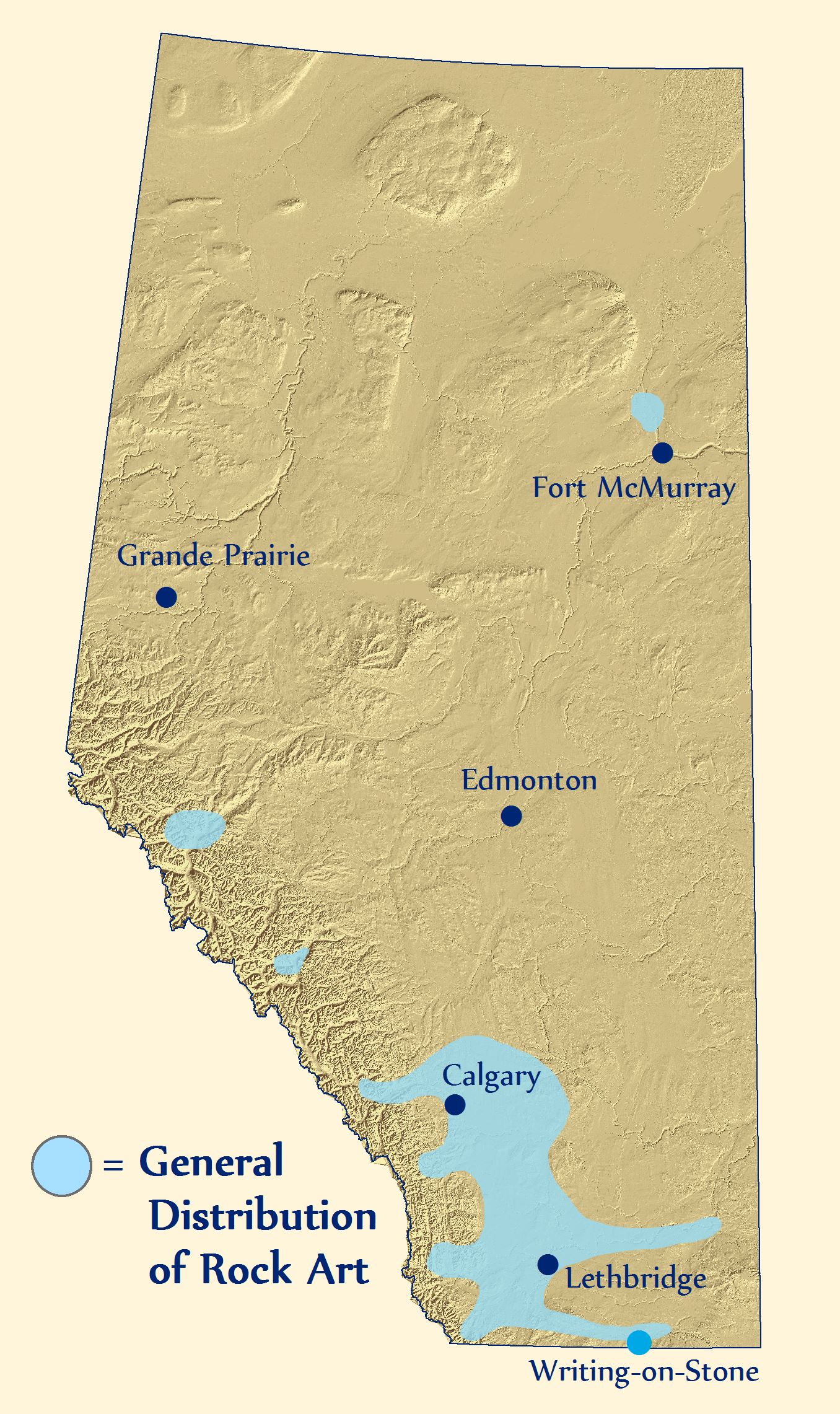
Alberta’s rock art includes pictographs (paintings), petroglyphs (engravings), carved boulders, and effigies (rocks arranged to form shapes). Art that was applied to rock walls has a variety of functions and there are six major types in Alberta.
This map depicts the general extent of recorded First Nations rock art in Alberta.
‘En Toto Pecked’ involves figures that were entirely pecked out of the rock wall and this tradition of art appears in Alberta from 2500-1500 years ago. It is thought to have originated in Wyoming.
‘Vertical Series’ may be a type of rock art that acted as a communication system that related events and actors. It may be ideographic (like Egyptian hieroglyphs) with name glyphs like the Mayans of Central America.
‘Columbia Plateau’ refers to vision quest or hunting ritual art thought to be made by people originally from interior B.C. This style of rock art ranges from a few hundred to several thousand years old.
‘Foothills Abstract’ is a rock art style that consists of enigmatic shapes and motifs that may be the work of religious figures. Subjects include handprints, animals (and their tracks), and stylized humans.
‘Plains Biographical’ refers to rock art that documents events, important figures, or tallies of things acquired/exchanged by the Blackfoot and their ancestors.
Lastly, ‘Plains Ceremonial’ refers to spiritually important rock art that is still of great significance to modern Blackfoot Nations. Out of respect for the power of these and other rock art images to modern First Nations, photographs of the various styles of rock art are not included here.
The Milk River Valley Through Time
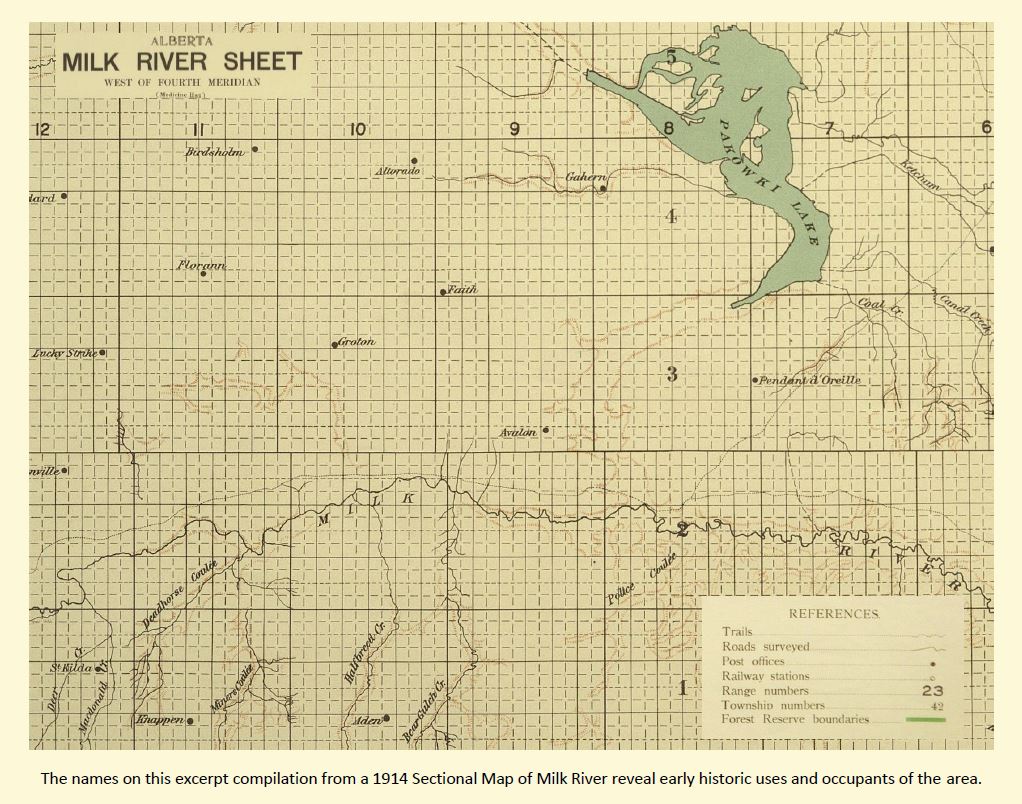
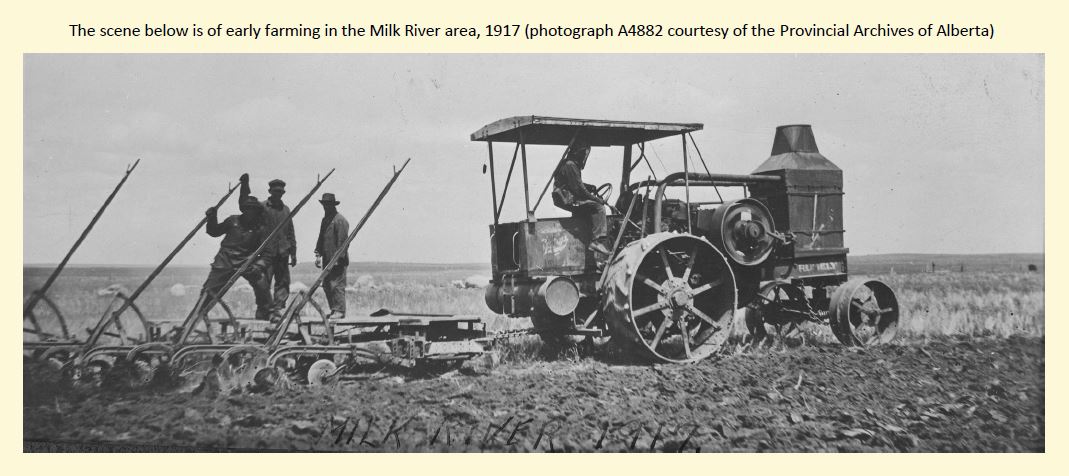
First Nations pursued buffalo herds in the Milk River region and view the valley as a sacred place where stories and dreams were recorded on the rock walls. The earliest Europeans included a mix of traders, coal miners, and Northwest Mounted Police, the early history of which is still recorded in modern place names.
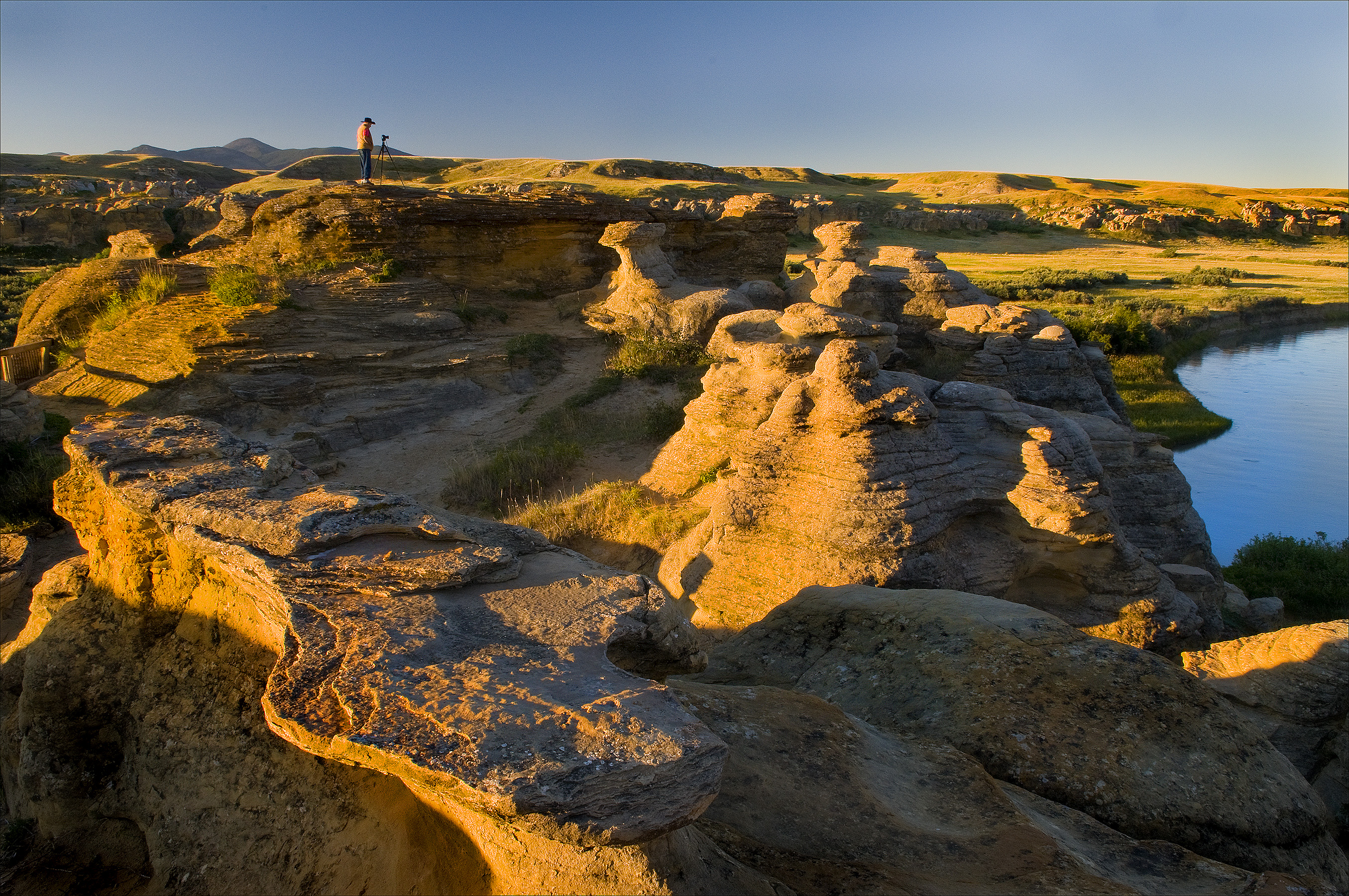
Cattle quickly replaced a vacancy left when buffalo were eliminated in the late 1800s. In addition to ranchers, new irrigation techniques and canals opened up the area to more intensive cultivation. Modern users of the Milk River landscape include farmers, Kainai First Nations, oil and gas operators, ranchers, and people in the tourism industry associated with Writing-on-Stone Provincial Park and National Historic Site (the photograph below is of the morning light on the park’s sandstone hoodoos, courtesy of Robert Berdan). Just as the uses of the Milk River region have changed in the past, they will continue to evolve in the future.
The above painting by Anne McCartney is a textured narrative of landscape change in the Milk River Valley. The background is from an aerial photograph showing irrigated fields creeping to the valley’s edge. At lower right is a looming sandstone cliff that has witnessed a steady flow of First Nations, traders, miners, explorers, and farmers passing through the valley. In the upper left is a rock art panel depicting a battle scene from the deep past. Recent vandalism of that very panel highlights the need to protect and appreciate the landscape of Writing-on-Stone.
Protecting Rock Art Landscapes
The evocative and significant collection of art at Writing-on-Stone is under constant threat. Sadly, vandalism and graffiti have defaced some of the park’s art but through education and restricted access, much of the vandalism has now been curtailed. Instilling visitors with a healthy respect for the spiritual importance of the area to the modern Blackfoot will help ensure that the landscape is protected. Natural erosion, however, is unstoppable.
Much rock art has disappeared over the centuries from weathering of soft sandstone. New technologies are helping to better document the art and may lead to long term methods that slow rates of erosion. The park has been a key site in North America for experimentation with techniques to protect rock art.
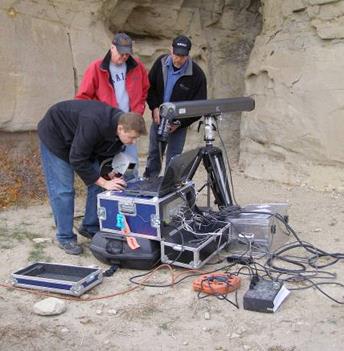
Archaeologists use laser scanners to accurately record rock art panels.
Portable laser scanners have been used to record high-quality images and to produce near-perfect replicas. Artificial drip-lines and plastic caps are diverting water from some exposed panels and a consolidant has been applied in experimental non-rock art locations to test the ability to strengthen rock and prolong the life of rock art images. Note that none of the preservation measures will be applied directly to ancient images without thorough review and cooperation with the Blackfoot people. Rock art left in its natural setting will eventually be lost, but there is much that can be done to enable a prolonged period of appreciation and enjoyment from viewing the hopes and dreams of early artists.
Written by: Todd Kristensen, Northern Archaeologist, and Jack Brink, Royal Alberta Museum