Written by: Fraser Shaw, Heritage Conservation Advisor
If you’ve ever driven down the beautiful Cowboy Trail, chances are you’ve driven by at least a few historic ranches. Some of these ranches, like Bar U and E.P., have been operating for over a hundred years.
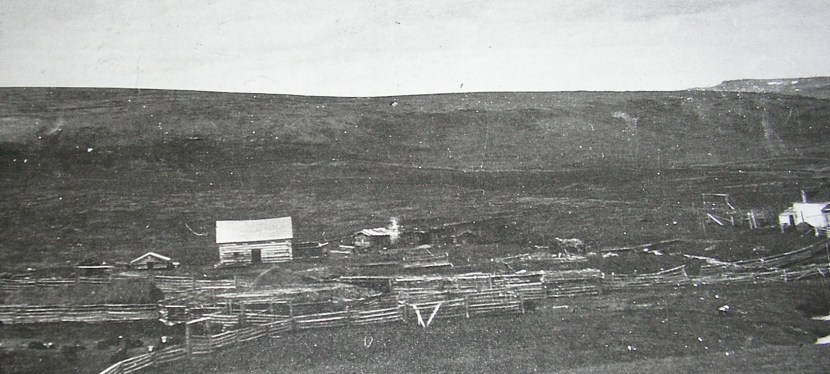
Another of those ranches is the Circle L Ranch, started by a storekeeper from Salt Lake City in the late 1800s. The site recently underwent a restoration project to help ensure historic small-scale ranching in remained intact and accessible. The ranch is a Provincial Historic Resource and an excellent example of an early family-run ranch in southern Alberta.
In June, we featured several buildings that the City of Lethbridge recently designated as Municipal Historic Resources (MHRs). But Lethbridge isn’t the only city that has been actively protecting its heritage resources and listing them on the Alberta Register of Historic Places. Over the past few months, the City of Lacombe has designated five places as MHRs and added them to the Alberta Register of Historic Places.
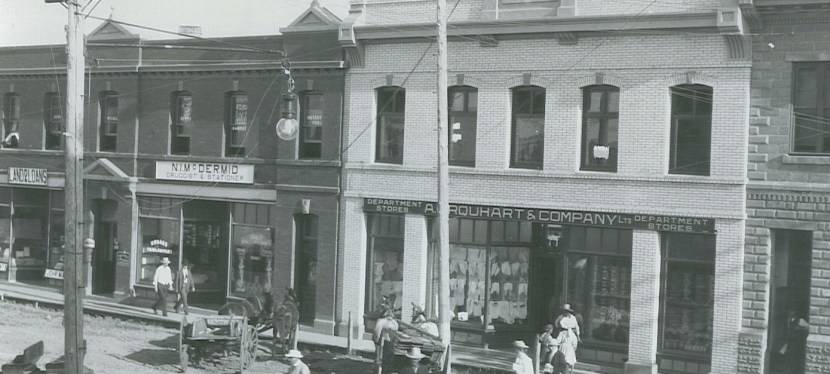
Lacombe has been one of Alberta’s most active communities in protecting its historic places. As an early community in the former Alberta Main Street Program, Lacombe has restored and maintained one of the largest historic downtown cores in the province. As of June 1, 2019, there are six sites in Lacombe designated as Provincial Historic Resources and seven designated as Municipal Historic Resources.
Written by: Todd Kristensen, Regional Archaeologist, Archaeological Survey of Alberta
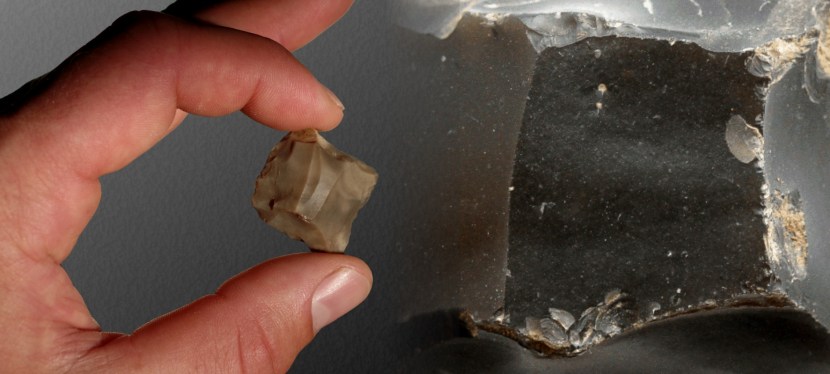
Did you know that for over 200 years, guns around the world had a specific part made of stone that archaeologists have found evidence of in Alberta? Gunflints are chunks of rock that generated sparks to ignite gunpowder. Their use in guns first appeared in Europe in the early 1600s. Most of Alberta’s earliest guns were muskets, which began replacing bows and arrows in the province in the late 1700s.
Gunflints reveal lots of information about fur trade life in Alberta and they tell archaeologists important details about when guns first arrived and who first brought them. Patterns of gunflints at archaeological sites can show where gun repairs took place or where the flints were stored. Historic records of the number of traded gunflints can tell us which forts were specializing in certain tasks and how many hunters or trappers they were supplying. In general, gunflints are interesting historic artifacts that are often the only preserved record of a weapon technology, flintlock firearms, that ultimately changed the West.
Muskets had a metal piece called the flash pan that was mounted on the outside of the gun and held a small pile of gunpowder protected from wind and rain by a movable lid (a ‘frizzen’). When the trigger was pulled, the gunflint pushed the frizzen, opened the flash pan, and created a spark. A small explosion of gunpowder on the outside of the gun (the ‘flash in the pan’) was then sent through a hole to a larger load of powder inside the musket barrel. This explosion then launched the musket ball towards future food or enemies.
Diagram of how flintlock guns worked (by Todd Kristensen).
Flintlock guns were used in North America before 1650, and, in parts of the West, gunflints were used well into the late 1800s. While a technology called percussion caps began replacing the flintlock in the mid-1800s in North America, guns were still hard to come by and flintlocks had a certain durability that kept them in use.
Editor’s note: The following blog post is part two of a two-part series looking at the history and influence of Doukhobors in Alberta. Read part 1 here.
Written by: Matthew Wangler, Historic Resources Management Branch
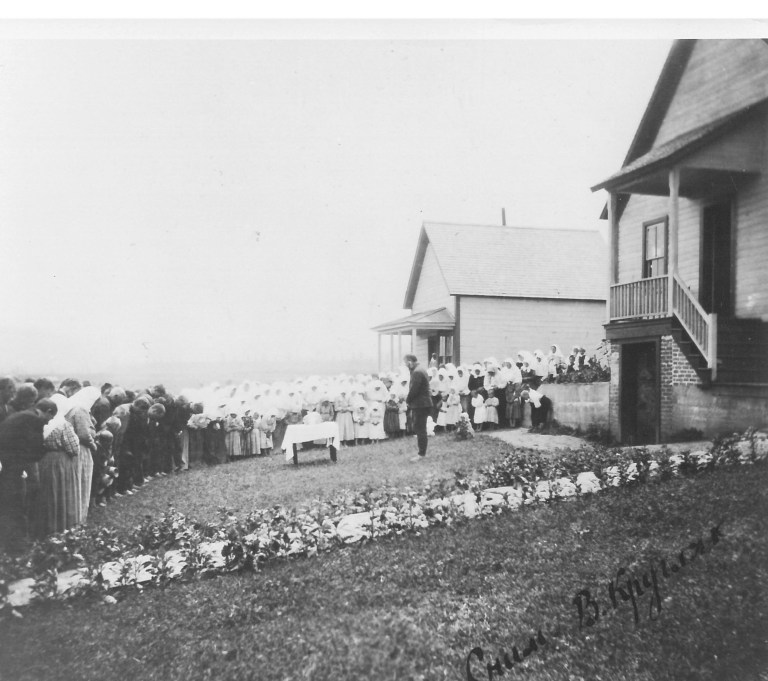
Following the establishment of the community in British Columbia, Verigin sought to diversify and strengthen the Doukhobor economy by purchasing new land in southern Alberta. It was not the first time that the Doukhobors had considered Alberta as a home for their community. In 1898, members of a Doukhobor delegation had initially explored purchasing land near Beaverhills Lake by Edmonton, but the proposal was scuttled, as local Member of Parliament Frank Oliver was opposed to their presence. While some Saskatchewan Doukhobors were working in Alberta as agricultural labourers and construction workers in 1911 and 1912, the first Doukhobor villages in the province were established in 1915 in the Cowley/Lundbreck area. Additional land was purchased in the following years, and Verigin arranged to rent land in the Vulcan area on a crop-share basis. The Alberta Doukhobors dedicated themselves to growing grain and raising horses and cattle. The settlements were successful, and at their peak, they boasted 300 members in 13 small villages. The communities tended to 300 horses and 400 shorthorn cattle, and produced 100,000 bushels of grain annually; they also constructed two-grain elevators and a flour mill. The Doukhobors seemed well-suited to the physical landscape of southern Alberta, and found that the region was also distinctly accommodating to smaller religious communities. Anabaptist groups like the Mennonites and Hutterites had already established themselves in the area, as had Mormons fleeing persecution in the United States. During their time in Alberta, the Doukhobors also developed positive relations with their Blackfoot neighbours.
Village of Bogatoi Rodnik near Lundreck, Alberta. Taken circa 1920. Source: Royal Alberta Museum.
Over the past few months, some of Alberta’s municipalities have been protecting their built heritage by designating a number of new Municipal Historic Resources (MHRs). These resources are structures and other sites that the municipality has deemed to be of significant heritage value to their community. Like Provincial Historic Resources, municipal designations are listed on the Alberta Register of Historic Places. Municipally designated properties also qualify for conservation grants from the Alberta Historic Resources Foundation.
The City of Lethbridge recently added six new MHRs to the Alberta Register of Historic Places. As of May 31, 2019, the City of Lethbridge has 26 designated MHRs listed.
The most recent listed designations by the City of Lethbridge are:
Watson Residence
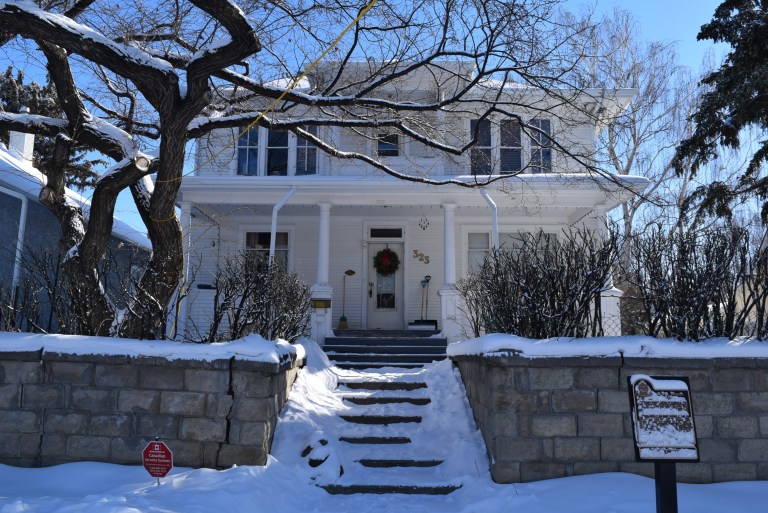
Located in the Victoria Park neighbourhood on 14th Street South between 3rd and 4th Avenue, the Watson Residence is an Edwardian Foursquare with classical revival detailing and ornamentation. It was built in 1910/11. It has heritage value as an example of residential construction during Lethbridge’s rapid expansion in the pre-First World War period, and as an excellent example of an urban foursquare home. It was also the residence of Allan James Watson, who was a long-serving superintendent of the Lethbridge School District.
Watson Residence, Lethbridge, February 2019. Source: Historic Resources Management, Government of Alberta
Stone tools and debitage, also known as lithics, are one of the most common types of artifacts found in Alberta. In the past, stone tools were an essential part of Indigenous ways of life. These stone tools and associated debitage (pieces flaked off while the stone tool was being manufactured) are made from a variety of stone types, but generally they need to be produced from quality raw materials. The characteristics of a quality raw material for making stone tools include stones that are finer-grained, somewhat brittle and uniform in texture and structure, and have few or no inclusions because these might make the rock break in unpredictable ways. Some of the highest quality material that was used in Alberta in the past comes from other places around North America, such as Knife River Flint from North Dakota, obsidian from British Columbia and the northwestern United States, and other types of cherts, argillites and other materials from neighboring provinces and states. However, several material types are available locally. Some of the most common types available in Alberta include quartzites, siltstones, cherts and petrified wood. In East Central Alberta, a common type of rock utilized by Indigenous groups in the past was pebble chert. There are areas where this stone is readily available and it can be high enough quality to be knapped into tools. While these pebble cherts can sometimes be found today in road cuts or blowouts all across East Central Alberta, there are two pre-contact quarries and associated archaeological sites near Consort, AB where large concentrations of these materials were found, collected and utilized. At these sites, there is evidence that Indigenous groups used rounded and fist-sized pebbles of chert to make stone tools.
The Misty Hills quarry site and complex (Borden block EkOp) is unique because it has large densities of both high quality chert and quartzite pebbles found in more than 130 blowouts across the site. In addition to the raw pebbles, there are many associated quarry Read more →
Written By: Colleen Haukaas (Archaeological Survey)
This week’s post is an update on archaeological project and site data for 2018 from the Archaeological Survey. Click the image below the see the full size.
Disclaimer: the archaeological site counts for 2018 are not final. They are constantly being updated as consultants and researchers submit their reports to the Archaeological Survey.
Editor’s note: The following blog post is part one of a two-part series looking at the history and influence of Doukhobors in Alberta.
East of the Crowsnest Pass, nestled within the small community of Lundbreck, sits a simple white building clad in asbestos shingles and covered with metal roof. The structure looks utilitarian and spare; it could easily be mistaken for the kind of modest community halls one occasionally sees in Alberta’s small towns. While the building is almost entirely non-descript, the history that it embodies is extraordinarily rich.
The history of the Alberta Doukhobors is an essential chapter in the story of one of the largest experiments in communal living in North America. Approximately 7,500 Doukhobors came to Canada in 1899, at the time it was the largest mass migration in the country’s history. In stark contrast, at a 2018 meeting of Doukhobors in British Columbia, a grim question was posed: will there be any Doukhobors active in their faith by 2030? Between their noteworthy arrival at the end of the nineteenth century and their dwindling membership today, the Doukhobors have lived a tumultuous and compelling experience in Canada. This post attempts to explore the vision and roots of the Doukhobor community, and their early experiences in Canada.
The Doukhobor Prayer Home in Lundreck (also known as the Doukhobor Hall [dom or house]) is one of the few tangible reminders of one of the most remarkable communities of people to ever settle in this province.Read more →
Seasons Greetings to all! With the holidays approaching rapidly, many of us reminisce about the Christmas experiences from childhood. One of the common memories my co- workers and I share is waiting impatiently for the fabled Sears Wish Book to arrive in our mail boxes. For many of us, the arrival of Christmas catalogues was a much anticipated event in our households. The very name, Christmas catalogue, conjures up images of flipping excitedly through pages filled with shiny new toys destined for children’s wish lists. I for one, remember spending hours pouring over the catalogues, carefully folding the corners of the pages containing coveted items and circling of all the gifts I hoped Santa might bring me.
Children waiting for Santa Claus on Christmas Eve, 24-Dec-1947 (City of Edmonton Archives EA-600-663b)
In the late 19th Century, mail order catalogues for larger department stores in urban centres, such as Montreal and Toronto, were the norm for purchasing goods in rural communities in Canada. In 1822, the first mail order catalog in Canada was introduced by Carsley’s department store in Montreal. The first Eaton’s Christmas catalogue, called “The Wishing Book” was produced in 1884. Timothy Eaton’s vision was for the book to be accessible to all and “go wherever the maple leaf grows, throughout the vast Dominion.” The department stores had vast mail-order departments dedicated to making sure mail-order customers received their purchases no matter how far the goods had to travel. By the 1950’s, the ability to purchase a variety of consumer goods through mail-order catalogues expanded rapidly. Many department stores marketed to the young and old, with catalogues specifically designed for the lucrative holiday season. The catalogues offered a variety of gift-giving options from fashions to merchandise and included a special section containing all manner of toys for under the Christmas tree. In 1953, Canadian department store giant Simpson’s was acquired by the American Sears. The business merger resulted in the first Simpsons-Sears catalogue to be published and would eventually become the most successful department store catalogue in the country.
If you would like to take a stroll down memory lane and revisit Christmas catalogues from your childhood, please visit Wishbookweb. This fabulous online resource of vintage Christmas catalogues has a current catalog page count of 25,617 pages. For Flash-enabled desktop browsers, users can enjoy full-featured navigation, including text-search features and special page-turning sound effects! Happy browsing!!
Snapshot of a few Wishbook Web catalogue resources available, accessed via: Wishbook Web – The Christmas Catalog Archive Project, Dec 4/18.“A sincere wish for happiness at Christmas and throughout the New Year.” Christmas card, made in Canada date unknown.
Written By: Marsha Mickalyk, Archaeological Permits and Digital Information Coordinator & Pauline Bodevin, Regulatory Approvals Coordinator, Historic Resources Management Branch.
The rehabilitation of the Tipton Investment Company is now complete! Designated a Provincial and Municipal Historic Resource, the building is located within the Old Strathcona Provincial Historic Area along Whyte Avenue in Edmonton. It was constructed in the early days of the 1900s and survives as one of the last wood “boom town” style commercial structures in the district.
Storefront Elevation (Before) – September 2015 Source: Alberta Culture and Tourism – Heritage Division
Storefront Elevation (After) – September 2018 Source: Alberta Culture and Tourism – Heritage Division
The current owners, with the assistance from their consultants, contractors, and provincial and municipal heritage regulators, have successfully preserved the heritage values of the modest single-story structure while expertly incorporating an addition. The rehabilitation not only changes the property to a creative two-story multi-tenant complex, but does so while honouring the wood building as the primary heritage value on the lot. Now that’s how it’s done!
The rehabilitation of the Tipton Investment Company is a shining example of how to keep what is of value, provide upgrades to services and Read more →