Historic Archaeology at Edmonton’s Mill Creek Ravine – Volunteers Welcome!

Attention Edmontonians!

Have you ever wondered about archaeology in your own city? Have you ever wanted to be an archaeologist? This summer an archaeologist from the University of Chicago is leading an archaeological investigation in the Mill Creek Ravine! Haeden Stewart is looking for remains from historic settlements to learn more about daily life in the early 20th century, as the city was industrializing. In the early 1900’s, the Mill Creek Ravine was home to several mills, meat packing plants, a railway line, and homes of the ravine’s workers.
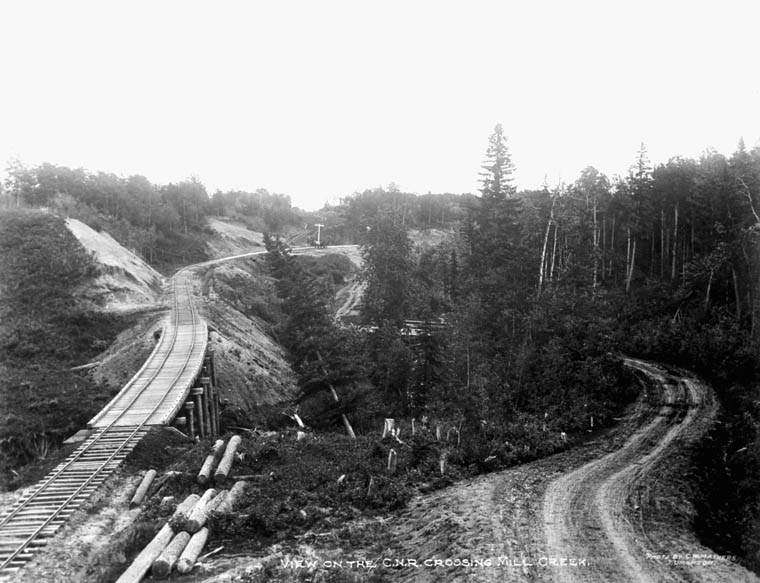
mill creek crossing
Early industrial Edmonton – View of the C.N.R. crossing Mill Creek, 1900-1925. Library and Archives Canada MIKAN 3335022

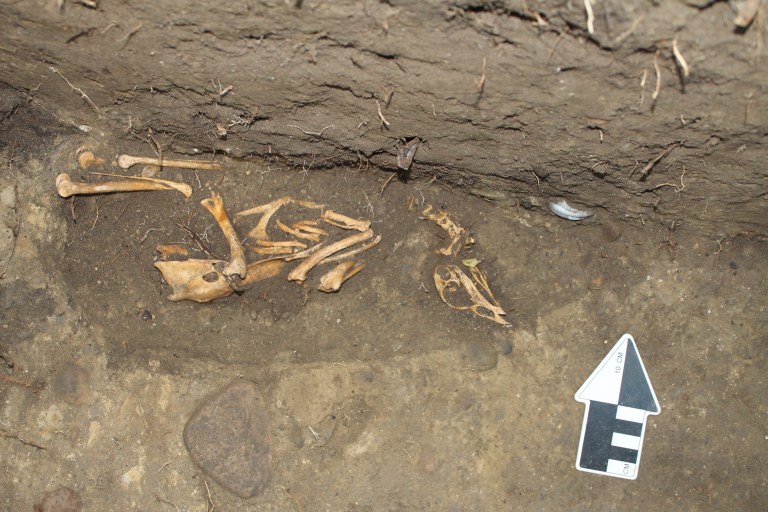
Haeden will be excavating two locations this summer. The first is a shanty town located at the north end of the Mill Creek Ravine. This town was one of many that settlers built in the first few decades of the 20th century. Some shanty towns were more temporary, but some, like the Ross Acreage in Mill Creek, were more substantial and housed settlers for many years. Haeden’s team has already been working at the shanty town for several weeks, where they have unearthed some great finds, including animal bones, glass bottles, and the remains of two chickens buried in a pit!

IMG_7501
Glass bottles excavated at a historic shanty town in Mill Creek, Edmonton. Photo credit: Haeden Stewart
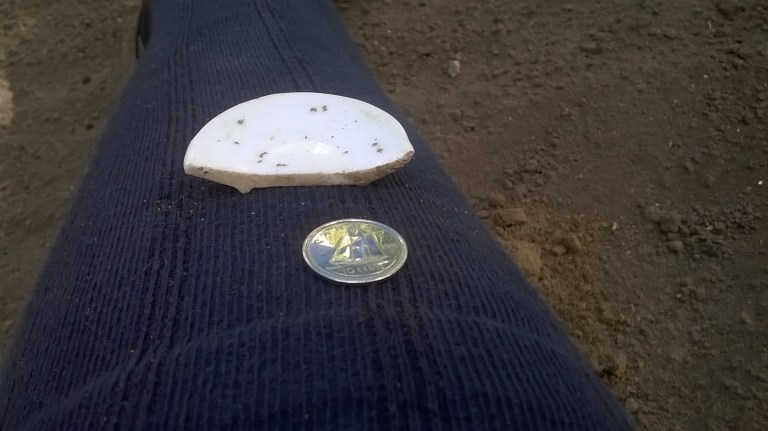
WP_20160714_11_58_24_Pro
Toy saucer from a historic shanty town in the Mill Creek Ravine, Edmonton. Photo Credit: Haeden Stewart.
IMG_7486
Chicken bones buried in a pit in a Shanty Town in Mill Creek Ravine, Edmonton. Photo credit: Haeden Stewart

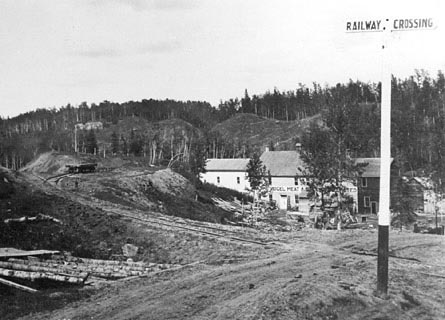
Next, Haeden plans to excavate at Vogel’s meatpacking plant in the south end of the ravine. Vogel’s was one of three large meatpacking plants built by 1910 in the Mill Creek Ravine.
ea-10-1134
Vogel’s meatpacking plant in 1902. Image credit: Edmonton – A City Called Home EA-10-1134 http://www2.epl.ca/edmontonacitycalledhome/EPLEdmontonCityCalledPhotosSingle.cfm?id=51

Haeden will be excavating every day of the week, from approximately 830am-530pm, except for Tuesday.  If anyone is interested in volunteering to help out with the excavation please contact Haeden at haedenstewart@uchicago.edu, or call\text him at 773-827-4004 to make arrangements.
Edmonton’s River Valley: The Glitter of the Gold Rush

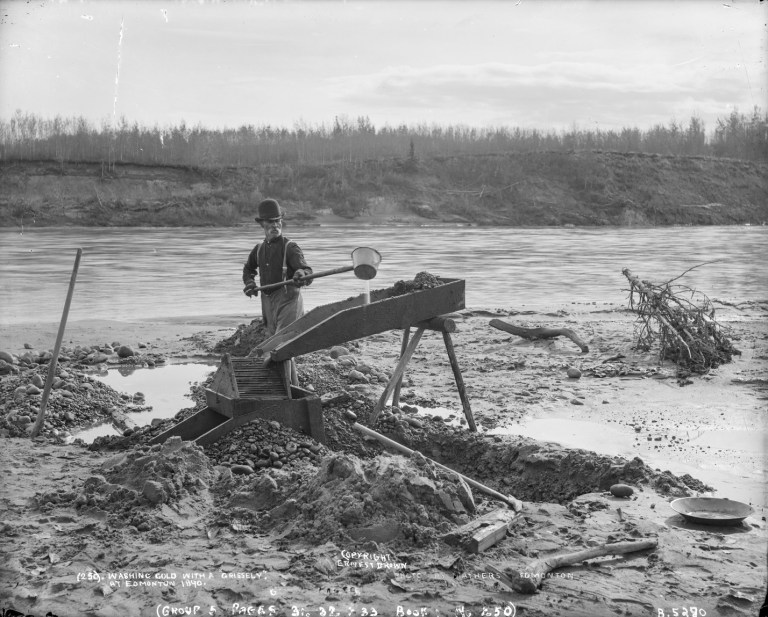
Every summer around this time of year, I look forward to checking out the sights and sounds of Edmonton’s local exhibition formerly known as Klondike Days. Its very name conjures childhood memories full of non-stop carnival rides, piping hot corn dogs and the sweet smell of freshly spun cotton candy. The name Klondike Days was originally brought in by exhibition organizers in the 1960’s and the Klondike gold rush theme was enthusiastically embraced by the public. I’ve always wondered what our local historical connection to the gold rush really was. Is there really gold to be found in the river valley?

B5280
Man washing gold at Edmonton, 1890. Source: Provincial Archives of Alberta, B5280

Read more

Gathering at Victoria Settlement

Students at Victoria School, circa 1910: Left to right Frank Whitford, Fred Kuzemsky, unidentified, Wasyl Kotyk, Wayne Kozub or Esepenko, teacher Mr. Rowbottom, Demetrius Ponich, Metro Starchuk, David Thompson, Elena Brucenorsky, Wasyl Brucenorsky [in doorway] and two unidentified at far right (Photo: Rev. D.M. Ponich Collection, Alberta Culture and Tourism).
Students at Victoria School, circa 1910: Left to right Frank Whitford, Fred Kuzemsky, unidentified, Wasyl Kotyk, Wayne Kozub or Esopenko, teacher Mr. Rowbottom, Demetrius Ponich, Metro Starchuk, David Thompson, Elena Brusanowsky, Wasyl Brusanowsky [in doorway] and three unidentified at far right (Photo: Rev. D.M. Ponich Collection, Alberta Culture and Tourism).
Descendants of settlers from Alberta’s historic Victoria Settlement district, and enthusiasts of Alberta’s history generally, are invited to take part in a special gathering and genealogical symposium on the 6th of August 2016 at the Victoria Settlement Provincial Historic Site.

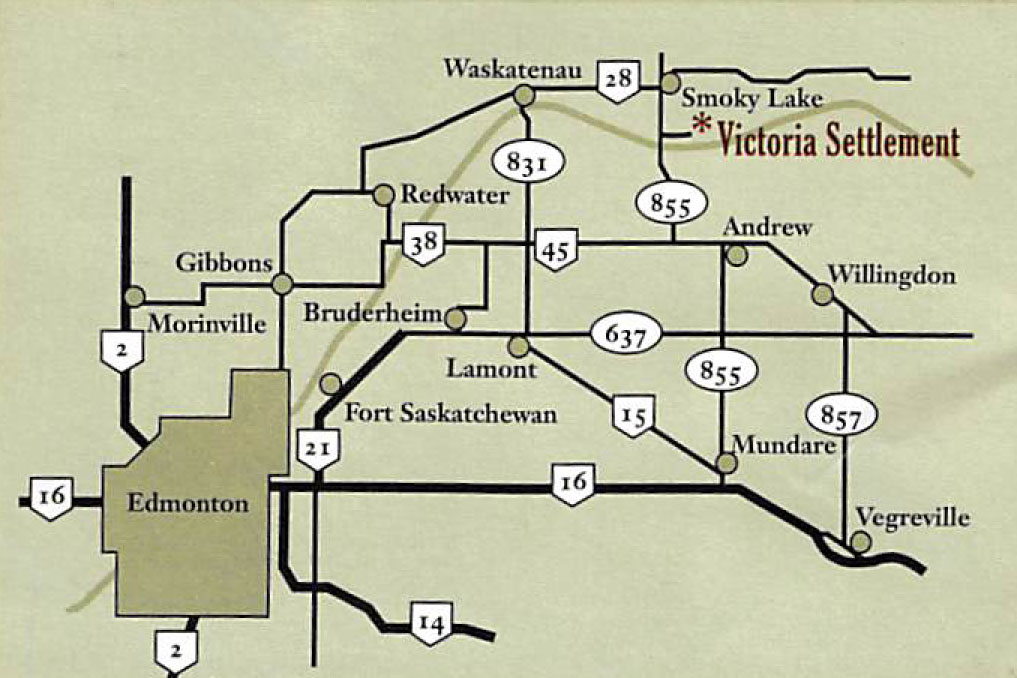
The agenda for the day’s events are listed below. An area map illustrating the location of Victoria Settlement Provincial Historic Site can be found below or at the site’s website: http://www.history.alberta.ca/victoria/location/location.aspx

Gathering at Victoria Settlement

Saturday, August 6, 2016

9:00-9:30                     Set up of tents, tables, registration, displays from participants.

9:30-10:00                   Registration – meet and greet.

10:00-10:30                 Ross Stromberg: Program Coordinator, Alberta Culture and Tourism.

10:30-10:45                 Elaine Breadon Peiche: Victoria Home Guard Society.

10:45-11:45                 Peter Melnycky: Historian, researcher, author of 

                                      ‘A Veritable Canaan – Alberta’s Victoria Settlement.’

11:45-12:30                 Linda Collier: President of Historical Society of Alberta; historian and

                                      great-granddaughter of Rev. George McDougall.

12:30-1:00                   Enjoy your picnic lunch and mingle!

1:00-1:45                     Graham Dalziel: Member of Smoky Lake Heritage Board; owner of

                                      historic Riverlot #3 – with a suitcase full of found treasures!

1:45-2:30                     Donna Shanks and John Althouse: Donna is President of Edmonton

                                      branch of the Alberta Genealogical Society. John is a member of E.A.G.S

                                      and Editor of Clandigger.

3:00-3:30                     Steven Bentley: Historian and genealogist with some ‘Whitford’ stories.

3:30-4:00                     Group photo and closing.

4:00                              Carpool to cemetery for those who wish to explore it.

5:00                              Victoria Settlement Historic Site closes.

BONUS: There will be THREE genealogical consultants on site to help with family histories! Steven Bentley plus Bill and Sandy Macdonald.

Please bring your picnic lunch!  AND, your family history, stories, research to share.

Everyone is responsible for their own entrance fee to V.S. ($5.00 per person).

Check the Victoria Settlement website and Plan Your Visit:

http://history.alberta.ca/victoria/planyourvisit/visit.aspx

If you plan to join us, a quick email to victoriasettlementgathering@gmail.com would help us with our planning.

WE CAN’T WAIT TO MEET ALL OF YOU!

VS_map2

Changing Animals: Alberta’s Ice Age Megafauna and Wally’s Beach

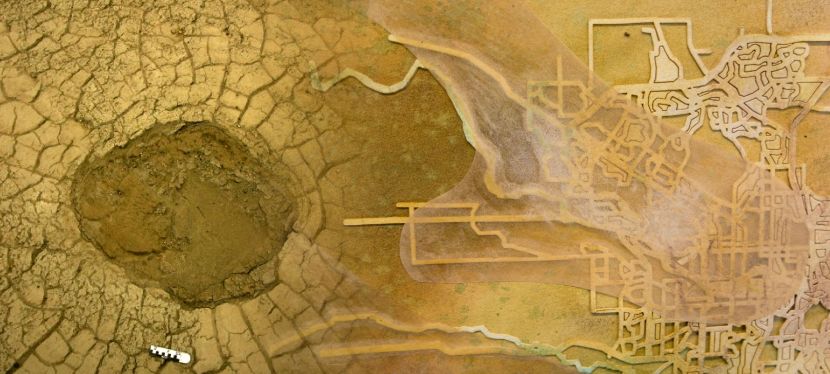
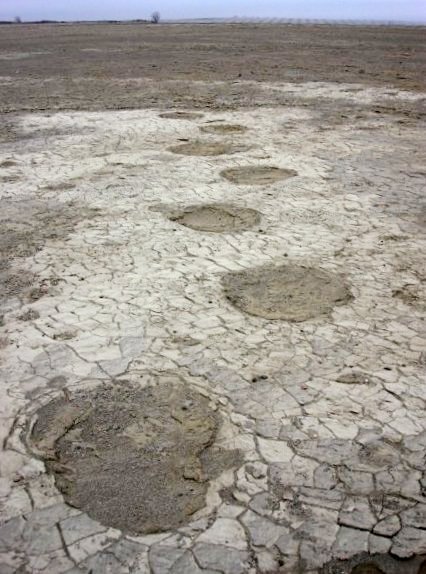
When St. Mary Reservoir in southern Alberta was filled in the 1950s, no one knew that it submerged an incredible record of life from 13,000 years ago. That record, including footprints of mammoth, camel, and horse, was recently exposed – the internationally significant site is now informing opinions about the role humans played in the extinction of Alberta’s ‘megafauna’.

Rare and information-rich trackways from lumbering mammoth were revealed by scouring winds at St. Mary Reservoir (courtesy of Shayne Tolman).

Wally’s Beach

Shayne Tolman, a teacher from Cardston, is responsible for drawing attention to St. Mary Reservoir and Wally’s Beach, a site complex on an ancient island in St. Mary River that is currently being investigated by Dr. Brian Kooyman and a team from the University of Calgary. Archaeologists have discovered that the menu of some of Alberta’s oldest humans included megafauna like camel, horse, and perhaps mammoth. Over six thousand artifacts indicate that people were hunting big game at a time when these animals were likely struggling to cope with climate change. Did human hunting lead to megafauna extinction or are warming temperatures to blame? Many researchers argue that pre-contact human populations were too small to impact big game while others suggest that targeted hunting patterns among small groups could have big consequences.

Megafauna of Alberta at the end of the last Ice Age (produced by Todd Kristensen)

Read more

Remembering Allan Pard

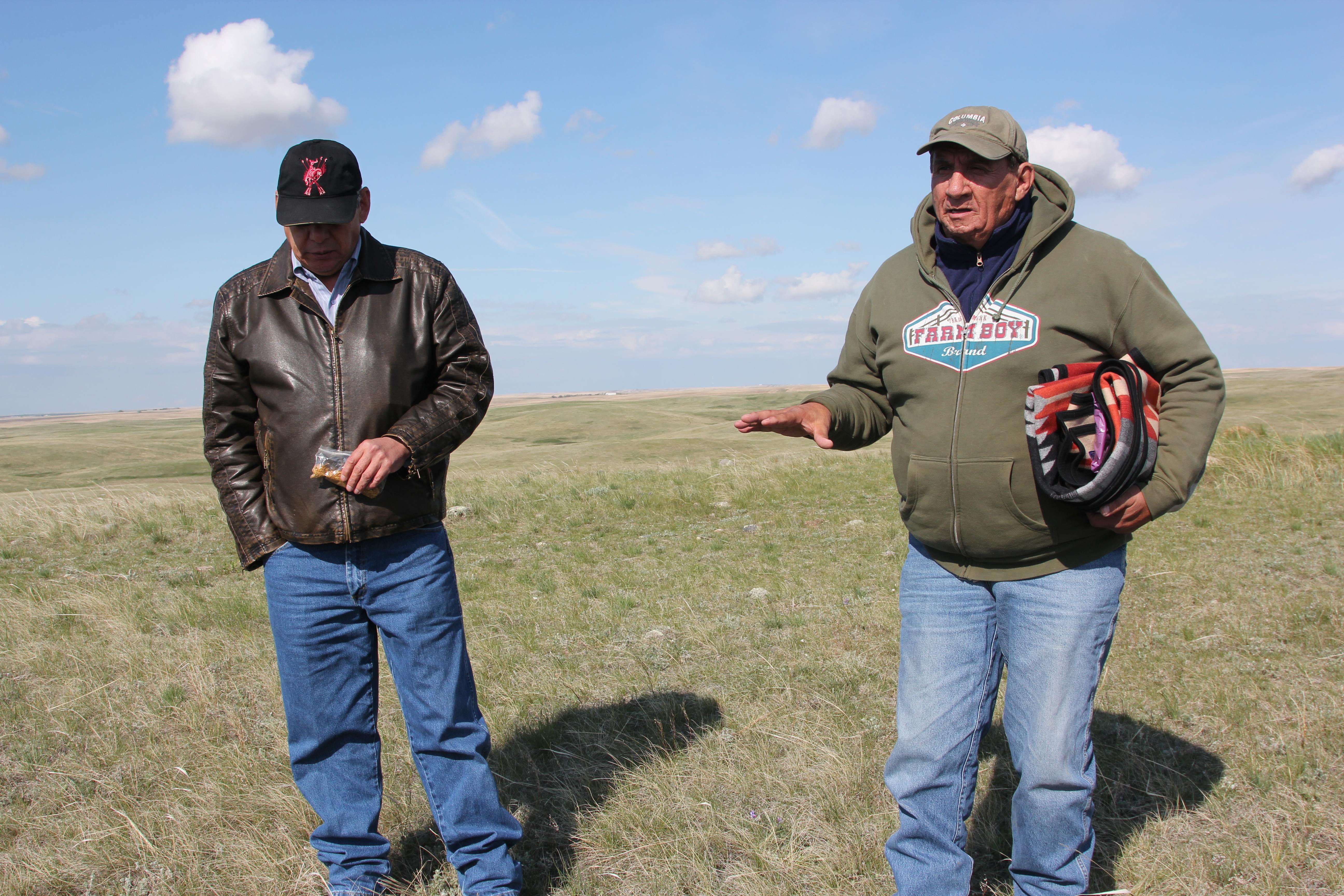
Allan Pard (right) and Blair First Rider (left) (Photo Credit: Jack Ives)

Alberta Culture and Tourism staff are heartbroken by the loss of our mentor, colleague and friend Allan Pard. Allan (Mi’kskimmiisoka’simii “Iron Shirt”) was a highly respected and beloved Piikani Nation Elder and ceremonialist, active in ceremony and numerous sacred Societies. Working for the Government of Alberta for more than 30 years, Allan was integral to a large number of Alberta Culture and Tourism initiatives and served as a senior adviser to the Ministry of Indigenous Relations. He constantly strived to bridge relationships between Indigenous and non-Indigenous peoples by fostering environments of understanding and respect. He challenged us to do better, and led by example each step of the way. Read more

Honouring Alberta’s Heritage Heroes

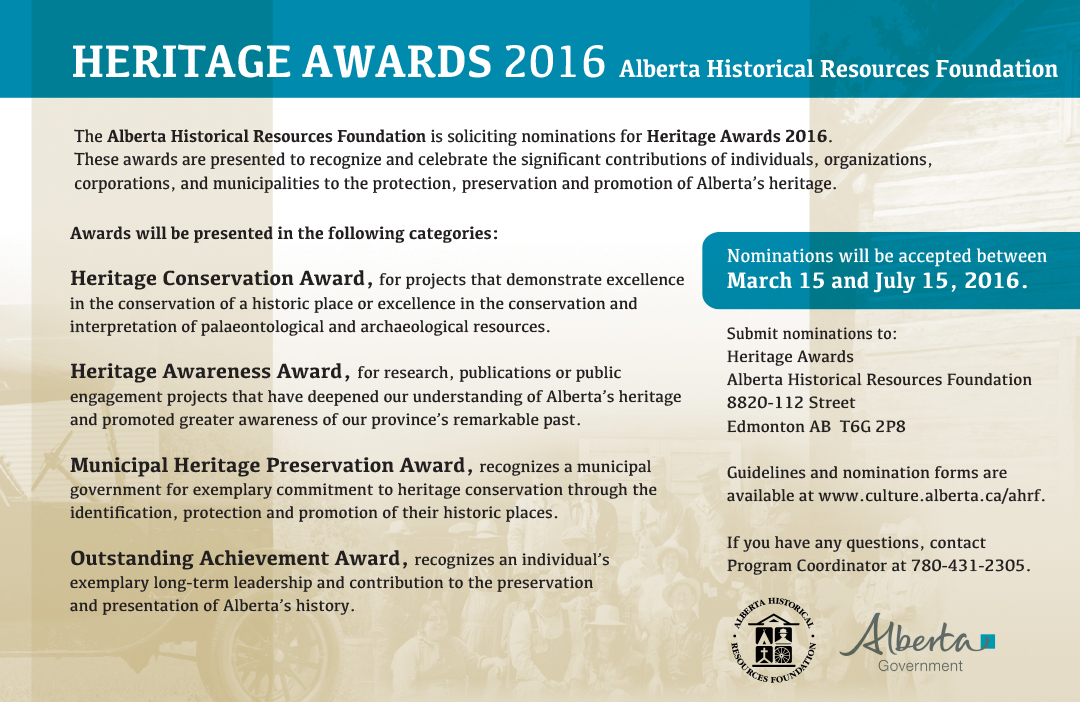
Nominations for the Alberta Historical Resources Foundation’s Heritage Awards are still open. Help us honour and celebrate the outstanding accomplishments of individuals, organizations, municipalities and businesses who have contributed to the preservation of Alberta’s heritage.

Deadline for nominations is July 15. The awards ceremony will take place on October 14 at the historic McDougall Centre in Calgary.

Print

For a copy of the guidelines and nomination form, click here or contact Carina Naranjilla at 780-431-2305 or Carina.Naranjilla@gov.ab.ca. More information is also available at http://www.culture.alberta.ca/heritage-and-museums/grants-and-recognition/heritage-awards/.

Written By: Carina Naranjilla, Grants Program Coordinator

The Borden Number System: What the FcOq?

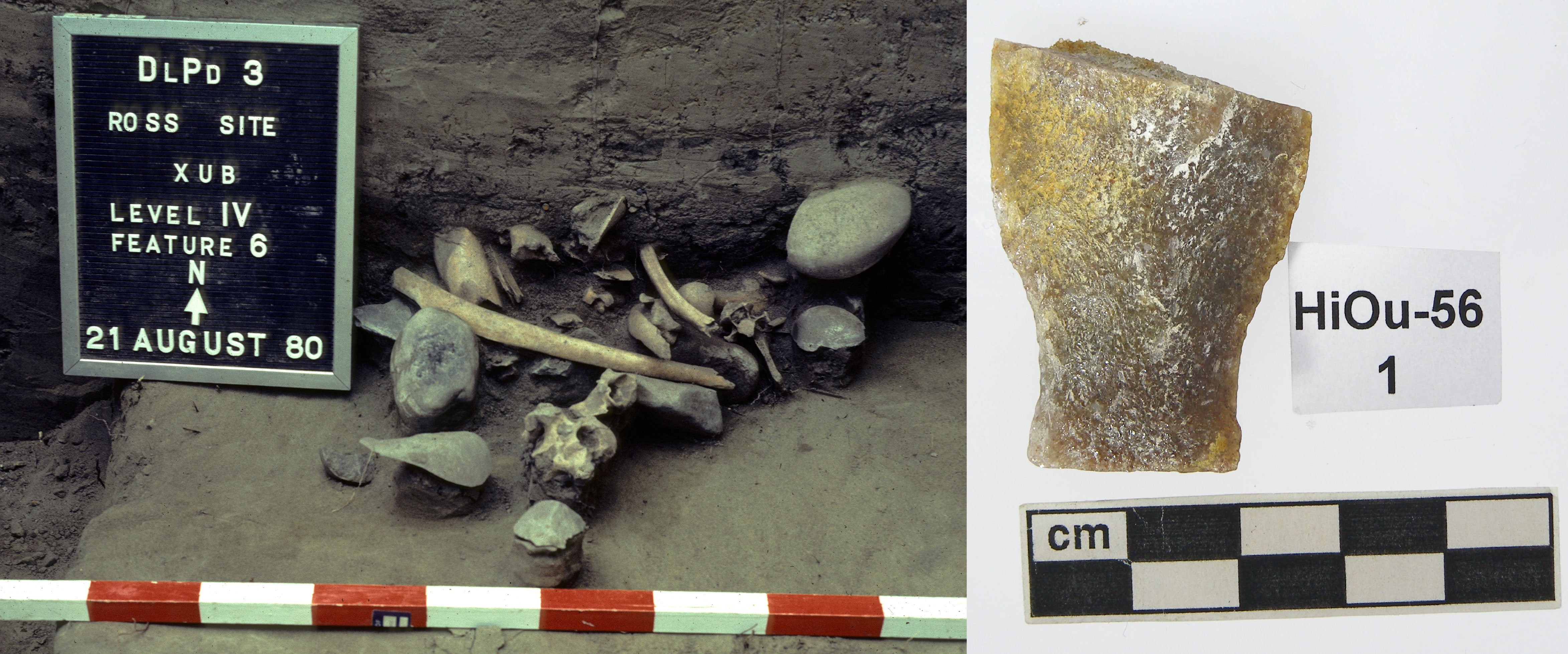
In a previous post we talked about how Alberta has almost 40,000 recorded archaeological sites. Each of these sites has its own record and associated artifacts so, you can imagine, it is a lot to keep track of. One of the most important tools we use to organize site data is a Borden number. You may have heard sites referred to by their Borden number before; for example Head-Smashed-In is also known as DkPj-1. The Borden number is actually more important than the site name as the Borden number is what is used to organize all site records and for cataloguing artifacts. In fact, the majority of sites in Alberta do not have a name at all, they are known solely by their Borden number.

Borden number DlPd-3 (Ross Site) is used as the unique identifier for this archaeological site (left). Borden numbers are also used to catalogue artifacts that are recovered from archaeological sites (right).
Borden number DlPd-3 (Ross Site) is used as the unique identifier for this archaeological site (left). Borden numbers are also used to catalogue artifacts as a way to identify what site they came from (right). (Photo Credits: Royal Alberta Museum)

Read more

The Battle of Jutland, First World War Commemoration and Alberta Place Names

No single event has had such a dramatic impact on place names in Alberta than the First World War Battle of Jutland. Deep in the heart of Kananaskis Country can be found a series of mountains bearing the names of the ships and naval commanders of this naval battle. At least twenty-six mountains bear names commemorating the Battle of Jutland – sixteen of them are named for Royal Navy vessels that took part in the battle and ten are named for the Admirals, ship captains and seamen that lead and fought at Jutland. Additionally, many features associated with the mountains (glaciers, lakes and creeks) have subsequently been given Jutland names. The great number of Jutland-related geographical names in Alberta is curious. While there is no questioning the significance of the Battle of Jutland – it was the only major sea battle of the First World War, one of the few times in which dreadnought battleships fought directly against each other and its results affected strategy and tactics on both sides and altered the course of the war – it was also a battle in which there was no significant Canadian presence; no Canadian ships were involved and only one Canadian casualty has ever been confirmed. So, how did so many of these mountains along the Alberta-British Columbia boundary end up being named to commemorate this battle?

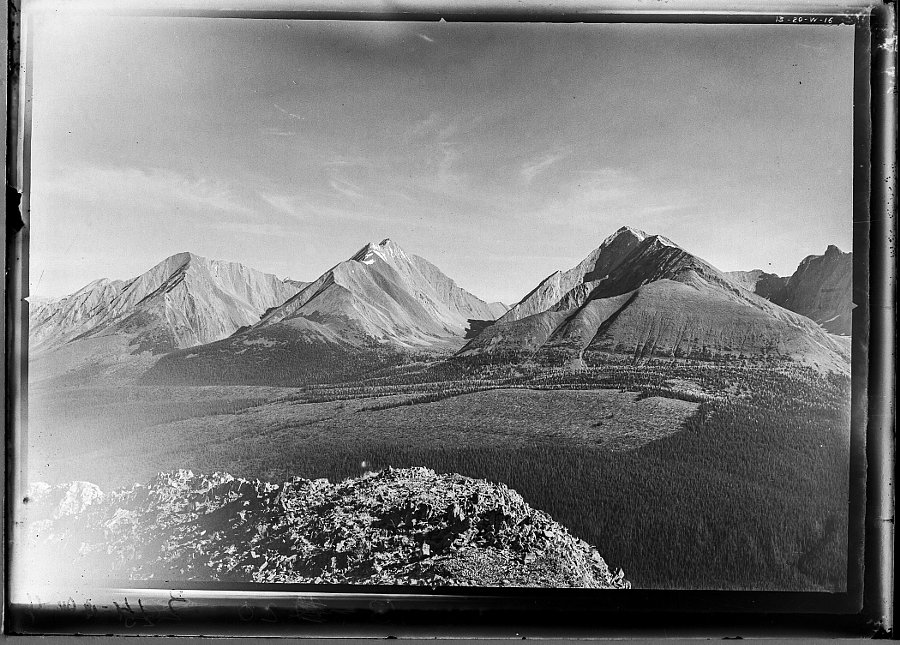
Mount Engadine (left), The Tower (middle) and Mount Galatea (right), taken in 1916 by the Interprovincial Boundary Survey. Mount Engadine and Mount Galatea are named for Royal Navy vessels that fought at the Battle of Jutland, the seaplane carrier HMS Engadine and the light cruiser HMS Galatea.
Mount Engadine (left), The Tower (middle) and Mount Galatea (right), taken in 1916 by the Interprovincial Boundary Survey. Mount Engadine and Mount Galatea are named for Royal Navy vessels that fought at the Battle of Jutland, the seaplane carrier HMS Engadine and the light cruiser HMS Galatea. Image Source: Mountain Legacy Project, IMG_3320. The Mountain Legacy Project is based at the School of Environmental Studies, University of Victoria, Victoria, BC. For more information, go to mountainlegacy.ca, or email mntnlgcy@uvic.ca.

Read more

National Aboriginal Day 2016

Photo Credit: Government of Alberta

The Historic Resources Management Branch is privileged to work with and learn from Indigenous communities in Alberta. On June 21, we join Canadians nation-wide in celebrating National Aboriginal Day. Now in its 20th official year, National Aboriginal Day provides an opportunity for Indigenous and non-Indigenous peoples alike to come together in recognition of the histories, cultures and contributions of First Nations, Metis and Inuit peoples in our province and across the country. Indigenous and Northern Affairs Canada (INAC) has put together a great video to celebrate the 20th Anniversary.

Whether you take in a film at Edmonton’s Amiskwaciy History Series’ Film Festival, check out the festivities at Head Smashed In Buffalo Jump, visit the Friendship Centre in your community or commemorate the day in your own way, take the time to remember: we are all Treaty people.

A listing of 2016 National Aboriginal Day events in Alberta can be found here.

Written By: Laura Golebiowski, Aboriginal Consultation Advisor

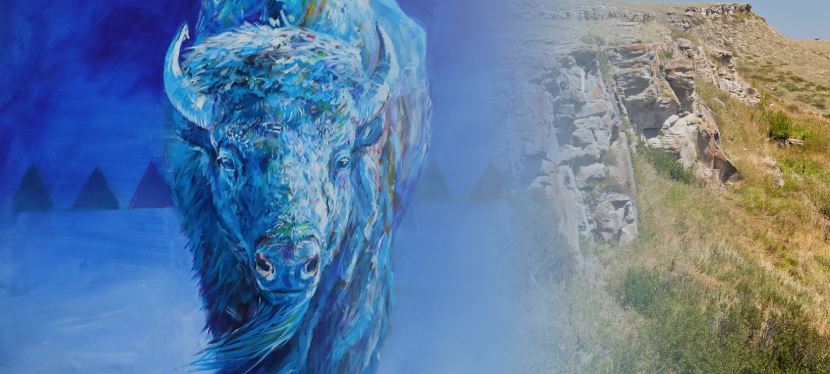
Blood Kettles and Buffalo Jumps: Communal Hunting on the Plains of Alberta

According to Blackfoot tradition, as Old Man traveled north he created the mountains, rivers, grass and trees. When he came to the area of the present day Porcupine Hills in southwest Alberta, he formed images of people from mud and breathed life into them. The people asked Old Man what they would eat, and so, he created images of buffalo from clay and brought them to life. He then took the people to a rocky ledge and called to the buffalo, who ran in a straight line over the cliff: “Those are your food.”

Tens of millions of buffalo once roamed the Great Plains of North America from Alberta’s grasslands down to Texas. To people of the plains, there was no more important food source. A number of ingenious methods were devised for communal (group) hunting – buffalo were lured into ambushes, corralled with fire, chased onto frozen lakes or into deep snow, and driven into elaborate traps called pis’kun by the Blackfoot (translated as ‘deep-blood kettles’). Of the hundreds of mass kill sites, perhaps none is more impressive than the buffalo jump, the most famous of which is Alberta’s Head-Smashed-In. Read more