In February 2016, the City of Medicine Hat designated the Elizabeth Street School as a Municipal Historic Resource. In September, a plaque about the school’s history and designation was unveiled. The school is the most recent of Medicine Hat’s historic resources to be listed on the Alberta Register of Historic Places.
Elizabeth Street School during construction, ca. 1912. The school’s Classical Revival details, notably the cornice at the roofline and the keystone and voissoir details around the entryways, are evident. Source: Provincial Archives of Alberta, A10594
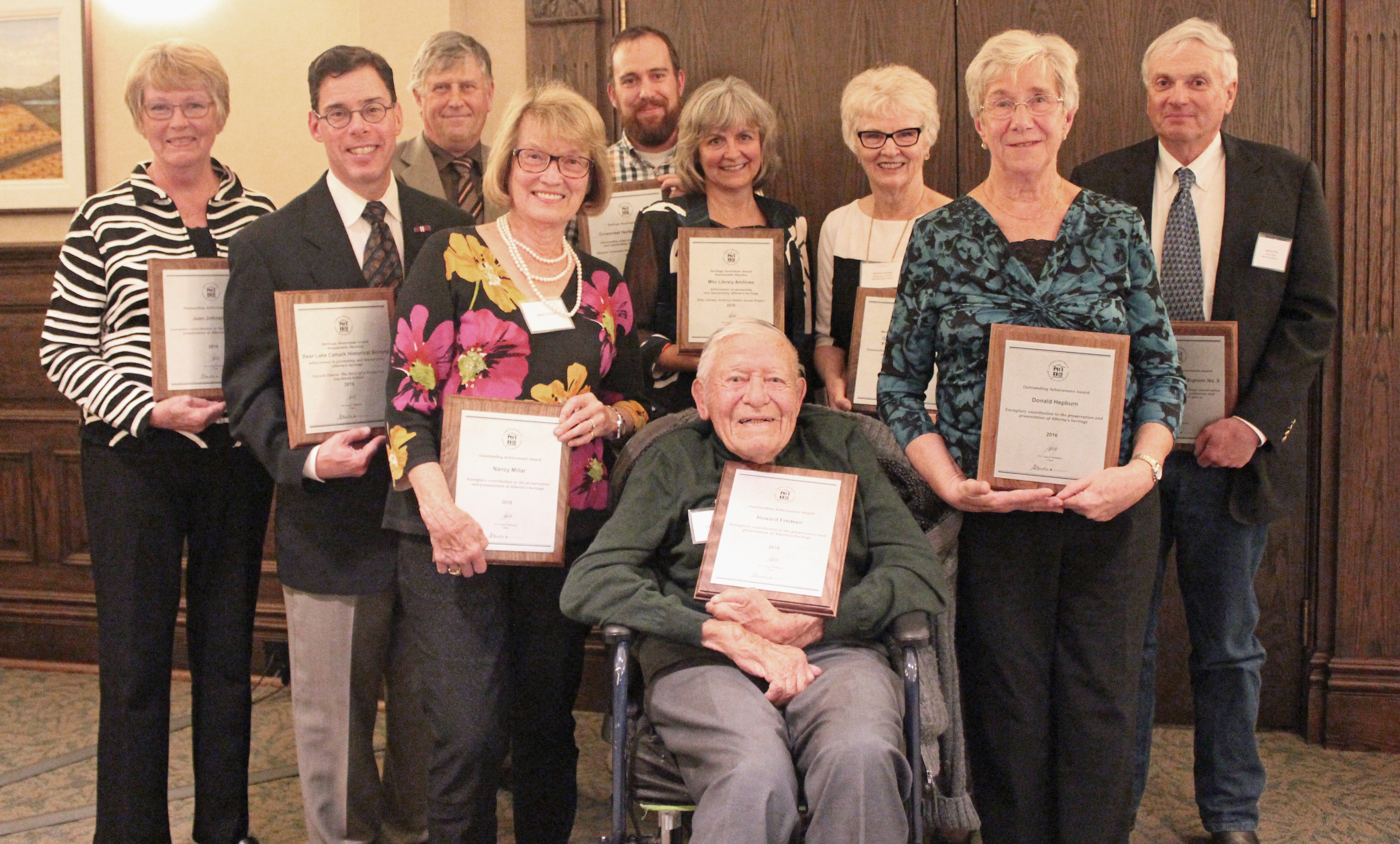
Alberta Historical Resources Foundation 2016 Heritage Award Recipients.
The night of October 14 was filled with pride and honour as award recipients, guests, staff and board members celebrated the biennial Heritage Awards at the historic McDougall Centre in Calgary.
The Alberta Historical Resources Foundation presented the awards in four categories to 14 deserving individuals and organizations in recognition of their accomplishments and contribution to the preservation and promotion of Alberta’s heritage.
Outstanding Achievement
Don Hepburn (Red Deer)
Howard Fredeen (Lacombe)
Jean Johnstone (Lethbridge)
Nancy Millar (Calgary)
Honourable mention – Elizabeth and Bill Bullick (Coronation)
Heritage Conservation
Glen Leslie Church Preservation Group (County of Grande Prairie), Glen Leslie Church restoration
Empress and District Historical Society (Empress), Canadian Pacific Railway Station restoration
Heritage Awareness
Crowsnest Heritage Initiative, “Discover Crowsnest Heritage” signage program
Haying in the 30’s Cancer Support Society, “Haying in the 30’s” event
Honourable mention – Bear Lake Canuck Historical Society, “Canuck Classic: The Story of a Treasured One-Room School”
Historic places are unfortunately fair game for graffiti attacks – sometimes especially so when these places are visible and widely recognized landmarks. Defined as writing or drawings scribbled, scratched, or painted illicitly onto walls and other surfaces, graffiti from a heritage conservation perspective is an intervention to be removed or reversed. It clearly differs from old markings that are an acknowledged and legitimate part, or “character-defining element”, of a historic place. Examples of the latter are prisoners’ inscriptions etched into the basement cell walls of the Cardston Courthouse or, on the opposite side of the law, North West Mounted Police members’ initials carved into the sandstone outcrops overlooking Police Coulee at Writing-On-Stone Provincial Park. These special cases contribute to heritage value rather than obscure or detract from it. Read more →
Shortly before his death in April of 1915 while serving with the Royal Navy Volunteer Reserve, English poet Rupert Brooke penned the now famous lines of The Soldier. He surmised that should he die during the course of the war, there would be some corner of a foreign field “That is for ever England”. In a similar vein, one might consider the ultimate sacrifices paid by Albertans during two World Wars and their final resting places as corners of foreign fields that are for ever Alberta.
During Canada’s two World Wars approximately 127,000 Albertans served in the country’s armed forces, of Read more →
You may have recently seen a news story about archaeological finds at McKinnon Flats, approximately 22 km southeast of Calgary (see below for news links). Today, McKinnon Flats is a popular recreational area, used for fishing, hiking and bird watching. But did you know that five centuries ago it may also have been used for bison hunting and camping?
Archaeologists of Lifeways of Canada Limited have been contracted by Alberta Culture and Tourism to find out about early settlement at McKinnon Flats. They’re part of Culture and Tourism’s three-year Post-Flood Investigation Program, which was initiated to record the effects of the June 2013 southern Alberta flood on archaeological and palaeontological sites along rivers such as the Bow, Highwood, Sheep and Kananaskis. As a result of the program, 100 new archaeological sites were identified and additional information was gathered at 87 sites that had been recorded prior to the flood. Many of these sites were found eroding from the riverbanks, with some in need of investigation before they disappeared entirely. Read more →
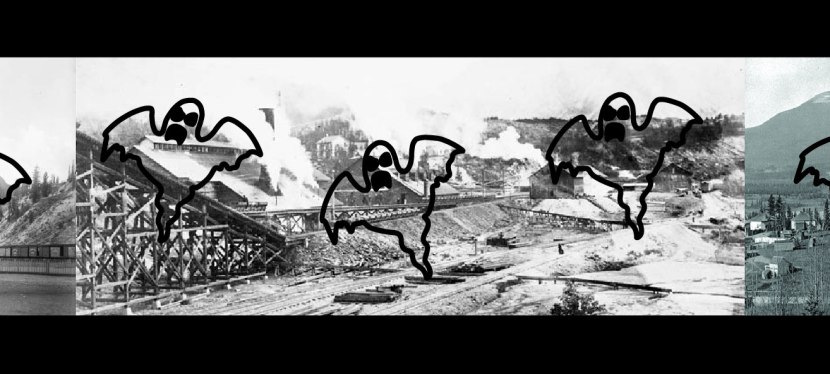
In keeping with the haunted heritage theme started last year, I thought it would be fun to look at some other spooky places in Alberta. Some of the most haunting places in our province are deserted ghost towns. Along any lonely stretch of highway, travellers are bound to come across the decaying remains of one of Alberta’s abandoned towns. Desertion of these small settlements occurred when local natural resources were depleted and transportation routes shifted elsewhere. With no reason for being, these towns became nothing more than crumbling relics of a bygone era. Read more →
October is Women’s History Month in Canada, when we celebrate the achievements of women throughout our past and use their stories to inspire Canadians today. The twentieth century saw women entering occupations previously the exclusive domain of men. A variety of circumstances combined to allow these advances, including the rise of public education, social activism culminating in universal suffrage, legal challenges that established women as “persons” and the upheaval created by two world wars. These changes are not sufficient to explain the careers of the three women described in this blog; it took determination, persistence, courage and intelligence for them to succeed and carve a place for themselves as professional women in these fields that were predominantly, if not exclusively, the preserve of men.
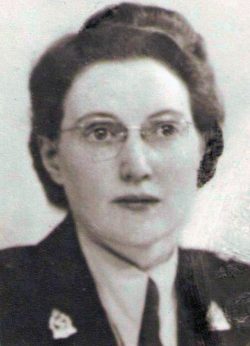
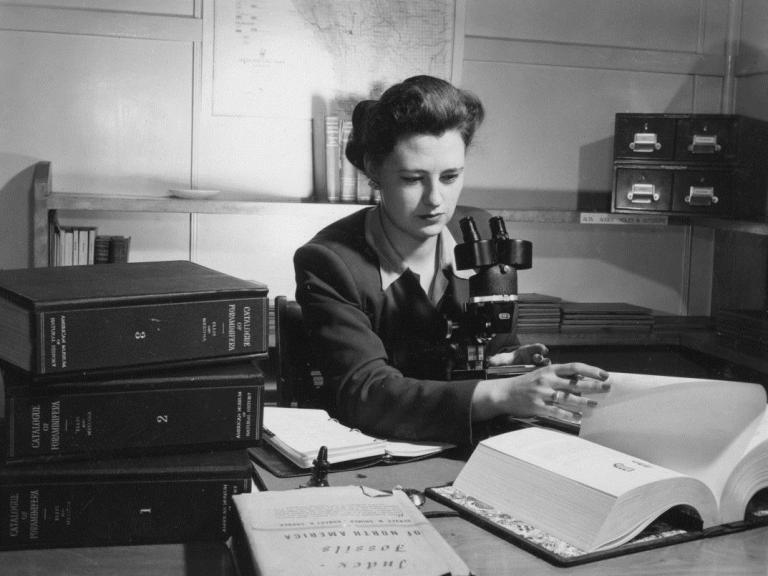
Diane Loranger, geologist, ca. 1946-1947. (Glenbow Archives, IP-14A-1470)
Pottery traditions have developed independently all over the globe thanks to the versatility of clay as a medium for utilitarian function and the expression of identity. Over 450 sites in Alberta have pre-contact pottery dating from 300 to close to 2000 years old. Fragments or “sherds” of pots at archaeological sites reveal surprising amounts of information about how people lived, how they transmitted knowledge, and why pottery traditions persisted in Indigenous populations for millennia. Ancient pottery production continues to influence modern potters and it can inform how modern society uses material goods to express identity. Read more →
Origin of the Names Battle Lake, Battle Creek and Battle River
Note: This post was originally published on RETROactive March 9, 2011.
Battle Lake is located approximately 53 km west of Wetaskawin and is one of a series of water features in the area that are identified by the name Battle, including Battle Creek, Battle Lake and Battle River.
The name Battle Lake was first recorded in the 1883 field notes of Tom Kains of the Dominion Land Survey (DLS). He recorded it as “Battle River Lake” due to its location on the Battle River. He later shortened the name to Battle Lake and, in 1901, that form of the name was approved by the Geographic Board of Canada for use on maps. Read more →
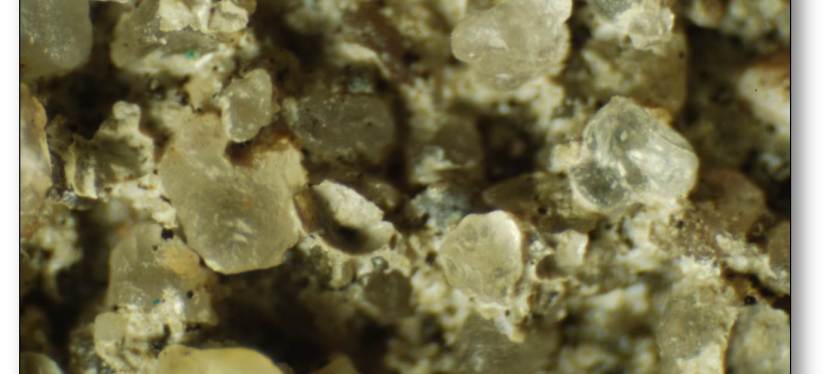
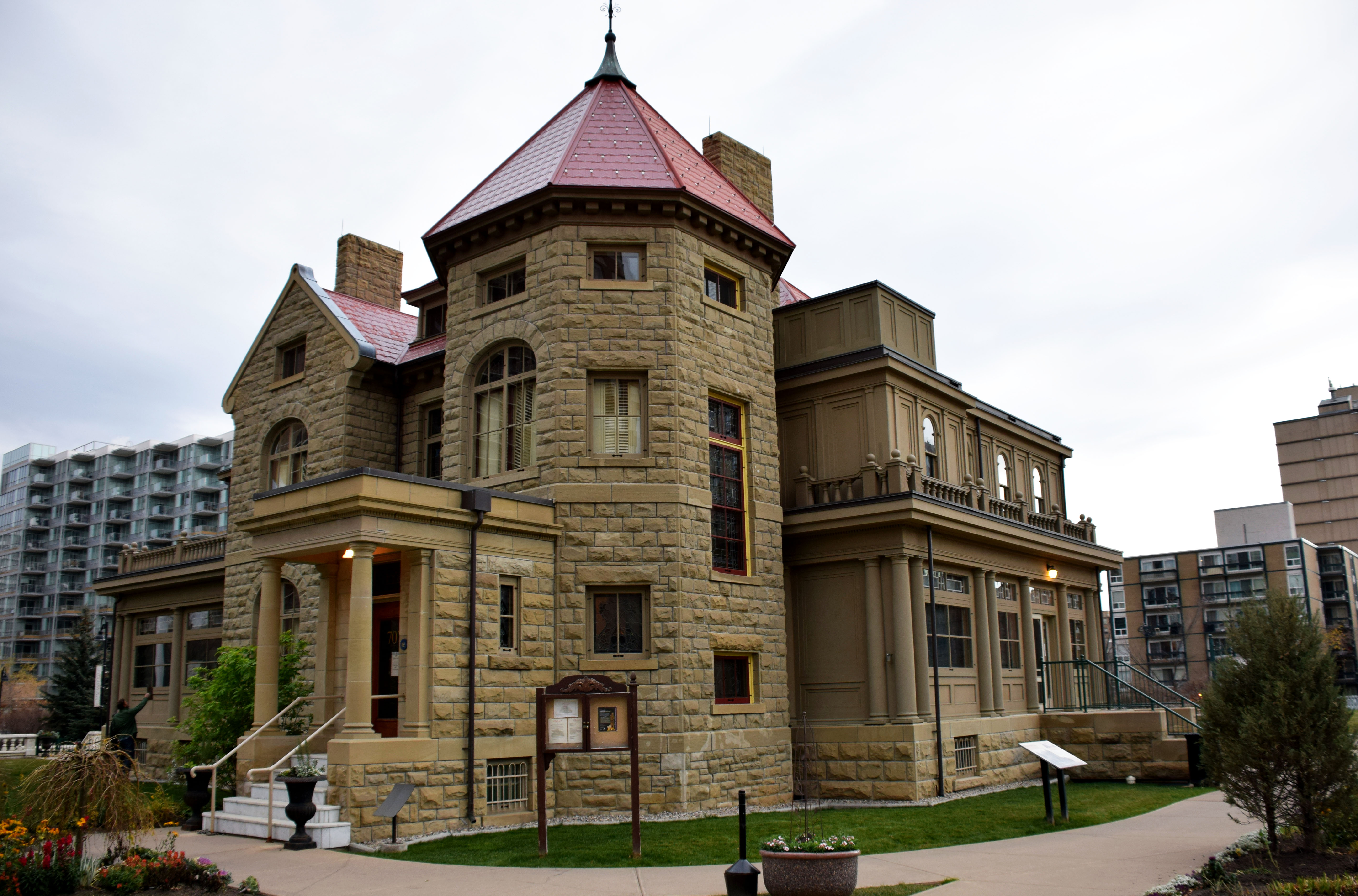
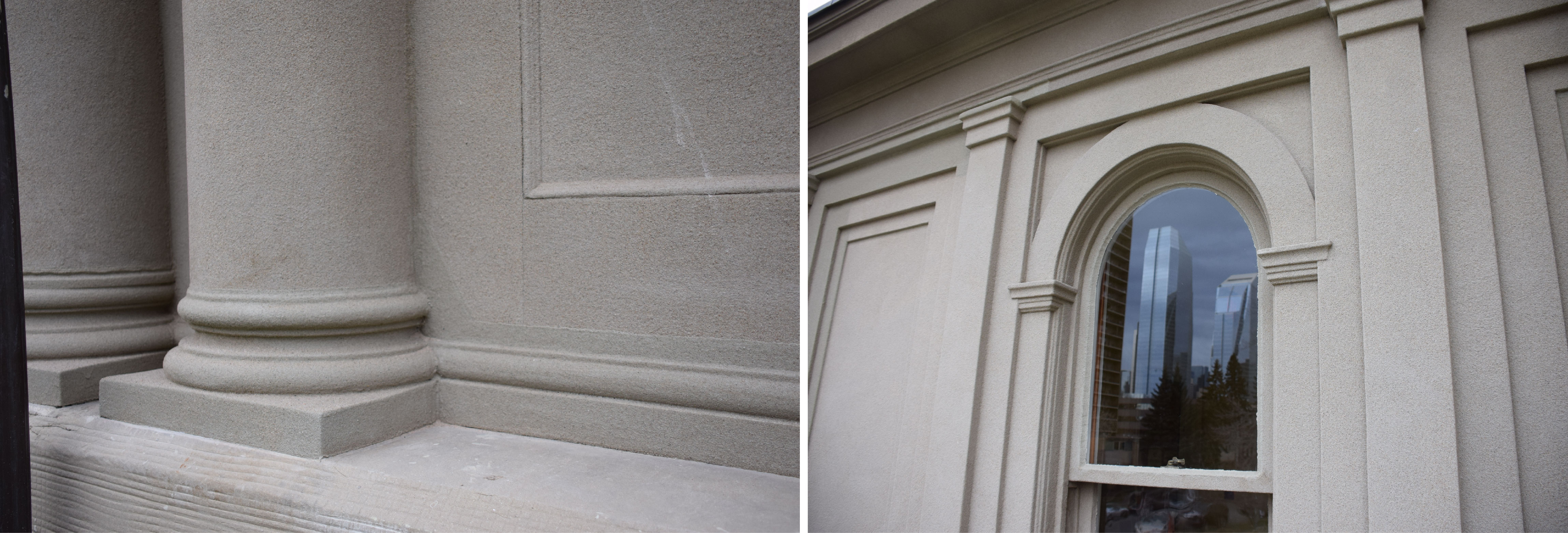
Sand painting is a faux finish technique that was not uncommon for exteriors of masonry buildings in the early part of the twentieth century. By dusting sand onto paint while still tacky, painted wood or metal details were made to resemble stone. If you guessed you were looking at magnified grains of sand in the teaser photograph above, you were right. The photograph, taken through a binocular microscope, is actually of a sand paint sample taken from the Senator Lougheed Residence in Calgary.
Senator Lougheed Residence, Calgary.Sand painted wood details at the Senator Lougheed Residence, Calgary.