A New Window for Canadian Historical Images: The New York Public Library Digital Collections

Researchers, bloggers and casual internet searchers will be interested in exploring a new source of historic images available to the public, many with relevance to Alberta and Canada in general. The New York Public Library Digital Collections includes over 674,000 items, featuring prints, photographs, maps, manuscripts and streaming videos. More than 180,000 of the items are in the public domain and available for downloading without charge, by the public, directly from the Digital Collections website in high resolution.
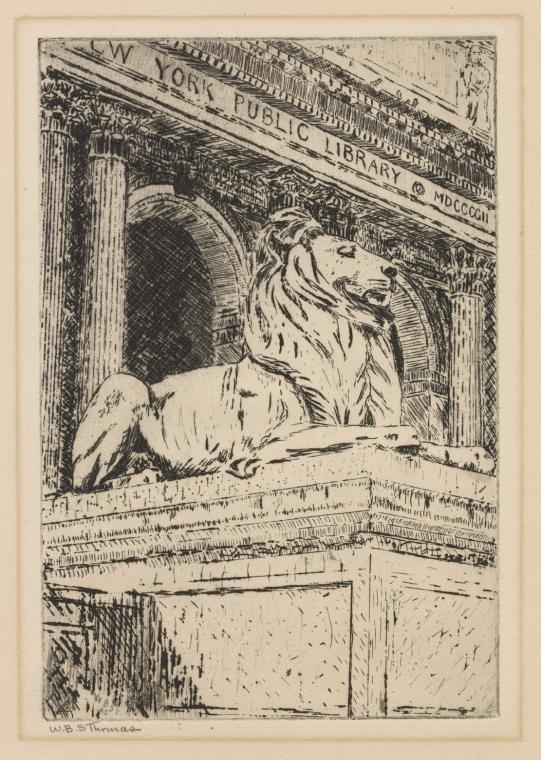
The Miriam and Ira D. Wallach Division of Art, Prints and Photographs: Print Collection, The New York Public Library. "Sculptured lion in front of N.Y.P.L." New York Public Library Digital Collections. Accessed March 10, 2016. http://digitalcollections.nypl.org/items/620a3d58-fe41-dc81-e040-e00a18060f0c
The Miriam and Ira D. Wallach Division of Art, Prints and Photographs: Print Collection, The New York Public Library. “Sculptured lion in front of N.Y.P.L.” New York Public Library Digital Collections. Accessed March 10, 2016. http://digitalcollections.nypl.org/items/620a3d58-fe41-dc81-e040-e00a18060f0c

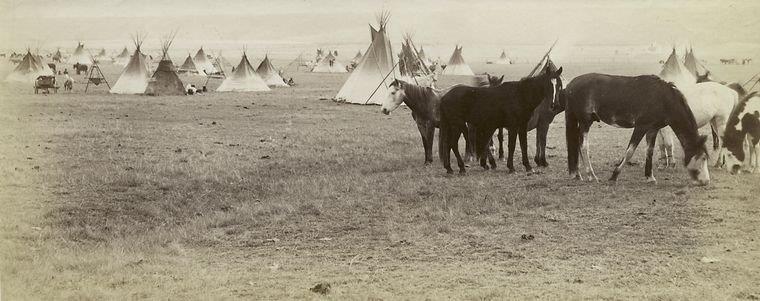
Browsing through the collection, researchers will find numerous images illustrating Alberta’s rich history, including remarkable images from the Blackfoot reserve in southern Alberta.
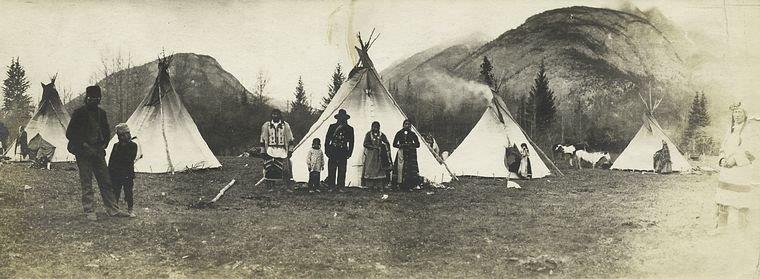
The Miriam and Ira D. Wallach Division of Art, Prints and Photographs: Photography Collection, The New York Public Library. "Indian camp at the foothills of the Rockies, Alberta." New York Public Library Digital Collections. Accessed March 10, 2016. http://digitalcollections.nypl.org/items/510d47dc-4569-a3d9-e040-e00a18064a99
The Miriam and Ira D. Wallach Division of Art, Prints and Photographs: Photography Collection, The New York Public Library. “Indian camp at the foothills of the Rockies, Alberta.” New York Public Library Digital Collections. Accessed March 10, 2016. http://digitalcollections.nypl.org/items/510d47dc-4569-a3d9-e040-e00a18064a99
The Miriam and Ira D. Wallach Division of Art, Prints and Photographs: Photography Collection, The New York Public Library. "Indian camp, Blackfoot Reserve, Alberta." New York Public Library Digital Collections. Accessed March 10, 2016. http://digitalcollections.nypl.org/items/510d47dc-4568-a3d9-e040-e00a18064a99
The Miriam and Ira D. Wallach Division of Art, Prints and Photographs: Photography Collection, The New York Public Library. “Indian camp, Blackfoot Reserve, Alberta.” New York Public Library Digital Collections. Accessed March 10, 2016. http://digitalcollections.nypl.org/items/510d47dc-4568-a3d9-e040-e00a18064a99

Many of the images posted on the site are also contained within the collections of such institutions as the Glenbow Museum and Archives, the Provincial Archives of Alberta and the Library and Archives of Canada. Due diligence is always a wise course of action when considering using any image, and the New York Public Library collection is no exception. Some image captions such as the one identifying the first train to arrive at Read more

Alberta Historical Resources Foundation Seeking Board Members

The Alberta Historical Resources Foundation (AHRF) – the primary source of the Government of Alberta funding for heritage projects – is currently accepting applications to fill seven vacancies on the Board of Directors, including the position of Chair.

Founded in 1973, AHRF has evolved into a complex agency that serves a wide range of stakeholders. Board members are appointed for a term of up to three years. Board meetings are held four times a year for approximately 1.5 days. Board members are also occasionally asked to attend heritage events on behalf of the Foundation.

Online applications are preferred. For details on the position profile and to apply online, please visit www.jobs.alberta.ca. Job ID is 1035487.

Help us ensure the preservation and promotion of Alberta’s heritage through a competent and vibrant board. Applications will be accepted until May 15, 2016.

Archaeology and the June 2013 Floods in Southern Alberta

In June 2013, heavy rainfall triggered catastrophic flooding in southern Alberta that has been characterized as some of the worst in the province’s history. Areas along the Bow, Elbow, Highwood, Red Deer, Sheep, Little Bow and South Saskatchewan Rivers, and their tributaries, were affected. Estimates of property damage from the flood make it one of the most costly in Canadian history. Personal property, however, was not the only casualty. The torrents of water accelerated natural erosional and depositional processes, resulting in significant alteration to many of southern Alberta’s river systems.

Debris-flow fan on the Highwood River, caused by the June 2013 flood.
Debris-flow fan on the Highwood River.
Erosional exposure on the Sheep River, caused by the June 2013 flood.

The potential for finding archaeological sites along southern Alberta’s river systems has always been high. The distribution of known archaeological sites in Alberta indicate the importance of the major river systems to precontact and historic people as sources of fresh water, food resources and travel corridors.  As a result of these associations, a number of archaeological sites were also identified as casualties of the June 2013 flood. Read more

Power and Powder: Early Guns in Alberta

It’s hard to overstate the profound impact of firearms in Alberta’s history. The earliest guns delivered food, protection, and intimidation. Technological improvements from European contact to the 1900s led to significant changes in the ways that guns were used across the province. This blog briefly explores the evolution of firearms in Alberta and the archaeological record of it.

First Guns

Firearms were introduced to Canada in the 1500s but didn’t spread to Alberta until much later. Their first appearance in the province was likely through raiding or trading in the southern U.S. by Plains First Nations. Early gun models, like flared-mouth blunderbusses, were designed for close encounters on battle fields but proved ineffective on the prairies. It wasn’t until the advent of portable flintlock muskets that guns spread like wildfire across the West.

An 1805 Barnett flintlock trade musket that came to be one the most popular Northwest Trade guns. Over 20 000 guns were sold out of Canada’s major fur trade depot at York Factory from 1600 to the late 1700s. Figure by Todd Kristensen and Julie Martindale.

Read more

Celebrating National Volunteer Week: Calhoun Bay Archaeological Sites Tour

April 10 to 16, 2016 is National Volunteer Week in Canada. Well over 12.7 million Canadians have generously donated their time and energy to important causes. Volunteers help our communities grow strong and resilient. Even the smallest effort has the ability to transform, leaving profound and lasting effects in local communities. The work of volunteers affects virtually every aspect of our society and the heritage field is no exception. This week is the perfect time to reflect on the importance of volunteer work involved in the preservation of heritage. Over the years, the Archaeological Survey section of Alberta Culture and Tourism has developed a strong working relationship with the staff of the Parks Division of Alberta Environment and Parks. Both ministries regularly collaborate on joint efforts to preserve Alberta’s natural and cultural heritage for future generations. An important component of our preservation partnership is sharing heritage information with Parks volunteers. The Archaeological Survey participates in these programs to help Parks provide support, increase communication and offer new learning experiences for both staff and volunteers.

Calhoun Bay Provincial Recreation Area Parks Volunteer Conference Field Trip

The Archaeological Survey’s Regional Archaeologists, Caroline Hudecek-Cuffe and Wendy Unfreed participated in Alberta Parks’ Volunteer Conference Field Trip to Calhoun Bay Provincial Recreation Area (PRA) as part of a 3-day conference held in September 2015. Calhoun Bay PRA is located along the eastern shores of Buck Lake surrounded by thick boreal forests. On the bus ride to the site, Caroline and Wendy treated their fellow riders to an introduction to Alberta archaeology and explained how the Read more

Mount Lougheed and Wind Mountain

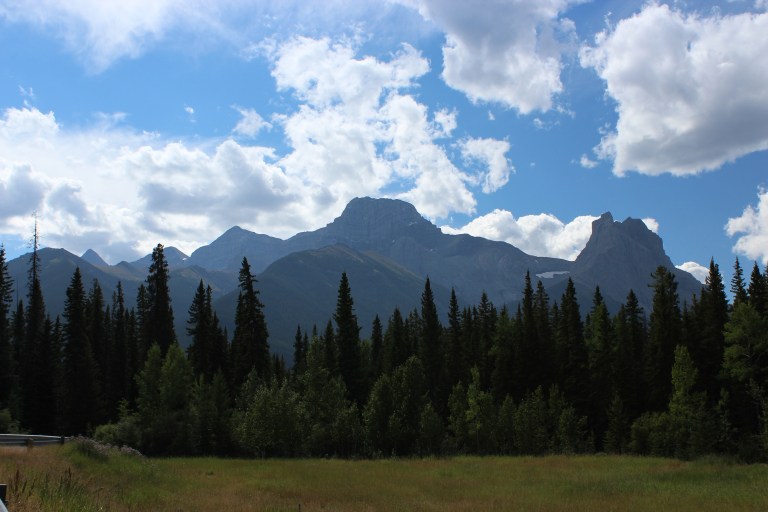
One of the most recognizable mountains in the Canadian Rockies is Mount Lougheed. Located approximately 15 kilometres southeast of Canmore, this majestic 3,150 metre (10,335 ft.) mountain is named for Sir James Alexander Lougheed. However, Lougheed is not the only name the mountain has had. In fact, it is not even the first mountain in the area to bear the name Lougheed. The story of how the mountain became known as Mount Lougheed is interesting.

IMG_0322

Mount Lougheed from the Trans-Canada Highway, August 2011. The entire massif is known as Mount Lougheed. The large, central peak is likely the feature named “Windy Mountain” by Eugene Bourgeau in 1858. The prominent peak furthest to the right is Windtower Mountain. The peak known today as Wind Mountain is the distinctly pointed peak visible on the horizon at left side of the photograph.
Source: Larry Pearson, Historic Places Stewardship Section, Alberta Culture and Tourism.

In 1858, Eugène Bourgeau (sometimes spelled Bourgeaux), a botanist with the Palliser Expedition, accompanied James Hector up the Bow Valley towards what is now Canmore. Bourgeau named many of the mountains and lakes along the way. Bourgeau was struck by the way the clouds swirled around one particular peak. James Hector, in his account of August 11, 1858, noted that Read more

The Butterfly Effect

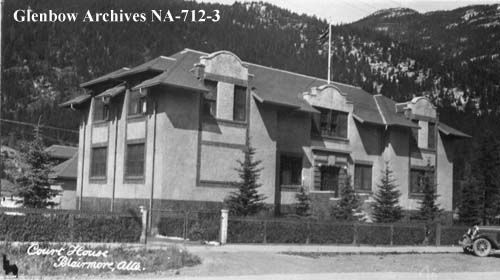
Peeling paint and powdering plaster were the first indications something was amiss at the Blairmore Courthouse, a Provincial Historic Resource in the Crowsnest Pass. A leak in the cedar shingle roof, replaced just the previous year, was immediately suspected. Detailing around the dormers in particular, part of the 1922 building’s distinctive Spanish Colonial Revival design by architect R.P. Blakey, is tricky and vulnerable to water penetration.

1920s view of Blairmore Courthouse from the southwest (Photo Credit: Glenbow Archives)
1920s view of Blairmore Courthouse from the southwest (Photo Credit: Glenbow Archives NA-712-3)

Nippon School of Technology, which owns the building and runs a technical school and exchange program for Japanese engineering students there, inspected the roof from the attic and found no active leaks. Puzzled, N.I.T. engaged a conservation architect to inspect the building and identify sources of moisture causing the paint and plaster failure. The findings were at once surprising and (in hindsight) credible.   Read more

AHRF 2016 Heritage Awards

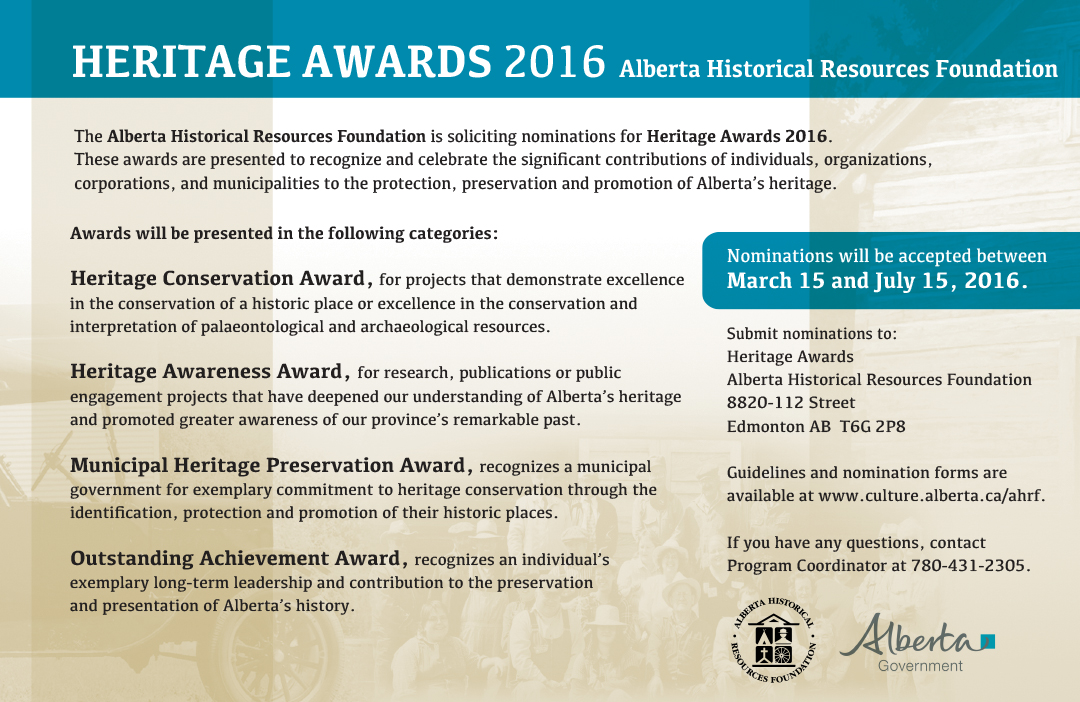
Calling for Nominations for the Alberta Historical Resources Foundation’s (AHRF) 2016 Heritage Awards

Nominations for the AHRF’s biennial Heritage Awards are now open!  This is an excellent opportunity to recognize and celebrate the outstanding accomplishments of individuals, organizations and municipalities who have demonstrated their commitment to preserving, and promoting appreciation of, Alberta’s heritage.

Awards are presented to projects for the Heritage Conservation and Heritage Awareness Awards; to municipalities for the Municipal Heritage Preservation Award; and to individuals for the Outstanding Achievement Award.

Print

For a copy of the guidelines and nomination form, click here or contact 780-431-2305 or e-mail Carina.Naranjilla@gov.ab.ca.  More information is also available at http://www.culture.alberta.ca/heritage-and-museums/grants-and-recognition/heritage-awards/

Deadline for nominations is July 15.  The awards ceremony will take place on October 14 at the McDougall Centre in Calgary.

Written By: Carina Naranjilla, Grants Program Coordinator, AHRF

Mount Edith Cavell

Located between the Astoria and the Whirlpool rivers is a mountain considered by many to be the most majestic in Jasper National Park, if not the entire Canadian Rocky Mountains. At an impressive altitude of about 3,300 metres, the mountain has been known by a number of names. French Canadian voyageurs using the Athabasca Pass referred to the notable landmark as La Montagne de la Grand Traverse (Mountain of the Great Pass). Dr. James Hector of the Palliser Expedition referred to it as Le Duc, probably after a Metis member of his party. In 1912, Arthur O. Wheeler of the Alpine Club of Canada and the Interprovincial Boundary Survey named it Fitzhugh Mountain, after the townsite of Fitzhugh, which was named for E. L. Fitzhugh, a director of the Grand Trunk Pacific Railway (the townsite of Fitzhugh was later renamed Jasper). It had also been periodically, and incorrectly, referred to as Mount Geikie. Today, and since 1916, the mountain is named Mount Edith Cavell, named for a British nurse who never set foot in Canada, let alone within Jasper National Park or on the mountain itself. How this mountain became a commemoration to Edith Cavell is an interesting lesson in Canada’s role in the First World War, its place in the Empire and the importance of wartime symbolism and the values of myth and memorialization.

PA354.1
North face of Mount Edith Cavell with Lake Cavell in the foreground, ca. 1945.
Provincial Archives of Alberta, PA354.1

Read more