Mount Lougheed and Wind Mountain

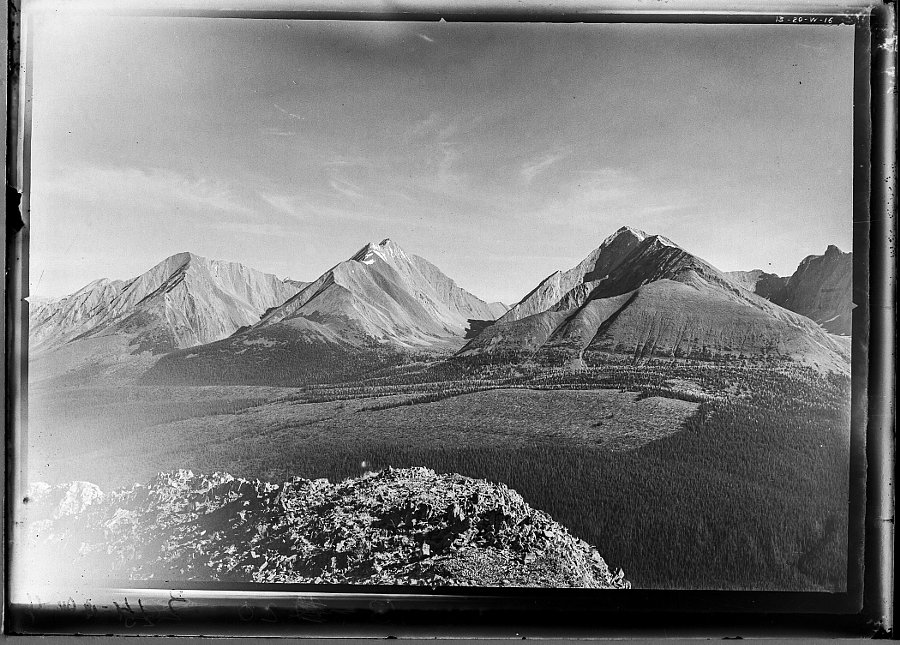
One of the most recognizable mountains in the Canadian Rockies is Mount Lougheed. Located approximately 15 kilometres southeast of Canmore, this majestic 3,150 metre (10,335 ft.) mountain is named for Sir James Alexander Lougheed. However, Lougheed is not the only name the mountain has had. In fact, it is not even the first mountain in the area to bear the name Lougheed. The story of how the mountain became known as Mount Lougheed is interesting.

IMG_0322

Mount Lougheed from the Trans-Canada Highway, August 2011. The entire massif is known as Mount Lougheed. The large, central peak is likely the feature named “Windy Mountain” by Eugene Bourgeau in 1858. The prominent peak furthest to the right is Windtower Mountain. The peak known today as Wind Mountain is the distinctly pointed peak visible on the horizon at left side of the photograph.
Source: Larry Pearson, Historic Places Stewardship Section, Alberta Culture and Tourism.

In 1858, Eugène Bourgeau (sometimes spelled Bourgeaux), a botanist with the Palliser Expedition, accompanied James Hector up the Bow Valley towards what is now Canmore. Bourgeau named many of the mountains and lakes along the way. Bourgeau was struck by the way the clouds swirled around one particular peak. James Hector, in his account of August 11, 1858, noted that Read more

The Butterfly Effect

Peeling paint and powdering plaster were the first indications something was amiss at the Blairmore Courthouse, a Provincial Historic Resource in the Crowsnest Pass. A leak in the cedar shingle roof, replaced just the previous year, was immediately suspected. Detailing around the dormers in particular, part of the 1922 building’s distinctive Spanish Colonial Revival design by architect R.P. Blakey, is tricky and vulnerable to water penetration.

1920s view of Blairmore Courthouse from the southwest (Photo Credit: Glenbow Archives)
1920s view of Blairmore Courthouse from the southwest (Photo Credit: Glenbow Archives NA-712-3)

Nippon School of Technology, which owns the building and runs a technical school and exchange program for Japanese engineering students there, inspected the roof from the attic and found no active leaks. Puzzled, N.I.T. engaged a conservation architect to inspect the building and identify sources of moisture causing the paint and plaster failure. The findings were at once surprising and (in hindsight) credible.   Read more

AHRF 2016 Heritage Awards

Calling for Nominations for the Alberta Historical Resources Foundation’s (AHRF) 2016 Heritage Awards

Nominations for the AHRF’s biennial Heritage Awards are now open!  This is an excellent opportunity to recognize and celebrate the outstanding accomplishments of individuals, organizations and municipalities who have demonstrated their commitment to preserving, and promoting appreciation of, Alberta’s heritage.

Awards are presented to projects for the Heritage Conservation and Heritage Awareness Awards; to municipalities for the Municipal Heritage Preservation Award; and to individuals for the Outstanding Achievement Award.

Print

For a copy of the guidelines and nomination form, click here or contact 780-431-2305 or e-mail Carina.Naranjilla@gov.ab.ca.  More information is also available at http://www.culture.alberta.ca/heritage-and-museums/grants-and-recognition/heritage-awards/

Deadline for nominations is July 15.  The awards ceremony will take place on October 14 at the McDougall Centre in Calgary.

Written By: Carina Naranjilla, Grants Program Coordinator, AHRF

Mount Edith Cavell

Located between the Astoria and the Whirlpool rivers is a mountain considered by many to be the most majestic in Jasper National Park, if not the entire Canadian Rocky Mountains. At an impressive altitude of about 3,300 metres, the mountain has been known by a number of names. French Canadian voyageurs using the Athabasca Pass referred to the notable landmark as La Montagne de la Grand Traverse (Mountain of the Great Pass). Dr. James Hector of the Palliser Expedition referred to it as Le Duc, probably after a Metis member of his party. In 1912, Arthur O. Wheeler of the Alpine Club of Canada and the Interprovincial Boundary Survey named it Fitzhugh Mountain, after the townsite of Fitzhugh, which was named for E. L. Fitzhugh, a director of the Grand Trunk Pacific Railway (the townsite of Fitzhugh was later renamed Jasper). It had also been periodically, and incorrectly, referred to as Mount Geikie. Today, and since 1916, the mountain is named Mount Edith Cavell, named for a British nurse who never set foot in Canada, let alone within Jasper National Park or on the mountain itself. How this mountain became a commemoration to Edith Cavell is an interesting lesson in Canada’s role in the First World War, its place in the Empire and the importance of wartime symbolism and the values of myth and memorialization.

PA354.1
North face of Mount Edith Cavell with Lake Cavell in the foreground, ca. 1945.
Provincial Archives of Alberta, PA354.1

Read more

Alberta on Fire: A History of Cultural Burning

Fire science has come a long way but the growing practice of prescribed burning is actually a return to a deep past. Archaeological and paleoecological researchers are demonstrating that Western Canada has been burning at the hands of people for thousands of years. Much of what was thought to be wilderness in the early 1900s was likely a mosaic of manipulated landscapes influenced by controlled burns. Alberta has a rich history of fire use and the recognition of it has implications for modern conservation and land management.

Ancient Fires

Tracking the history of fire in a landscape can be challenging and, in the paleoenvironmental record, it’s particularly difficult to distinguish human from natural burning. Fire scientists, however, are untangling fire history in interesting places. Christina Poletto is a Master’s student at the University of Alberta who will soon extract a long core of lake mud in northern Alberta in order to analyse changing layers of charcoal and pollen deposited over thousands of years. This information provides a baseline of natural fire history that she hopes to compare to cultural landscapes surrounding archaeological sites. “I want to Read more

Paleoindian Archaeology, Pleistocene Extinctions and Mongolian Use of Space: An Interview with Dr. Todd Surovell

The University of Alberta Association of Graduate Anthropology Students will be hosting the 24th Annual Richard Frucht Memorial Lecture Series from March 2-4, 2016. The distinguished speaker for this year’s conference is Dr. Todd Surovell of the University of Wyoming. I had a chance to interview Dr. Surovell about his research ahead of his upcoming visit to Alberta and he offered some fascinating insights into North American colonization, the extinction of North American megafauna, and his observations of household space use by Mongolian reindeer herders as a means to inform archaeological interpretations.

Dr. Todd Surovell at the Barnes Site, Hot Springs County, Wyoming (Photo: Todd Surovell)

How long have you been doing archaeology? What got you interested in it?

I have been doing archaeology for about 23 years. I got interested in archaeology somewhat by accident; I always thought I would be a biologist, zoologist, or ornithologist as I was an avid bird-watcher, but I registered for a course called Introduction to Anthropology at the University of Wisconsin and the teaching assistant was advertising an archaeology field school in western Wisconsin. I did the field school and fell in love with field archaeology. Read more

Naming and Renaming: The Place Names of John Ware

Alberta’s history is rife with many stories of interesting and fascinating cowboys and ranchers. High in this company stands John Ware, a black cowboy and rancher of near-mythic standing in Alberta’s history. John Ware has become almost an unofficial emblem of Alberta and western Canada, featuring prominently in centennial exhibits, in books and even on a Canada Post stamp. He is often portrayed as an embodiment of western Canadian values and as a demonstration of the levelling effect of the pioneer period and the cultural tolerance that was only possible on the Canadian prairies. There is little doubt that John Ware truly did enjoy the respect of his fellow ranchers and cowboys and his story, even if exaggerated, is an inspiring one. Yet, despite this outpouring of goodwill, respect and admiration, for many years John Ware was commemorated by a racially derogatory name prominently displayed on maps.

Glenbow Archives, na-263-1
John Ware with his wife Mildred and two of their children, Robert and Nettie, ca. 1896.
Glenbow Archives: NA-263-1

Read more

Hangar 14 and the British Commonwealth Air Training Plan

The British Commonwealth Air Training Plan (BCATP) is considered to be Canada’s primary contribution to the Second World War. Although the Plan was only in existence from 1940 to 1945, it left a lasting impact on Alberta and Canada as a whole. One of the most visible results of the Plan was the building construction that boomed during this time. There are examples of buildings produced during the BCATP period that are still in existence and the historical significance of these structures is evident today, one of which is Hangar 14, located at the former Blatchford Field and Municipal Airport site in Edmonton. This post will look at the foundation of the BCATP and summarize the distinct features of Hangar 14 that demonstrate the building’s significance as a provincial historic resource.

AAM 019
Hanger 14, the home of the Alberta Aviation Museum, Edmonton.
(Erin Hoar, 2015)

Read more

Yellowhead Townsite and Mine: Archaeology in Alberta’s Coal Branch

Alberta’s Coal Branch region, southwest of Edson, was once an area bustling with activity, not only due to coal production, but also with the day-to-day goings-on of communities. In its heyday, the Coal Branch supported a population of almost 3,000 people spread out among several towns including Cadomin, Mercoal, Mountain Park, Luscar, Lovettville, Coalspur, Robb, Coal Valley, and Beacon Hill. These communities, though small, had many amenities including stores, community halls, sports fields, schools, churches, and hospitals. Today, many of them have been completely abandoned or are only used for part of the year.

Part of the Yellowhead site, likely during the mid-to-late stages of mine development (Photo Credit: Provincial Archives of Alberta, Edmonton, PR1991.0312 A19987)
Part of the Yellowhead Townsite and Mine which was in operation from 1909-1919 (Photo Credit: Provincial Archives of Alberta, PR1991.0312 A19987)

Yellowhead Mine and its associated “stag camp”, and later townsite, was the first mining operation in production in the Coal Branch. Run by the Yellowhead Pass Coal and Coke Co., the mine began operations in 1909, before railroads or roads reached the area. Since the only way in and out of Yellowhead was by pack trail, the settlement was fairly isolated and difficult to get to. When mining first began, the coal could not be shipped out due to lack of rail access, so coal was stockpiled. The railroad Read more